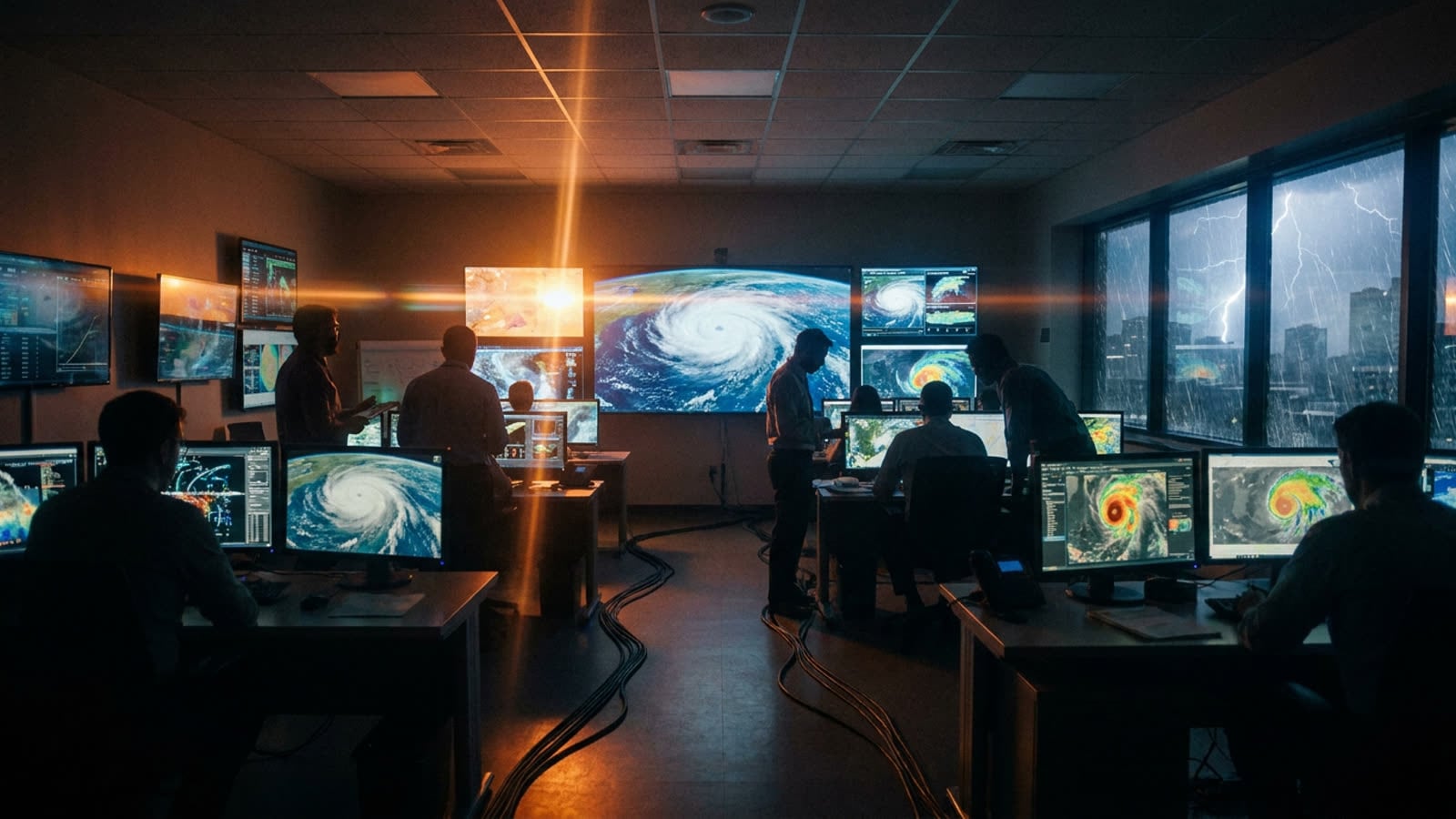
When a hurricane barrels toward the Gulf Coast, the forecasters at the National Hurricane Center consult two kinds of models. The first type, built over half a century, simulates the atmosphere using the fundamental equations of fluid dynamics—temperature, pressure, moisture, all crunched on supercomputers the size of tennis courts. The second type, which arrived only in the past few years, learns patterns directly from historical weather data using neural networks. The machine learning models are now routinely winning.
This is not a speculative future or a research curiosity. Major meteorological agencies, including the European Centre for Medium-Range Weather Forecasts, have integrated AI systems that match or exceed their traditional models on key metrics, particularly for predictions stretching beyond a week. For the billions of people whose livelihoods depend on knowing when rain will fall or frost will strike, this represents one of the most consequential applications of artificial intelligence in existence—and one that generates almost no headlines.
Why weather was ripe for disruption
Traditional numerical weather prediction is a triumph of twentieth-century science. It divides the atmosphere into a three-dimensional grid, applies the Navier-Stokes equations governing fluid motion, and steps forward in time. The approach works, but it is computationally brutal: a ten-day global forecast can require hours on machines costing hundreds of millions of dollars. And despite decades of refinement, certain phenomena—the precise track of a tropical cyclone, the timing of a thunderstorm—remain stubbornly difficult to pin down.
Machine learning sidesteps the physics entirely. Feed a neural network several decades of atmospheric observations, and it learns statistical relationships between today's conditions and tomorrow's weather. The training is expensive, but once complete, the model can generate a forecast in minutes on modest hardware. More importantly, it can capture patterns that the physics-based models miss—subtle correlations in the data that no human programmer thought to encode.
What the models actually do well
The gains are real but specific. AI excels at medium-range forecasting, roughly three to ten days out, where traditional models accumulate errors as small uncertainties compound. It has shown particular skill at predicting extreme events: the landfall location of hurricanes, the onset of heat waves, the probability of heavy precipitation. These are precisely the forecasts that matter most for emergency planning, agriculture, and energy markets.
The models are also remarkably efficient. Google's GraphCast system, one of the leading AI weather models, can produce a ten-day global forecast in under a minute on a single machine. The European Centre's traditional model takes hours on a supercomputer. This speed advantage enables ensemble forecasting—running hundreds of slightly varied predictions to quantify uncertainty—at a scale that was previously impractical.
The limits that remain
AI weather models are not magic. They struggle with phenomena that are rare in the training data: unprecedented heat records, unusual storm tracks, the cascading effects of climate change pushing conditions outside historical norms. They also lack the physical interpretability of traditional models; when an AI forecast goes wrong, diagnosing why is difficult. Meteorologists cannot peer inside the neural network and identify which atmospheric process was misrepresented.
There is also a data dependency that cuts both ways. AI models are only as good as the observations they learn from, which means they inherit any biases or gaps in the historical record. Regions with sparse monitoring networks—much of the Global South, the open oceans—are harder to forecast accurately.
Our take
The weather forecasting revolution offers a useful template for thinking about AI's genuine value. It succeeded not because machine learning is universally superior, but because the problem had the right characteristics: abundant high-quality data, clear success metrics, and a tolerance for statistical rather than causal explanation. The hype cycle around artificial intelligence tends to obscure these specifics, promising transformation everywhere while delivering it unevenly. Weather prediction is a reminder that the most important AI applications may be the ones that quietly improve life without demanding attention—and that the gap between what machine learning can do and what it is claimed to do remains worth scrutinizing.