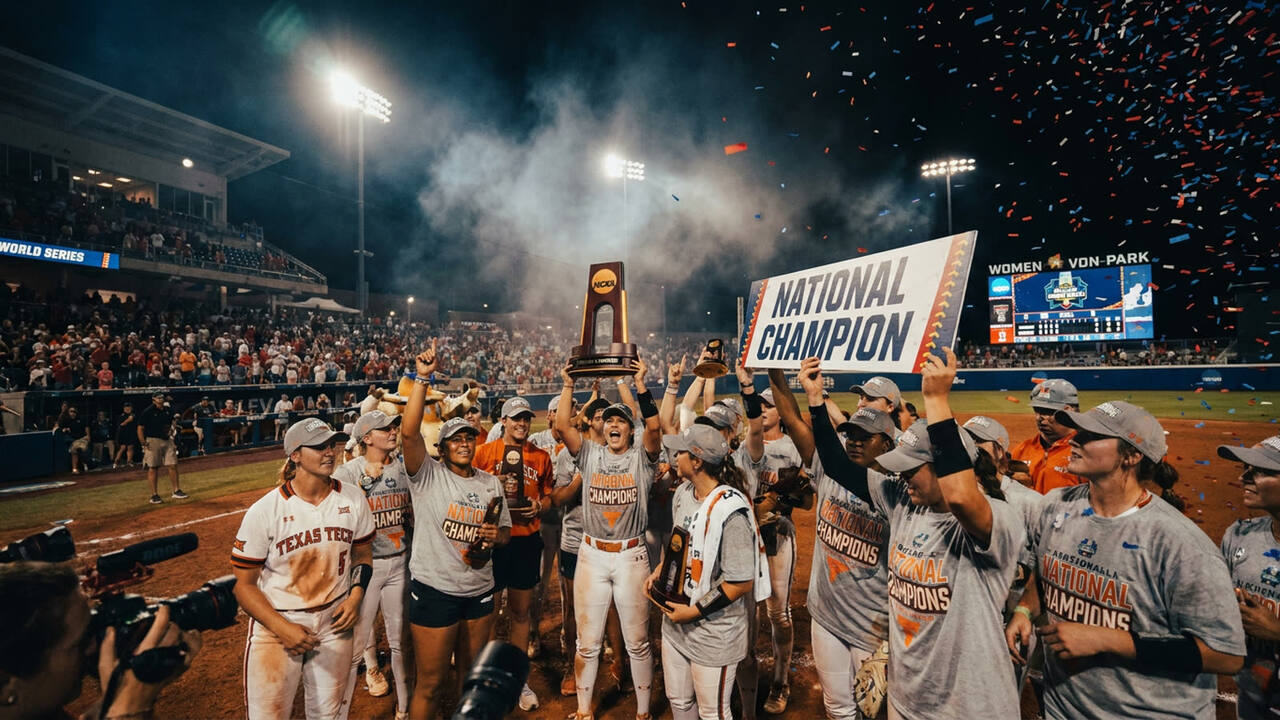
The Women's College World Series final is a rematch, but it is not a replay. When Texas Tech faces Oklahoma in the championship round, beginning Monday in Oklahoma City, the Red Raiders arrive as something more than sacrificial lambs for college softball's most ruthless dynasty.
Oklahoma has won four consecutive national titles and made the WCWS final look like a formality. The Sooners entered this tournament as heavy favorites again, their lineup still stacked with All-Americans, their program still operating on a different financial and competitive plane than nearly everyone else. But Texas Tech, making its second consecutive championship appearance, has the one thing that can neutralize Oklahoma's offensive machine: a pitcher who has been, for the past three weeks, essentially unhittable.
The Canady factor
Matty Canady's performance in the semifinal round was the kind of outing that shifts the calculus of an entire series. The junior right-hander carried Texas Tech into the final with a complete-game gem, mixing velocity with movement in ways that left opposing hitters consistently off-balance. Her spin rate and command have been elite all tournament, and she enters the championship with the lowest ERA of any remaining pitcher.
For Texas Tech, Canady represents the ceiling of what a single dominant arm can accomplish in a short series. College softball's format rewards hot pitching more than almost any other sport—a reality Oklahoma has exploited for years with its own rotation depth. Now the Red Raiders have a counter.
Oklahoma's unusual vulnerability
The Sooners are not broken, but they are not invincible either. Their run through the bracket has been uncharacteristically labored, with close games and defensive lapses that would have been unthinkable in previous tournament runs. The lineup that once seemed capable of outscoring any deficit has shown moments of frustration against quality pitching.
More concerning for Oklahoma: the wear on their pitching staff. Unlike Texas Tech's reliance on Canady, the Sooners have spread innings across multiple arms, and none have been as sharp as their historical standard. If Texas Tech can manufacture early runs and force Oklahoma into comeback mode, the dynamic shifts.
Our take
Oklahoma remains the favorite because Oklahoma is always the favorite—the program's resources, depth, and championship experience create margins that single-game heroics rarely overcome. But this is the most vulnerable the Sooners have looked in June since their dynasty began. Texas Tech has the pitching to steal a title. Whether they have the lineup to support Canady through a best-of-three against the sport's final boss is the only question that matters.