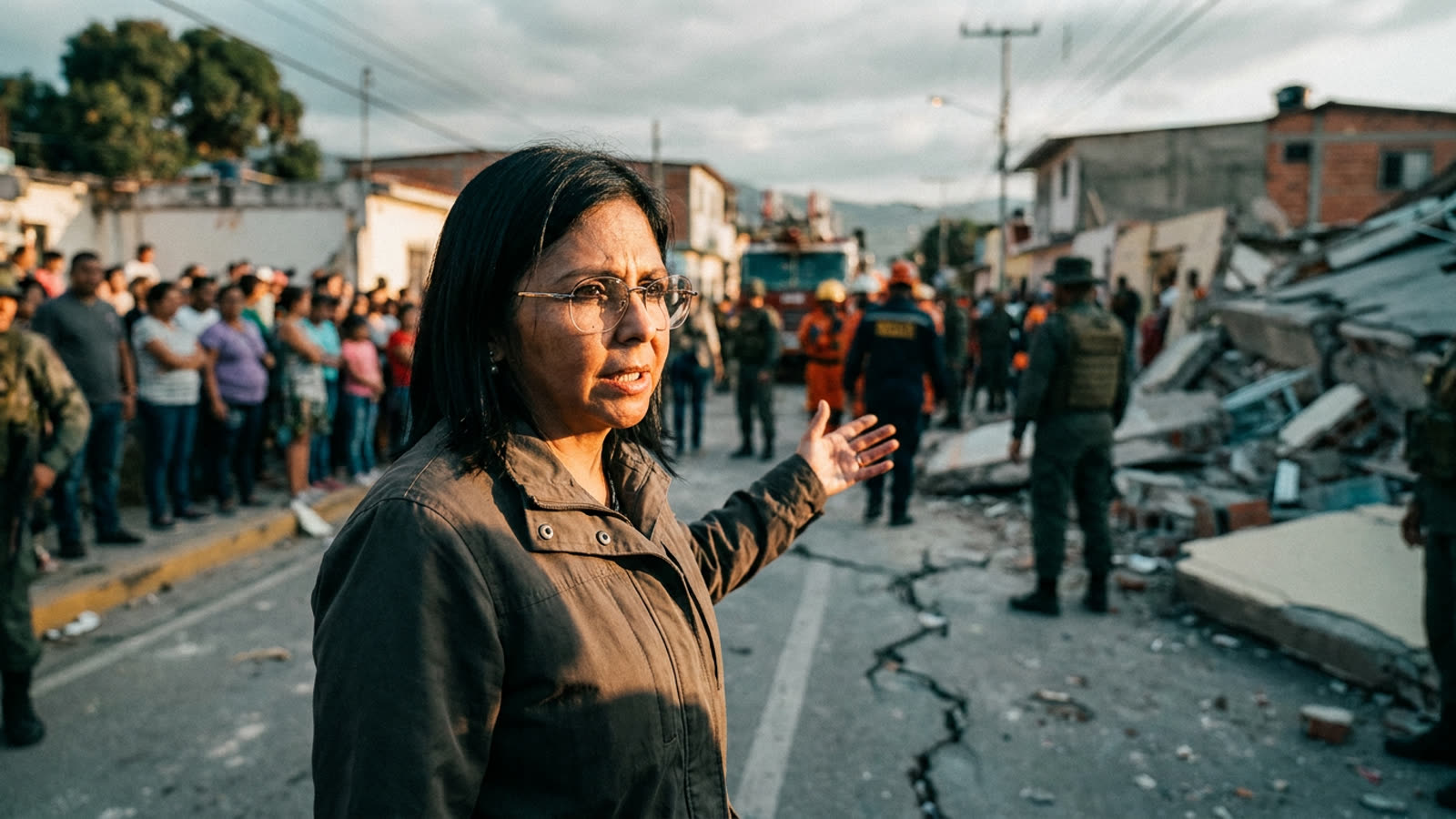
Natural disasters have a way of stripping governments to their essence. Hurricane Katrina revealed the rot beneath George W. Bush's competence narrative; the 2010 earthquake exposed Haiti's institutional void; now Venezuela's series of devastating earthquakes is forcing Delcy Rodríguez to prove she is more than Nicolás Maduro's loyal placeholder.
The seismic events have killed dozens and left entire communities in ruins across western Venezuela, a region already suffering from years of infrastructure neglect, emigration, and economic collapse. For Rodríguez, who assumed the presidency after Maduro's contested departure earlier this year, the timing could not be crueler. She inherits a state apparatus that has been systematically hollowed out—not by external sanctions alone, but by two decades of chavista mismanagement that prioritized political loyalty over institutional capacity.
The inheritance problem
Rodríguez came to power with credentials that read like a chavista loyalty test: foreign minister, vice president, chief negotiator with the opposition, Maduro's most trusted fixer. What she did not inherit was a functioning emergency response system. Venezuela's civil defense capabilities, once among the better-resourced in South America, have atrophied alongside everything else. Hospitals lack basic supplies. Roads to remote areas remain impassable not from earthquake damage but from years without maintenance. The military—historically the backbone of disaster response in Latin America—is stretched thin and demoralized.
The international community faces its own awkward calculations. The United States, which never recognized Maduro's government and has maintained sanctions through the transition, must now decide whether humanitarian need overrides political principle. The European Union has signaled willingness to provide aid, but through which channels? Rodríguez's government remains diplomatically isolated, recognized by allies like Cuba, Russia, and China but treated as illegitimate by most Western democracies.
Regional echoes
Venezuela's neighbors are watching with a mixture of concern and self-interest. Colombia, which shares a porous border and has absorbed millions of Venezuelan refugees, fears another wave of displacement. Brazil, under President Lula, sees an opportunity to position itself as regional mediator—offering humanitarian assistance while gently pressing for democratic reforms. The earthquake may accomplish what years of diplomatic pressure could not: forcing Rodríguez to accept international engagement on terms that acknowledge her government's limitations.
The disaster also tests the chavista narrative of external victimhood. For years, Maduro blamed every shortage on American sanctions and every failure on imperialist sabotage. Earthquakes, inconveniently, do not respond to ideology. The crumbling buildings and overwhelmed hospitals are products of choices made in Caracas, not Washington.
Our take
Delcy Rodríguez is not without political skill—she survived and thrived in Maduro's paranoid inner circle for over a decade. But competence in palace intrigue is different from competence in governance. The earthquake is forcing a question that sanctions, opposition protests, and international condemnation never quite managed to make urgent: can chavismo actually run a country, or only hold onto one? The rubble in western Venezuela suggests the answer, and Rodríguez has perhaps weeks to prove otherwise before the narrative calcifies.