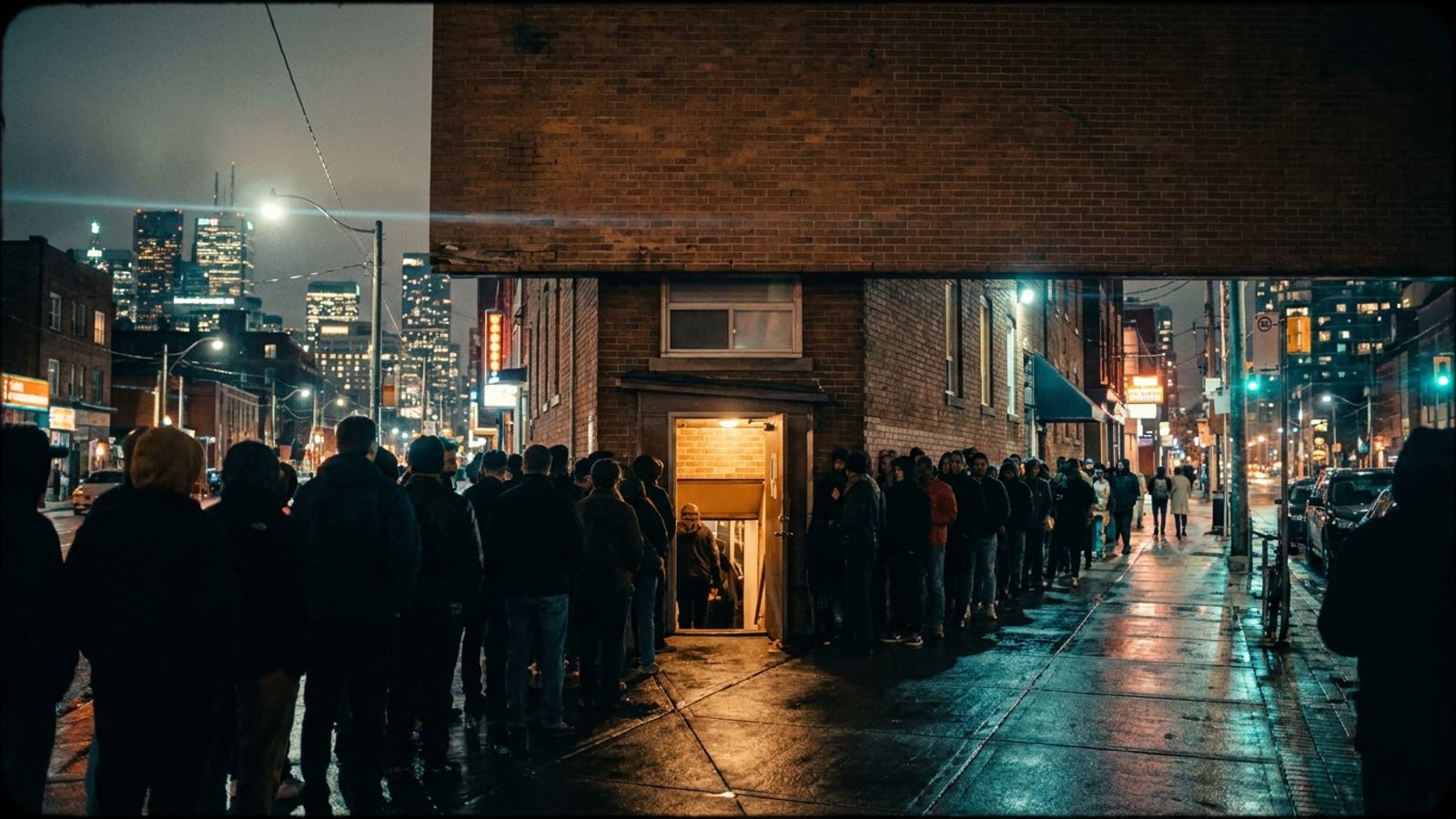
The best parties in Toronto have always been downstairs—not in the velvet-roped clubs of King West, but in the converted basements of Parkdale row houses and Scarborough bungalows. What began as pandemic-era improvisation has calcified into something more permanent: a parallel nightlife economy that operates beneath the city's punishing commercial real estate market.
This is not merely a story about young people finding cheaper places to dance. It is a case study in how urban economies adapt when traditional commercial infrastructure prices out the cultural production that makes cities worth living in.
The arithmetic of survival
Toronto's commercial vacancy rate has hovered near historic lows for years, but the spaces that remain available command rents that make traditional nightclub economics nearly impossible. A mid-sized venue in the downtown core now faces monthly costs that would have seemed absurd a decade ago, before factoring in liquor licensing, insurance, and the city's labyrinthine permitting process.
The basement economy sidesteps all of this. A residential basement costs nothing beyond the homeowner's existing mortgage. Liquor licensing becomes irrelevant when alcohol is technically BYOB. Insurance remains the homeowner's standard policy, which almost certainly does not contemplate a hundred strangers arriving at midnight.
The legal exposure is considerable, but the financial logic is irresistible. A basement party can break even with a twenty-dollar door charge and fifty attendees. A legitimate venue needs to clear thousands before the owner sees a cent.
Cultural production without capital
What emerges from this economic pressure is something more interesting than mere cost arbitrage. Toronto's basement scene has become an incubator for artists and DJs who would otherwise never find an audience. The barriers to entry are so low—a decent sound system, a WhatsApp group, a homeowner willing to tolerate the noise—that experimentation flourishes.
The city's most interesting electronic music, its most adventurous fashion, its most diverse crowds: all of this now happens in spaces that technically should not exist. The aboveground club scene, meanwhile, has retreated into safe commercial formulas that justify the rent.
This pattern is not unique to Toronto. Berlin's legendary club culture emerged from similar economic conditions in the years after reunification, when abandoned industrial spaces offered near-zero rents. London's warehouse scene of the late 1980s operated on the same logic. What distinguishes Toronto is that the basement economy has persisted and professionalized even as the broader economy recovered from the pandemic.
The city's quiet tolerance
Municipal authorities have adopted a posture of strategic ignorance. Aggressive enforcement would require resources the city does not have and would generate political backlash from residents who view the basement scene as harmless—or, increasingly, as essential to Toronto's cultural identity.
The result is a tacit bargain: keep the noise reasonable, avoid the truly dangerous overcrowding, and the city will pretend not to notice. This arrangement satisfies no one entirely but collapses under scrutiny from neither direction.
Our take
Toronto's basement economy is a symptom of a broader urban disease: the systematic extraction of value from cities until the cultural production that generates that value can no longer afford to exist there. The basements are not a solution; they are a workaround that allows a city to maintain the illusion of vibrancy while its official commercial spaces become increasingly sterile. The party will continue downstairs until the economics change—which is to say, indefinitely.