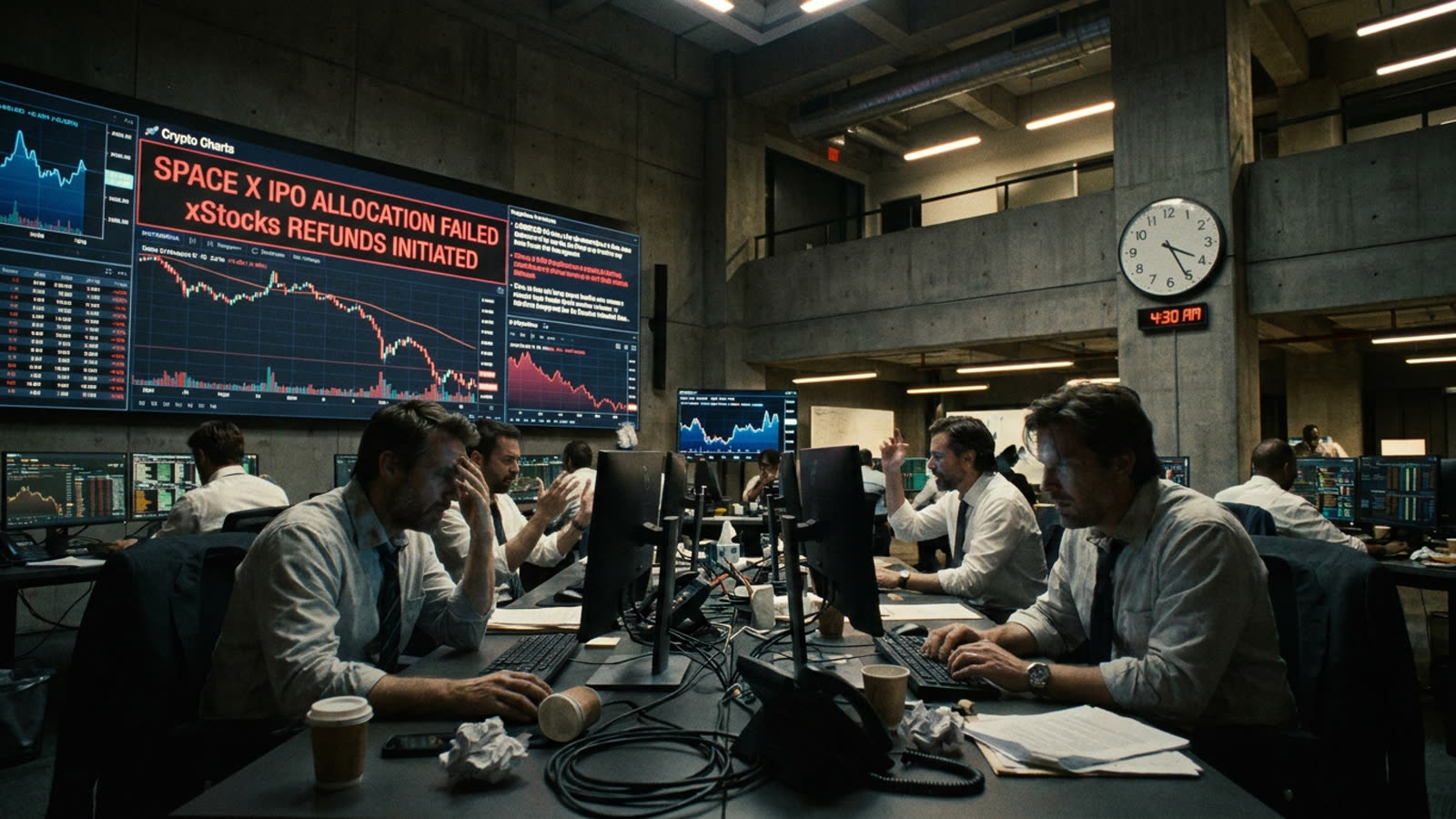
The promise was irresistible: own a piece of SpaceX, Elon Musk's rocket company, through the magic of blockchain—no brokerage account required, no accreditation checks, just connect your wallet and buy. When the dust settled on Friday, crypto exchanges were instead processing refunds, their tokenized SpaceX shares having failed to secure actual stock in the most anticipated IPO of the decade.
The xStocks debacle is not a scam story. It is something more instructive: a stress test that revealed exactly where crypto's synthetic Wall Street breaks down. The tokenization platforms did everything right by their own rules—they collected funds, issued tokens, promised to acquire underlying shares. What they could not do was compete for IPO allotment against Goldman Sachs, Fidelity, and the institutional machinery that has controlled new-issue distribution since the railroad age.
The allotment problem nobody discussed
Tokenized equity products work on a simple premise: a custodian holds real shares while blockchain tokens trade as proxies. This functions adequately for liquid secondary-market stocks where shares are abundant. IPOs are different. Allocation is a relationship business, and SpaceX's listing was roughly 40 times oversubscribed according to early indications. The underwriting syndicate—led by Morgan Stanley and JPMorgan—had no incentive to carve out meaningful allotment for crypto intermediaries with no prime brokerage history and questionable regulatory standing.
The xStocks operators apparently believed they could acquire shares in the aftermarket if primary allocation failed. But SpaceX opened at a sharp premium and kept climbing, making the economics of honoring pre-IPO token prices untenable. Refunds were the only option that did not involve insolvency.
Why this matters beyond crypto
Tokenized treasuries have crossed $14.6 billion in value, and BlackRock's BUIDL fund is now the largest tokenized money-market product on Earth. The industry's pitch to institutions rests on the idea that blockchain rails can eventually handle any asset class. SpaceX's IPO just demonstrated the limits: tokenization works for assets you can actually buy. For gated, relationship-driven markets—IPOs, private credit, pre-IPO secondaries—the blockchain is only as good as the access it wraps.
This distinction matters enormously as Wall Street and crypto continue their awkward courtship. The banks are happy to let Solana and Ethereum handle settlement plumbing. They have no intention of surrendering the lucrative gatekeeping that makes IPO allocation a favor to be dispensed.
Our take
The xStocks refund is embarrassing but honest—far better than the alternative of issuing unbacked tokens and hoping nobody notices. Still, the episode should temper the breathless narrative that tokenization will democratize capital markets overnight. Blockchain can move value efficiently; it cannot conjure access where none exists. SpaceX's IPO was a reminder that finance's most valuable commodity is not liquidity or transparency. It is the phone call that gets you in the room.