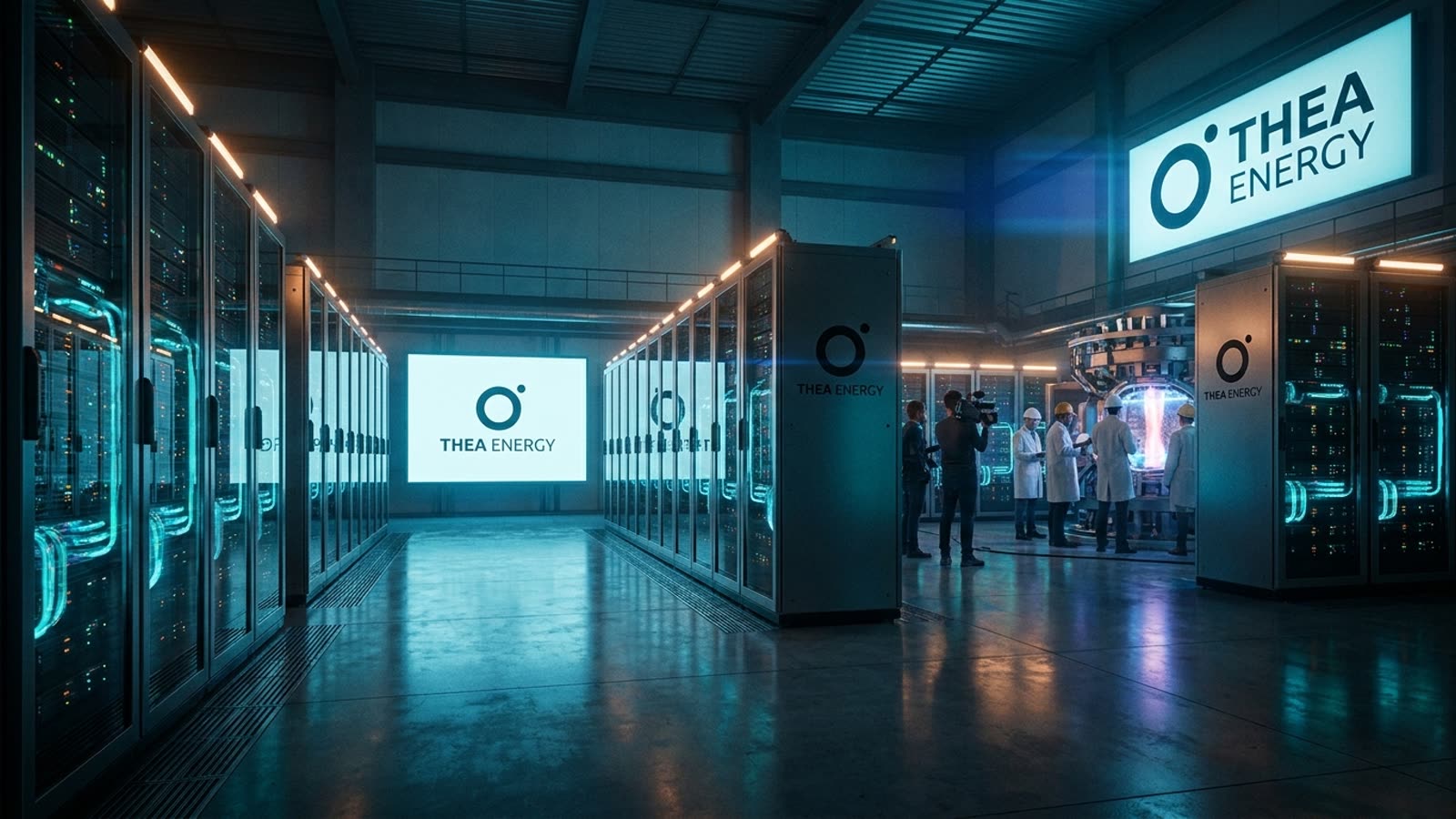
The latest entrant to the well-funded fusion club isn't promising to solve climate change in the abstract. Thea Energy, a Princeton University spinout, has closed a $100 million Series B that positions it squarely at the intersection of two of venture capital's most fervent obsessions: energy abundance and artificial intelligence infrastructure.
The round reportedly makes Thea one of the top-funded private fusion companies globally, joining the likes of Commonwealth Fusion Systems and Helion Energy in the billion-dollar-plus capitalization tier. But what distinguishes this raise isn't the quantum of capital—it's the thesis behind it.
The AI power problem
Data centers consumed roughly 4% of U.S. electricity in 2024. By most credible estimates, that figure will double or triple by the end of this decade as AI training runs grow exponentially more compute-intensive. Microsoft, Google, and Amazon have each signed nuclear and renewable power purchase agreements measured in gigawatts, not megawatts. The bottleneck for AI scaling is no longer chips alone—it's electrons.
Fusion, long derided as perpetually twenty years away, suddenly looks less like a physics curiosity and more like a strategic hedge. Thea's approach uses an array of planar coils to confine plasma in a stellarator configuration, which the company claims is simpler to manufacture and maintain than the tokamak designs favored by rivals. Whether the physics cooperates remains an open question, but the commercial logic is newly legible.
Why investors are betting now
The Series B investor list—not yet fully disclosed—reportedly includes funds with significant exposure to AI infrastructure. The calculus is straightforward: if you believe large language models will require order-of-magnitude more power within a decade, and you doubt that solar, wind, and legacy nuclear can scale fast enough, fusion becomes a rational portfolio allocation rather than a philanthropic gesture.
Thea's leadership has been careful to avoid the hype cycles that burned earlier fusion ventures. The company's stated timeline targets a demonstration reactor by the early 2030s, with commercial deployment sometime thereafter—aggressive by historical fusion standards, but modest compared to the breathless promises of some competitors.
Our take
Fusion investing used to be a vanity play for billionaires who wanted to save the world. Now it's a downstream bet on AI's continued dominance. That shift in motivation may actually improve outcomes: investors seeking returns impose discipline that philanthropists often don't. Thea Energy's $100 million is less a vote of confidence in plasma physics than a hedge against a future where the limiting factor on intelligence is the grid. Whether the stellarator works or not, the fundraise itself is a data point about where serious capital sees serious risk.