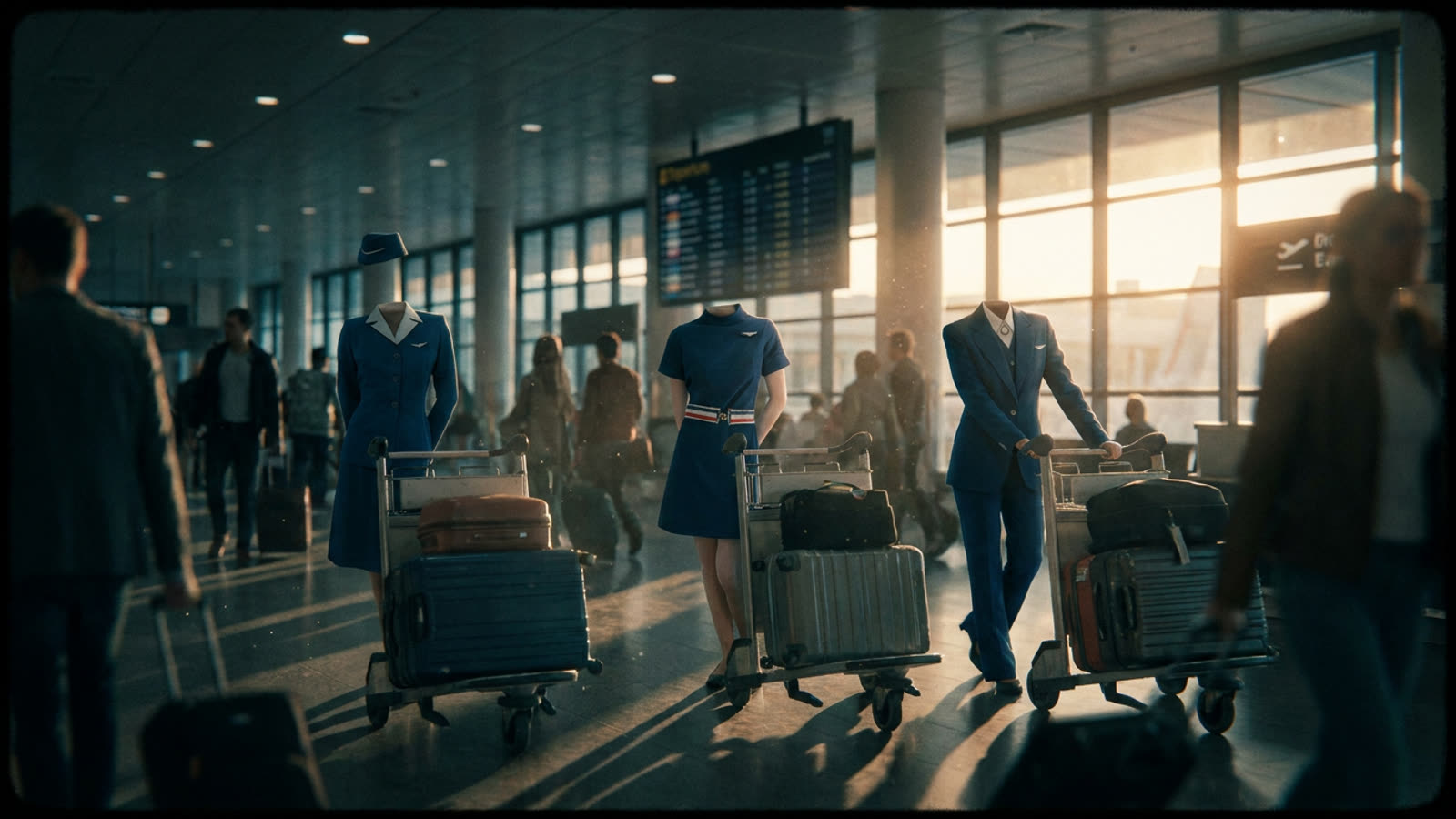
Few garments have tracked the arc of women's professional liberation quite like the flight attendant uniform. What began as a costume designed to reassure nervous male passengers that flying was safe enough for delicate ladies became, over decades, a battleground for labor rights, feminist politics, and the eternal tension between brand image and human dignity.
The original stewardesses of the early 1930s were required to be registered nurses — the uniform was medical white, the message clear: this aluminum tube won't kill you. But airlines quickly discovered that attractive young women in smart attire sold tickets, and the nurse's cap gave way to something closer to cocktail-party chic. By the 1960s, carriers competed not on safety records but on the length of their hemlines. Braniff's "Air Strip" campaign had attendants peeling off layers mid-flight. National Airlines asked, "I'm Cheryl. Fly me."
The body as company property
The glamour came with surveillance. Airlines enforced weight maximums, mandatory girdle checks, marriage bans, and age ceilings — often 32. Women who became pregnant were terminated immediately. The uniform wasn't clothing; it was a contract stipulating that your body belonged to the brand. Attendants were fired for gaining five pounds or letting their nail polish chip.
Labor organizing in the 1970s and 1980s dismantled many of these rules, though the fights were grueling. Flight attendants won the right to marry, to age, to become mothers. The uniforms lengthened, the stilettos flattened, and the job title itself shifted from "stewardess" — with its linguistic echo of servitude — to the gender-neutral "flight attendant."
Design as diplomacy
Today, airline uniforms remain surprisingly high-stakes branding exercises. Singapore Airlines retains its sarong kebaya, a garment so iconic the carrier has trademarked it; critics call it exoticizing, defenders call it heritage. Emirates and Qatar Airways dress crews in pillbox hats and red lips, projecting old-Hollywood glamour that reads as aspirational in some markets and retrograde in others. Meanwhile, carriers like Alaska Airlines and Virgin Atlantic have introduced gender-neutral options and relaxed grooming standards, responding to pressure from younger employees and shifting cultural expectations.
The design briefs reveal the contradictions airlines still haven't resolved: uniforms must be practical enough for safety demonstrations and emergency evacuations, elegant enough to justify premium fares, and inoffensive enough to avoid social-media controversy. A 2021 redesign for one major U.S. carrier reportedly went through more than a hundred prototypes before settling on a navy sheath that satisfied no one completely.
Our take
The flight attendant uniform is a garment that has never been allowed to simply be functional. It has always been asked to perform — to seduce, to reassure, to symbolize. That it now also has to signal progressive values while still selling business-class upgrades is the most honest reflection yet of the impossible demands placed on women in service industries. The hemline may have dropped, but the scrutiny hasn't.