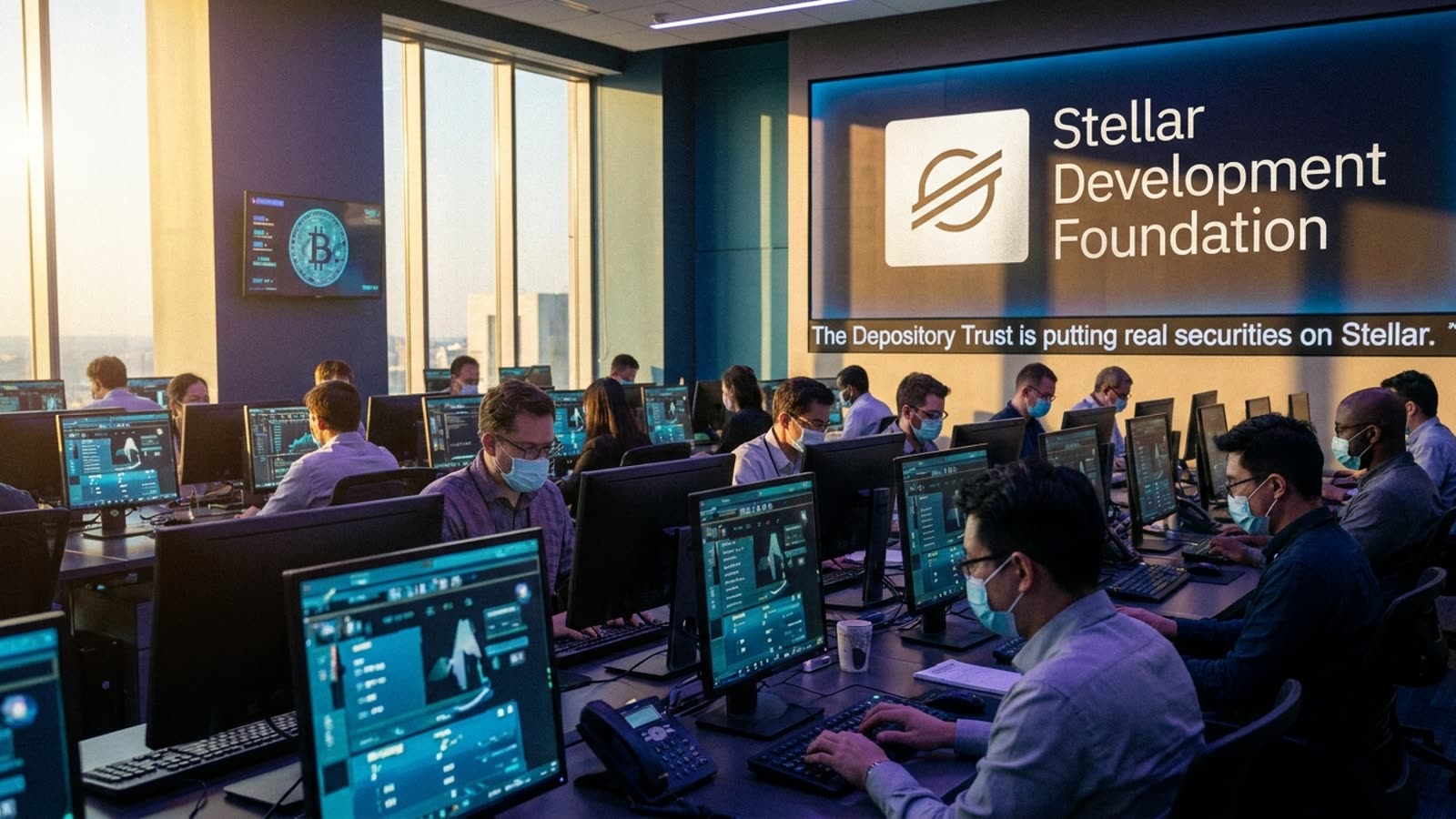
For years, Wall Street's blockchain experiments have been exercises in institutional throat-clearing — proof-of-concepts that proved nothing except that banks could deploy press releases. The Depository Trust & Clearing Corporation's announcement that it will bring tokenized assets to the Stellar blockchain represents something different: the plumbing of American finance actually connecting to public rails.
DTCC processes the vast majority of U.S. securities transactions, settling trillions of dollars daily through infrastructure built across decades. When this entity moves, it moves slowly and deliberately. That it has chosen Stellar — a public, permissionless network originally designed for cross-border payments — over a private consortium chain suggests the industry's thinking has evolved considerably since the hyperledger fever dreams of 2017.
Why Stellar, why now
The choice of Stellar is strategic rather than ideological. The network offers low transaction costs, reasonable throughput, and — critically — an established track record with regulated financial products. Circle's USDC has operated on Stellar for years, providing a template for compliant stablecoin infrastructure that DTCC can build upon.
The timing aligns with broader regulatory clarity. With the SEC recently approving Paxos to clear U.S. stocks on blockchain and the CFTC greenlighting crypto perpetual futures, the regulatory environment has shifted from hostile uncertainty to cautious accommodation. DTCC appears to be reading the room correctly: the question is no longer whether tokenization will happen, but who will control the rails when it does.
The settlement efficiency argument
Traditional securities settlement operates on a T+1 basis — trades executed today settle tomorrow. This creates counterparty risk, ties up capital in margin requirements, and generates friction that blockchain proponents have long argued is unnecessary. Tokenized assets settling on-chain could theoretically achieve near-instant finality, freeing billions in trapped collateral.
The practical benefits for retail investors may be modest initially. But for institutional players managing large portfolios across multiple asset classes, the efficiency gains compound quickly. DTCC's move suggests these players are ready to capture those gains rather than continue waiting for a perfect solution.
Our take
DTCC choosing a public blockchain over a walled garden is the most significant validation of crypto infrastructure since BlackRock filed for its Bitcoin ETF. The institution that literally keeps score for American capitalism has decided that permissionless networks are mature enough for production workloads. That decision matters more than any token price movement this month.