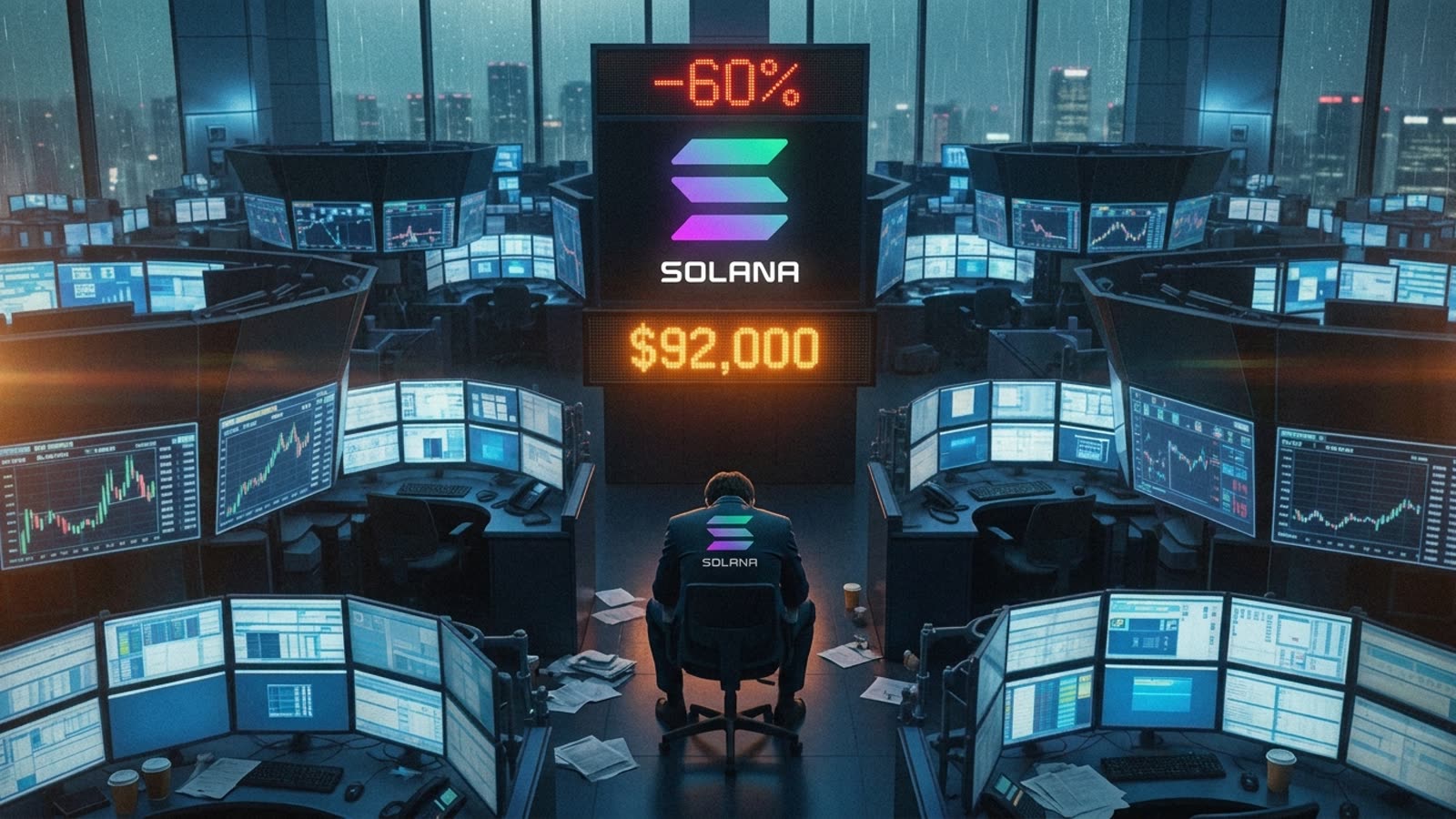
The cryptocurrency market has a peculiar way of burying its dead. Solana, trading at roughly $64 this week, has shed more than 60% of its value over the past twelve months, yet the collapse has unfolded so gradually that it barely registers as news. There are no dramatic liquidation cascades, no exchange freezes, no founder scandals—just a slow, remorseless grind lower that tells a more important story than any single-day crash could.
This is the unwinding of the Layer-1 thesis, and it deserves more attention than it's getting.
The trade that stopped working
The bull case for Solana was elegant: Ethereum was too slow and too expensive, so a faster, cheaper chain would inevitably capture market share. For a while, it worked. Solana became the default home for memecoin speculation, NFT projects priced out of Ethereum gas fees, and DeFi protocols chasing retail volume. The FTX collapse in late 2022 was supposed to be an extinction-level event—Sam Bankman-Fried's Alameda Research had been one of Solana's largest backers—yet the chain survived and even thrived through 2024.
What changed wasn't a single catastrophe but a series of small disappointments. Network outages became less frequent but never disappeared entirely. The memecoin casino migrated partially to Base and other Ethereum L2s. Institutional interest, which had been tepid to begin with, never materialized into the ETF flows that Bitcoin and Ethereum captured. Most damagingly, Ethereum's own scaling roadmap—particularly the rise of rollups—eroded the core value proposition. Why bet on a separate chain when you can get similar throughput on a network with deeper liquidity and more developer tooling?
The broader alt-L1 carnage
Solana is not suffering alone. Avalanche is down more than 70% over the same period. Polkadot has lost nearly 80%. Cardano, despite its devoted community, has cratered 77%. The market is quietly but decisively repricing the entire category of "Ethereum killers" toward something closer to zero premium over Bitcoin and Ethereum.
This isn't irrational. The crypto market has learned, painfully, that network effects compound. Liquidity begets liquidity. Developer ecosystems are sticky. The window for a new Layer-1 to establish itself as a credible third pillar of the industry appears to be closing, if it hasn't closed already. What remains is a collection of chains that may survive as niche platforms—Solana for certain DeFi applications, Avalanche for tokenized assets—but will likely never challenge the duopoly.
What the price action reveals
The most telling detail is the absence of capitulation. Solana's decline has been orderly, almost boring. Trading volumes are muted. Social media chatter has moved on to newer narratives. This is what a market looks like when it simply loses interest rather than panics. The tourists have left; the true believers remain, but their conviction alone cannot support valuations built for mass adoption.
For investors who bought the "diversified crypto portfolio" thesis—some Bitcoin, some Ethereum, some promising alt-L1s—the lesson is uncomfortable. Diversification in crypto often means owning multiple ways to underperform Bitcoin. The correlation on the way up masked the dispersion on the way down.
Our take
Solana may yet find a sustainable role in the crypto ecosystem, perhaps as the chain of choice for high-frequency trading applications or gaming. But the dream of becoming the next Ethereum is effectively over, and the market has priced that in with brutal efficiency. The interesting question now is whether any Layer-1 can break the duopoly, or whether we've reached the end of that particular experiment. The smart money appears to be betting on the latter.