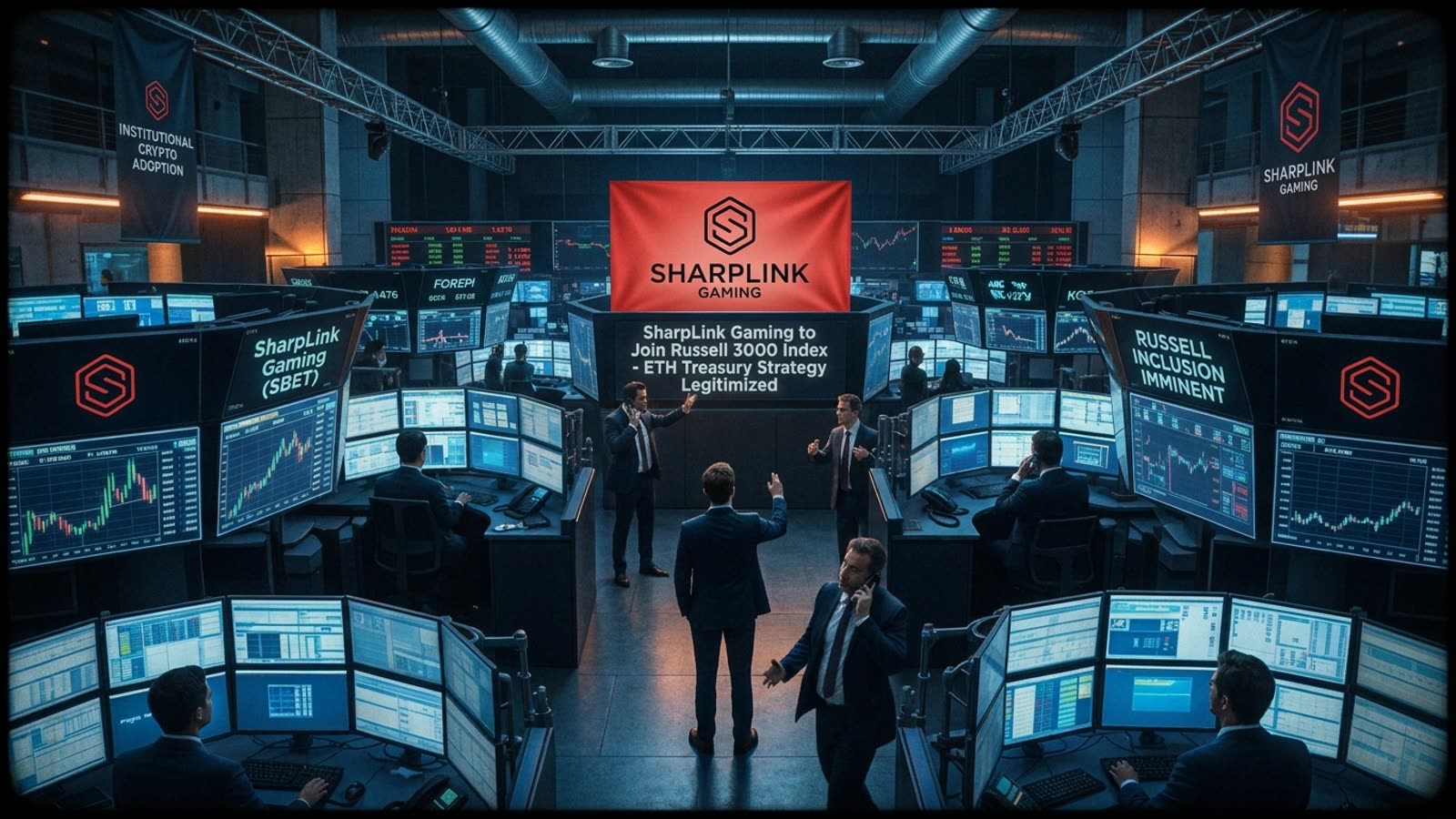
The Russell indexes don't care about your thesis on Ethereum's monetary premium. They care about market capitalization, liquidity, and whether a stock meets the mechanical criteria for inclusion. That SharpLink Gaming, a Joe Lubin-backed company whose core strategy revolves around accumulating Ethereum on its balance sheet, now qualifies for the Russell 2000 and Russell 3000 tells you something important: the crypto treasury trade has crossed from speculation into index-eligible respectability.
SharpLink announced this week that it expects to be added to the Russell indexes during the annual reconstitution, effective at market open on June 30. The company, which pivoted from sports betting technology to become what it calls an "Ethereum-focused treasury company," will join the thousands of firms tracked by passive investment vehicles managing trillions in assets. Index funds don't get to opt out.
The MicroStrategy template, Ethereum edition
MicroStrategy proved the concept: a company can transform itself into a leveraged bet on a cryptocurrency, and if it gets big enough, index inclusion forces institutional money to follow. Saylor's Bitcoin-hoarding vehicle entered the Nasdaq-100 last year, compelling funds that track the index to become Bitcoin holders by proxy, whether their mandates contemplated such exposure or not.
SharpLink is running the same playbook with Ethereum. The company has been accumulating ETH and positioning itself as a vehicle for investors who want corporate-structure exposure to the second-largest cryptocurrency. Lubin, the Ethereum co-founder whose ConsenSys empire has shaped much of the network's infrastructure, is a backer—lending the venture credibility within crypto circles while the Russell inclusion lends it credibility outside them.
The Russell 2000 is not the Nasdaq-100. It's a small-cap index, and SharpLink remains a modest enterprise compared to MicroStrategy's multi-billion-dollar market cap. But the principle holds: once you're in the index, passive flows must accommodate you.
What forced buying actually means
Index inclusion creates mechanical demand. Every fund benchmarked to the Russell 2000 or 3000—and there are many, from retail-facing ETFs to institutional separate accounts—must hold constituent stocks in proportion to their weight. When a new name enters, managers buy. They don't ask whether the company's Ethereum strategy makes sense; they ask how many shares they need to match the benchmark.
For SharpLink, this means a base of shareholders who own the stock not because they believe in Ethereum treasury strategies but because they believe in matching the Russell. That's a different kind of capital—stickier in some ways, more indifferent in others. It also means that any future Ethereum price appreciation flows through to a broader set of portfolios than crypto-native investors alone.
Our take
The crypto industry spent years begging for institutional legitimacy. Index inclusion is what legitimacy actually looks like: boring, mechanical, and utterly indifferent to the underlying asset's revolutionary potential. SharpLink joining the Russell won't move Ethereum's price or change the network's roadmap. But it does mean that the teacher pension fund in Ohio and the 401(k) plan in suburban Atlanta now have trace exposure to an Ethereum treasury strategy, whether anyone told them or not. That's not a revolution—it's something more durable. It's normalization.