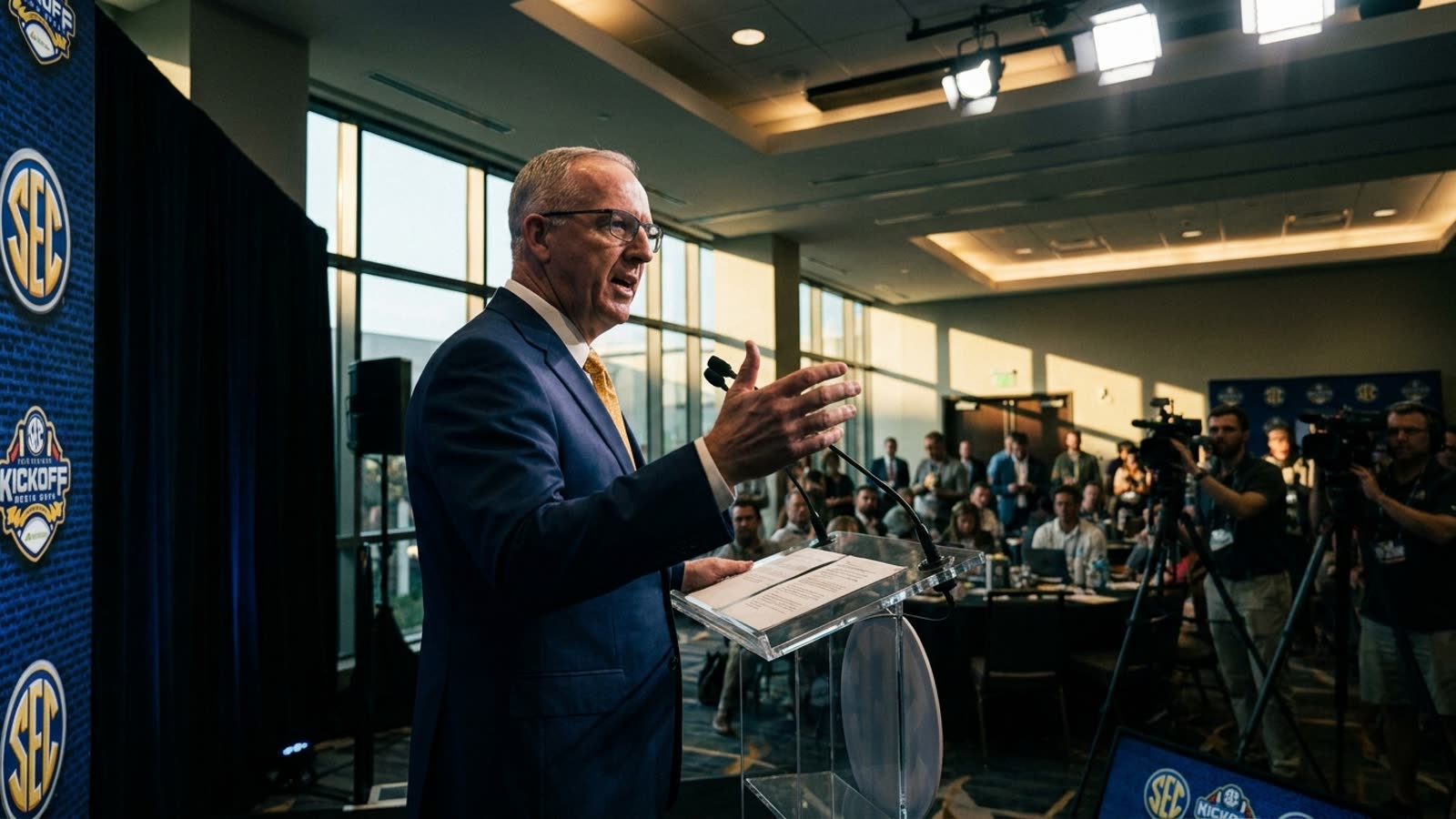
The Southeastern Conference has spent decades accumulating power within college athletics, and now its commissioner is openly suggesting that arrangement may have run its course. Greg Sankey's recent remarks — that the SEC could consider departing the NCAA if College Football Playoff negotiations don't yield satisfactory terms — represent the logical conclusion of a realignment era that has concentrated talent, television money, and institutional prestige into a single conference to a degree unprecedented in the sport's history.
This is not posturing. It is arithmetic.
The leverage equation
The SEC's bargaining position rests on a simple reality: the conference generates more revenue, attracts more viewers, and produces more NFL talent than any competitor. When Sankey declares his league the best "by far" despite the Big Ten's recent expansion, he is stating what television ratings and draft boards already confirm. The SEC's new media deal, worth approximately $300 million annually per school, dwarfs what most conferences can offer their members. That financial disparity creates a gravitational pull that has already reshaped the sport — Texas and Oklahoma's impending arrival being merely the most dramatic example.
The NCAA, meanwhile, operates as a regulatory body whose authority depends on voluntary participation. If the SEC concluded that NCAA membership imposed costs exceeding benefits, the organization would have no mechanism to compel continued affiliation. The conference could theoretically establish its own championship structure, negotiate its own broadcast arrangements, and set its own eligibility rules.
What a split would actually mean
An SEC departure from NCAA governance would not necessarily mean abandoning college football's broader ecosystem. More likely, it would involve creating a parallel structure for football while maintaining NCAA membership for other sports — a selective disengagement that preserves the parts of the relationship that still function while discarding the parts that don't.
The College Football Playoff's current expansion negotiations are the immediate flashpoint. The SEC wants a format and revenue distribution that reflects its competitive dominance. Other conferences, understandably, resist arrangements that would formalize their subordinate status. The NCAA sits awkwardly in the middle, possessing nominal authority over an enterprise it no longer meaningfully controls.
Our take
Sankey's comments are a negotiating tactic, but they're a negotiating tactic that happens to be true. The SEC has accumulated enough institutional mass that it no longer needs the NCAA's imprimatur to legitimize its football product. Whether the conference actually follows through on the implied threat matters less than whether the other parties believe it might. The answer, increasingly, is yes — and that belief alone will shape whatever CFP structure emerges. College football's governing fiction has always been that conferences are equal partners in a shared enterprise. The SEC is now saying the quiet part out loud: they're not partners, they're the enterprise.