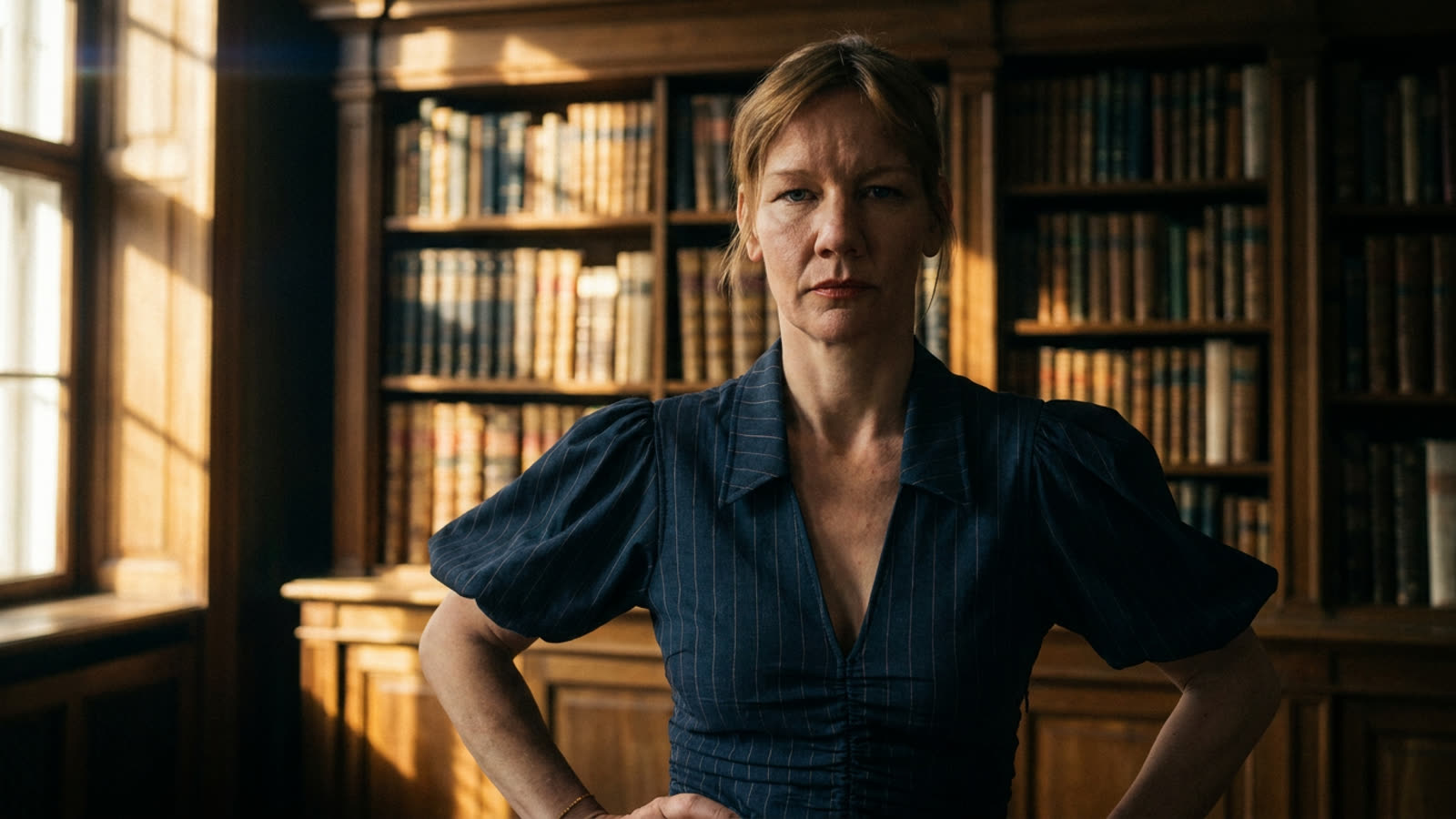
Sandra Hüller has spent the past three years becoming the face of European cinema's moral conscience—a woman who can convey complicity, grief, and quiet devastation without moving a muscle. Now, in Pawel Pawlikowski's Fatherland, she takes on Erika Mann, the eldest daughter of Nobel laureate Thomas Mann, and the fit is so precise it feels almost inevitable.
The film, which premiered in competition at Cannes this week, is a road movie in the loosest sense: Erika and her aging father, played by the great Hanns Zischler, traverse the American Southwest in the late 1940s, two German exiles processing what it means to have fled a country that devoured itself. Pawlikowski, whose Ida and Cold War established him as a master of the historical chamber piece, strips the narrative to its emotional skeleton. There are no grand speeches about fascism, no melodramatic confrontations. Instead, there is a daughter watching her father's mythology crumble in real time, and a father who cannot quite see his daughter as anything other than an extension of his own legacy.
The burden of brilliance
Erika Mann's biography is the stuff of twentieth-century tragedy: cabaret performer, anti-Nazi activist, war correspondent, and, ultimately, her father's most devoted caretaker. She was also queer, thrice married (once to W.H. Auden, in a lavender marriage to secure her British citizenship), and addicted to the amphetamines that would contribute to her early death. Pawlikowski wisely avoids the biopic trap of cramming all of this into two hours. Fatherland is interested in something narrower and more devastating—the particular loneliness of being brilliant in the shadow of someone more brilliant still.
Hüller plays Erika with a watchfulness that borders on surveillance. She anticipates her father's needs before he voices them, deflects his critics, manages his correspondence, and absorbs his casual cruelties with the practiced patience of someone who stopped expecting acknowledgment long ago. It is a performance of tremendous discipline, and Pawlikowski's camera—often static, always intimate—trusts her completely.
Zischler's quiet thunder
At 77, Hanns Zischler brings a papery fragility to Thomas Mann that never tips into frailty. His Mann is vain, self-absorbed, and intermittently charming, a man who has spent so long being treated as a monument that he has forgotten how to be a person. The film's most wrenching scenes are also its quietest: a dinner where Mann holds forth on Goethe while Erika stares at her plate, a late-night conversation in a motel room where he almost, but not quite, thanks her.
Pawlikowski shot the film in New Mexico and Arizona, and the landscapes—bleached, vast, indifferent—serve as a visual counterpoint to the claustrophobic intimacy of the Mann family dynamic. There is nowhere to hide in the desert, and yet both father and daughter remain stubbornly opaque to each other.
Our take
Fatherland is not a film that will satisfy audiences hungry for catharsis or historical spectacle. It is a film about the slow erosion of selfhood in service to someone else's genius, and it asks uncomfortable questions about what we owe our parents, our legacies, and ourselves. Hüller and Zischler are both operating at the peak of their powers, and Pawlikowski has made something that feels less like a movie and more like a bruise. It may not win the Palme—it is too quiet, too interior—but it will linger long after louder films have faded.