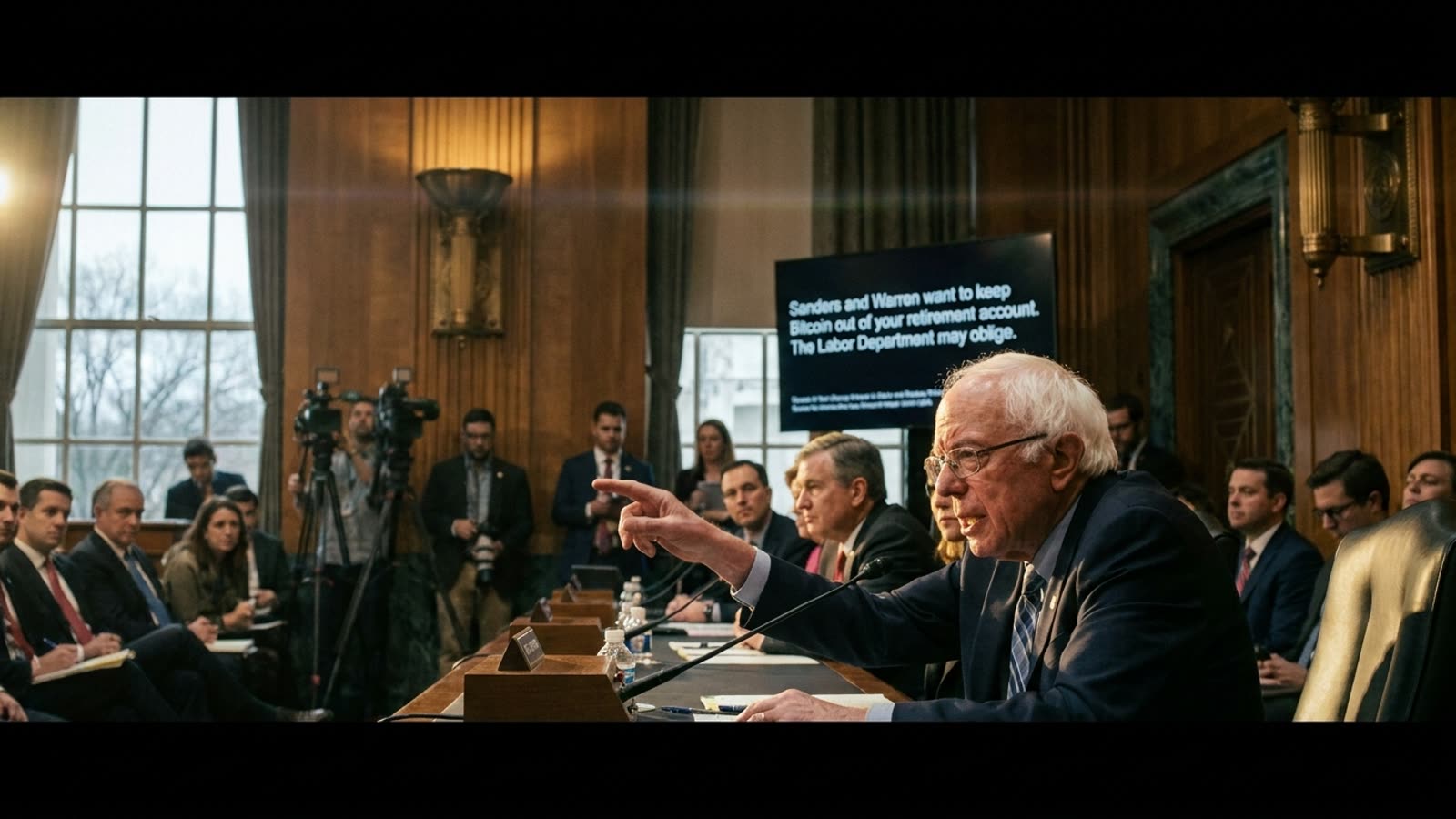
The progressive wing of the Democratic Party has found a new hill to defend: your retirement savings. Senators Bernie Sanders and Elizabeth Warren are urging the Department of Labor to reverse course on guidance that would permit Bitcoin and other cryptocurrencies in employer-sponsored 401(k) plans, arguing that volatile digital assets have no place in the nest eggs of ordinary Americans.
The timing is pointed. The Trump administration's Labor Department had signaled a softer stance on crypto retirement products, walking back Biden-era warnings that plan fiduciaries could face legal exposure for offering digital-asset options. Fidelity, which launched a Bitcoin 401(k) product in 2022, has quietly expanded its institutional offerings; several smaller custodians have followed. The senators' letter—co-signed by a handful of House progressives—demands the department reinstate its prior skepticism and issue explicit guidance discouraging fiduciaries from including crypto in default investment menus.
The fiduciary question
At the heart of the dispute is ERISA, the 1974 law governing retirement plans. Fiduciaries must act "solely in the interest" of participants, a standard that critics say crypto cannot meet given its historical drawdowns. Bitcoin fell more than 75 percent from its 2021 peak to its 2022 trough; even after its subsequent recovery and the approval of spot ETFs, annualized volatility remains several multiples higher than a diversified equity portfolio. Sanders and Warren argue that permitting such assets in retirement accounts exposes unsophisticated savers to catastrophic losses—and exposes plan sponsors to litigation.
Defenders of crypto inclusion counter that the same logic would have excluded small-cap equities or emerging-market funds decades ago. They note that most proposals cap crypto allocations at low single-digit percentages of a portfolio, limiting downside while offering asymmetric upside. The real issue, they suggest, is paternalism: who decides what risks adults are permitted to take with their own money?
Political math
The letter is unlikely to move the current Labor Department, which has shown little appetite for crypto restrictions. But it does something more important: it forces moderate Democrats to pick a side ahead of the 2026 midterms. Crypto PACs spent heavily in the last cycle, and several swing-state Democrats owe their seats to industry support. A public fight over retirement savings—a kitchen-table issue if ever there was one—could fracture the fragile bipartisan consensus that has allowed stablecoin and market-structure bills to advance.
Republicans, meanwhile, are happy to let Sanders and Warren become the face of crypto opposition. "If your retirement policy is 'trust the government, not yourself,' that's a clean contrast," one GOP Senate aide told reporters.
Our take
Sanders and Warren are not wrong that most retail savers lack the sophistication to evaluate Bitcoin's risk-reward profile. But the solution is disclosure and education, not prohibition. Banning crypto from 401(k)s while permitting leveraged ETFs and penny stocks in brokerage accounts is incoherent policy dressed up as consumer protection. The senators would be better served pushing for fiduciary-safe-harbor rules that cap allocations and require plain-English risk warnings. That would protect savers without treating them like children—and without handing Republicans a populist weapon in an election year.