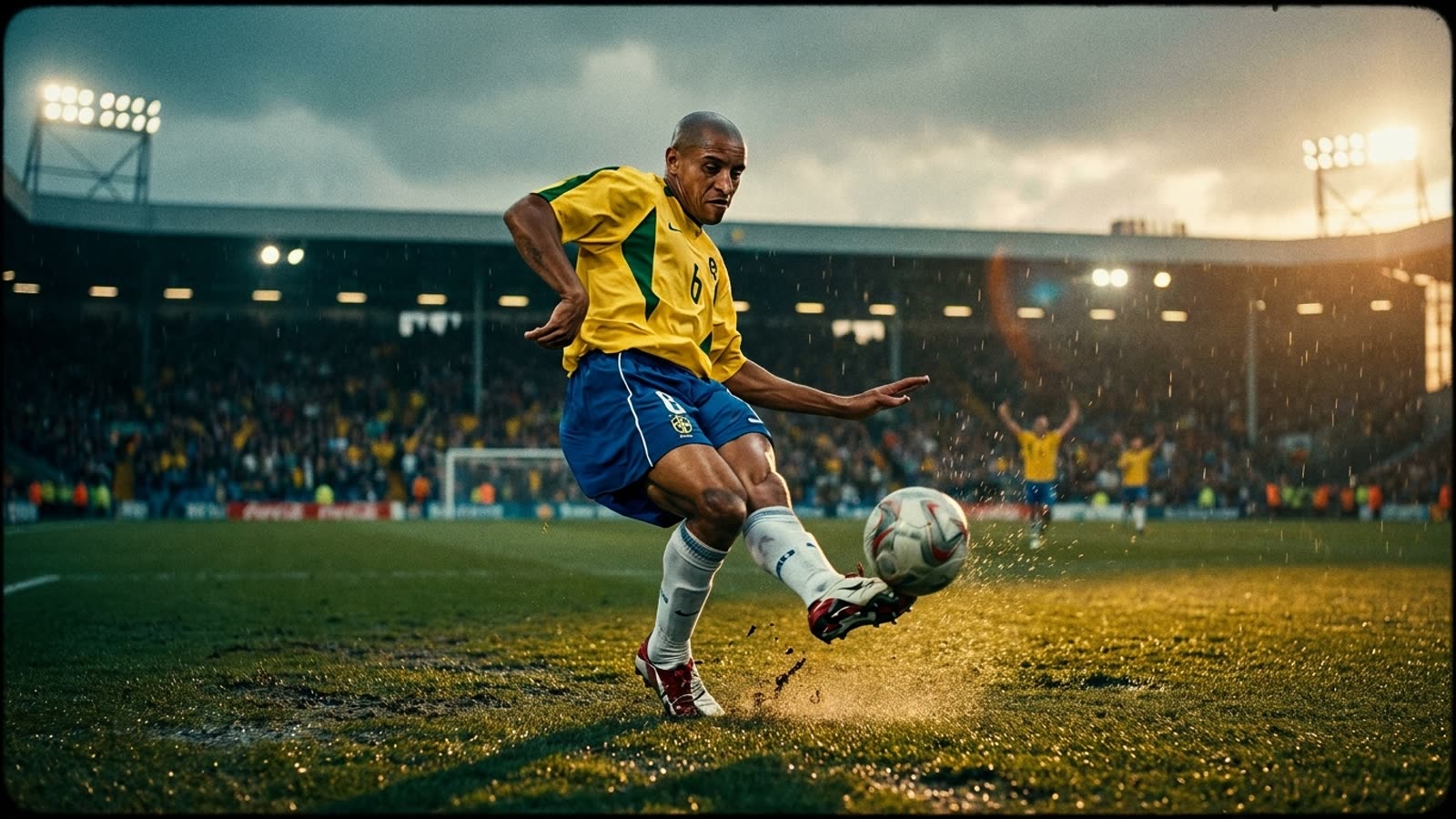
The ball should not have gone in. Every physicist who has studied Roberto Carlos's free kick against France in the Tournoi de France knows this, and yet the ball curved impossibly around the wall, past a motionless Fabien Barthez, and into the net. The French goalkeeper did not move because moving would have been irrational. The ball was clearly traveling wide.
Except it wasn't. The Brazilian left-back had struck the ball with the outside of his foot at roughly 130 kilometers per hour, imparting a spin that would make the ball swerve more than four meters in flight. Physicists at the University of Lyon later calculated that the trajectory violated what casual observers would consider possible aerodynamics. The Magnus effect—the same phenomenon that makes curveballs curve—was working at its absolute extreme.
The weapon and the will
Roberto Carlos possessed thighs that measured nearly 70 centimeters in circumference, a physical anomaly that allowed him to generate power that other players simply could not match. But raw strength without precision is merely violence. What made Roberto Carlos singular was his willingness to attempt shots that no rational player would try. He took free kicks from angles where the geometry seemed to demand a cross rather than a shot. He shot from distances where the probability of scoring approached statistical insignificance.
This was not recklessness. It was a different calculation entirely. Roberto Carlos understood that his physical gifts allowed him to operate in a probability space that did not exist for other players. Where a conventional left-back saw a crossing opportunity, he saw a shooting lane that only he could access.
The fullback revolution
Before Roberto Carlos, the left-back position was fundamentally defensive. Players were selected for their ability to neutralize right wingers, not for their capacity to become auxiliary attackers. Roberto Carlos, alongside his Real Madrid counterpart Cafu on the right, redefined what a fullback could be. The modern conception of attacking fullbacks—Marcelo, Jordi Alba, Andrew Robertson—descends directly from the template Roberto Carlos established.
At Real Madrid, he won three Champions League titles and four La Liga championships. With Brazil, he claimed the 2002 World Cup, starting every match of the tournament. But these honors, substantial as they are, do not capture his influence. He changed the position itself. Clubs began scouting fullbacks for offensive capability rather than merely defensive solidity. Youth academies started training defenders to attack.
Our take
The 1997 free kick endures not because it was important—it was a friendly tournament goal—but because it was impossible. Roberto Carlos made the impossible look like a choice, a decision to operate by different rules than everyone else on the pitch. That is the definition of greatness in any field: not merely excelling within existing parameters, but expanding what parameters can exist. Every time a fullback bombs forward today, every time a defender takes an audacious shot from distance, they are playing in the space Roberto Carlos created.