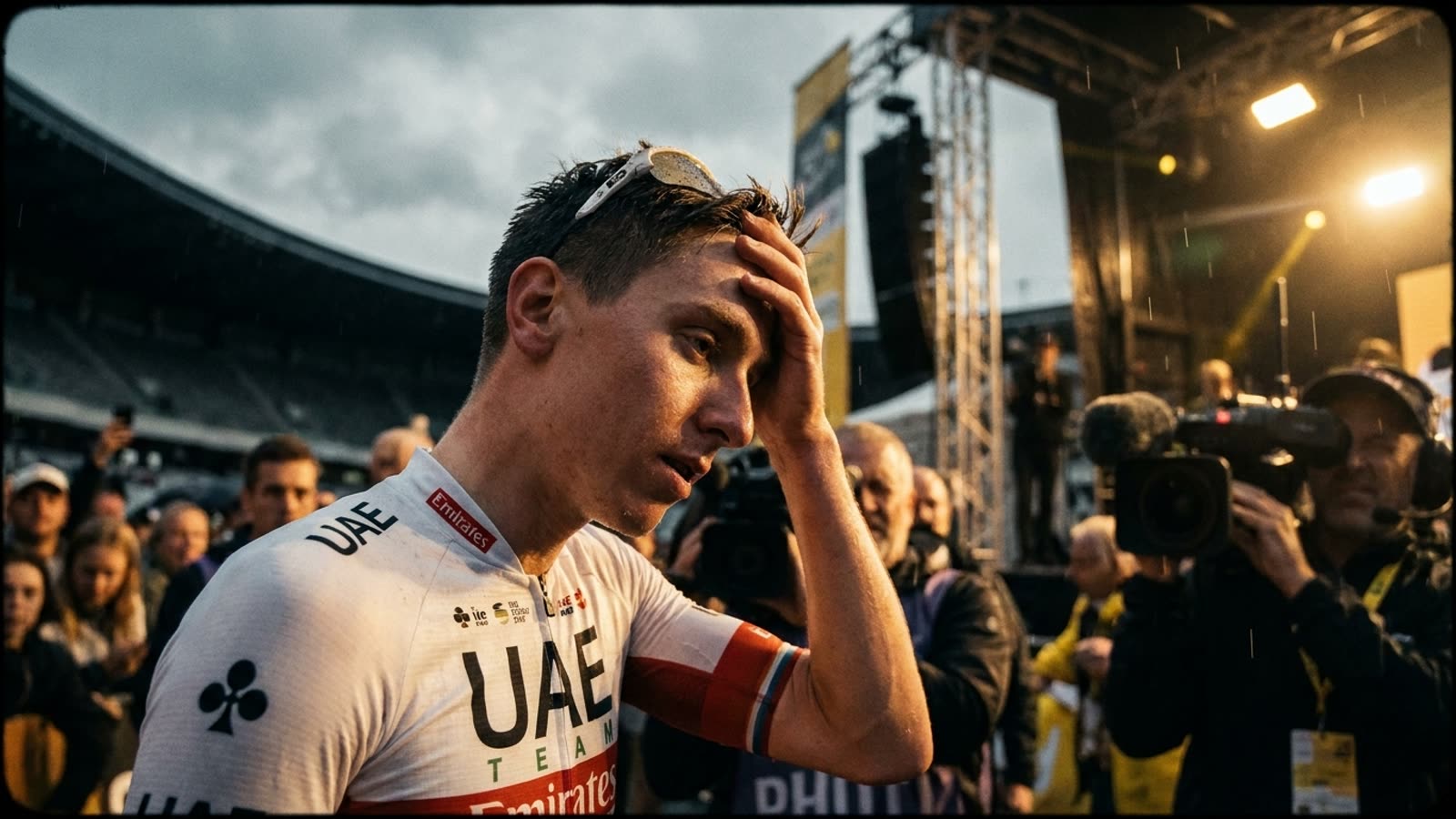
Professional cycling sells suffering as spectacle — the grimacing climbs, the skeletal physiques, the romanticized agony of grand tours. What it does not advertise is the sport's quieter terror: the moment a wheel clips a curb, a car drifts wide, or a patch of gravel appears where tarmac should be. Tadej Pogačar, the 28-year-old Slovenian who has dominated stage racing for half a decade, now carries three healed vertebrae as permanent evidence of that terror.
Speaking publicly for the first time since his August crash during a training ride in Monaco, Pogačar offered a phrase that lands heavier than any palmares update: "I'm just happy to be alive." The five-time Tour de France winner, who also holds two Giro d'Italia titles and a world championship, was descending a familiar route when he lost control at speed. The details remain sparse — Pogačar has declined to elaborate on the mechanical or environmental factors — but the outcome was unambiguous. Three fractured vertebrae. Emergency hospitalization. A career that looked, for several terrifying hours, potentially finished.
The fragility beneath the dominance
Pogačar's brilliance has always carried an air of invincibility. He attacks on climbs where others merely survive. He wins time trials against specialists. He has, since bursting onto the scene at the 2020 Tour, made the sport's hardest races look like exhibitions. That perception obscured a statistical reality: elite cyclists crash. They crash often. Chris Froome, a four-time Tour champion, nearly died in a 2019 reconnaissance crash. Fabio Jakobsen was placed in an induced coma after a horrific sprint finish in 2020. The peloton's history is littered with careers ended or permanently altered by moments of lost traction.
Pogačar's crash occurred away from cameras, away from the controlled chaos of competition. Training rides, counterintuitively, may be more dangerous — no race motorcycles clearing traffic, no team cars tracking every descent. Just a rider, alone with physics and probability.
The road back
Pogačar confirmed he has resumed light training on a stationary bike and expects to return to outdoor riding within weeks. His team, UAE Emirates, has not announced a target race for his comeback, though the 2027 Tour de France — where he would pursue a record-tying sixth title — looms as the obvious objective. The vertebrae, according to his medical team, have healed cleanly. The psychological residue is harder to scan.
"You think about it on every descent now," Pogačar admitted. "Maybe that goes away. Maybe it doesn't."
Our take
Cycling's governing bodies have spent years debating safety reforms — race radios, descent neutralizations, barrier placements — while the sport's fundamental danger remains irreducible. Humans on carbon frames at 80 kilometers per hour will sometimes fall. Pogačar's survival, and his apparent path to full recovery, is genuinely fortunate. His candor about fear is rarer still. The greatest cyclist of his generation admitting vulnerability does not diminish his palmares. It clarifies what those victories always cost.