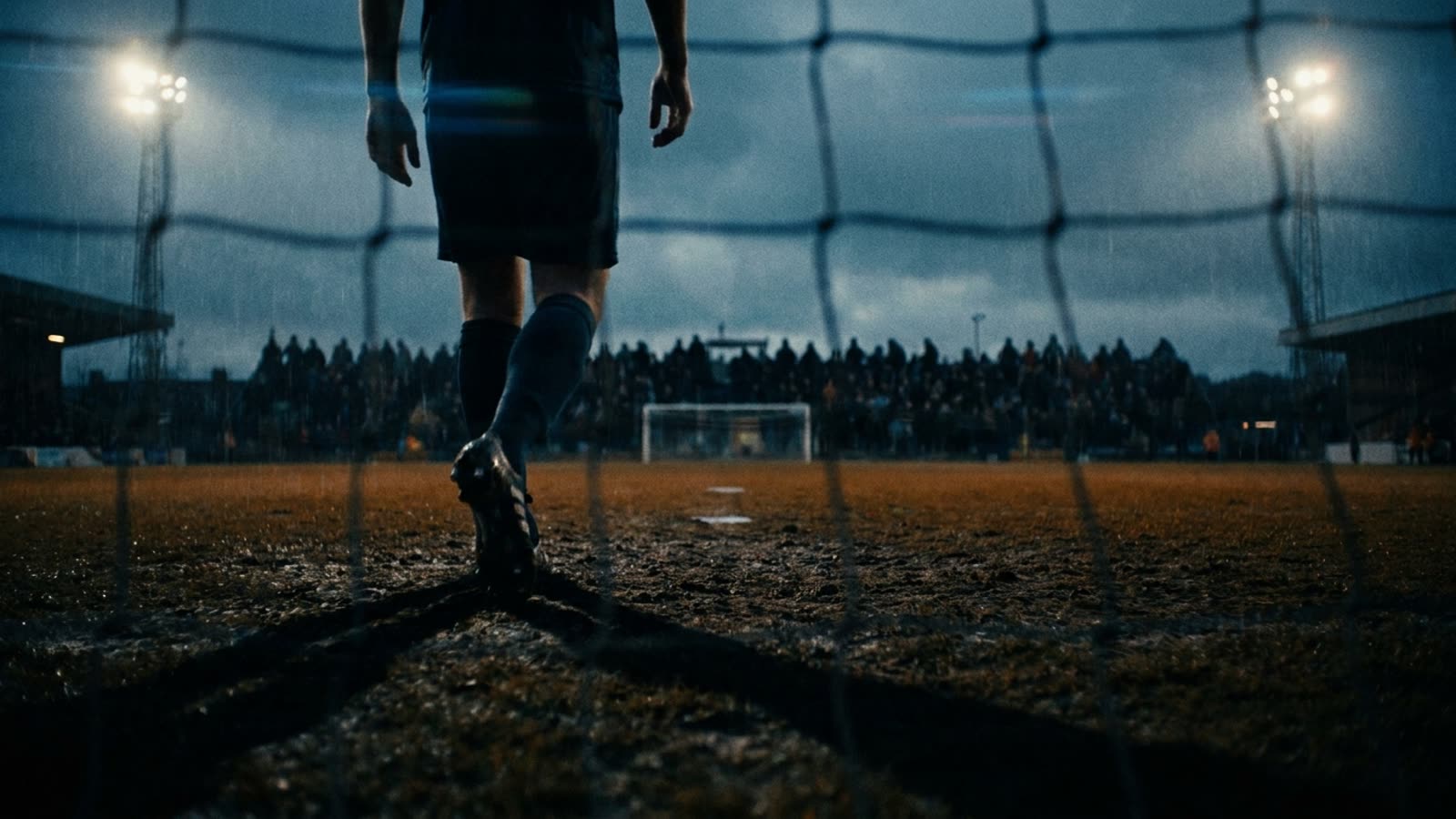
The penalty kick is, technically speaking, an absurdity. A stationary ball, a goalkeeper who cannot move until the ball is struck, a target roughly twenty-four feet wide and eight feet tall, and a shooter standing just twelve yards away. The mathematics should be overwhelming: even average professionals convert penalties at rates above seventy percent in regular play. Yet in World Cup knockout shootouts, that figure drops precipitously, and entire footballing nations have built elaborate psychological trauma around what should be routine.
This paradox sits at the intersection of sport and cognitive science, revealing that the penalty shootout is less a test of technique than a real-time experiment in how human beings process pressure.
The weight of a nation's gaze
What changes between a penalty in the thirty-seventh minute and one in a shootout is not the geometry of the goal or the reflexes of the goalkeeper. It is the meaning assigned to the act. Researchers studying motor control under pressure have documented a phenomenon called "explicit monitoring" — when athletes under stress begin consciously attending to movements that are normally automatic. A penalty taker who has struck thousands of balls without thought suddenly becomes aware of his run-up, his plant foot, the angle of his hips. The body, flooded with cortisol and adrenaline, begins to betray the very muscle memory it spent years developing.
This explains why shootout misses so often look catastrophically bad — balls ballooned into the stands, weak efforts rolled straight at the goalkeeper. These are not failures of ability but failures of automaticity. The conscious mind, attempting to help, becomes a saboteur.
The goalkeeper's asymmetric advantage
Goalkeepers, curiously, tend to perform better in shootouts than their expected save rates would suggest. Part of this is selection — managers choose their most psychologically resilient keepers for such moments. But there is also an asymmetry in the pressure equation. The goalkeeper is expected to lose each individual duel; any save is heroic. The shooter is expected to score; any miss is catastrophic. This imbalance of expectation liberates one party while crushing the other.
Clever goalkeepers exploit this dynamic through gamesmanship — delaying tactics, pointed stares, subtle movements designed to inject additional doubt into an already anxious mind. The rules nominally prohibit such behavior, but enforcement is inconsistent, and the psychological damage is often done before any whistle is blown.
Ritual as refuge
Elite penalty takers often develop elaborate pre-shot routines: a specific number of steps backward, a particular breathing pattern, a fixed point of focus. These rituals serve no biomechanical purpose. Their function is psychological — they create a portable sense of normalcy, a micro-environment of control within the chaos of a World Cup shootout. The routine becomes a kind of cognitive anchor, pulling the athlete back toward automaticity and away from the paralysis of overthinking.
National football associations have invested heavily in shootout preparation, bringing in sports psychologists and running simulated pressure scenarios. Whether this training transfers to actual World Cup moments remains contested; the gap between a simulated crowd and a hundred million viewers may be unbridgeable.
Our take
The penalty shootout endures because it is spectacular television and because no one has proposed a better alternative that doesn't simply extend exhausted players further toward injury. But we should be honest about what we are watching. It is not a fair test of which team played better football, nor even a reliable measure of which team has superior technique. It is a test of which collection of individuals can best manage their own nervous systems under extraordinary duress — a skill related to football only tangentially. That this arbitrary mechanism has decided World Cup finals is either a beautiful absurdity or a sporting injustice, depending on which side of the twelve yards your sympathies fall.