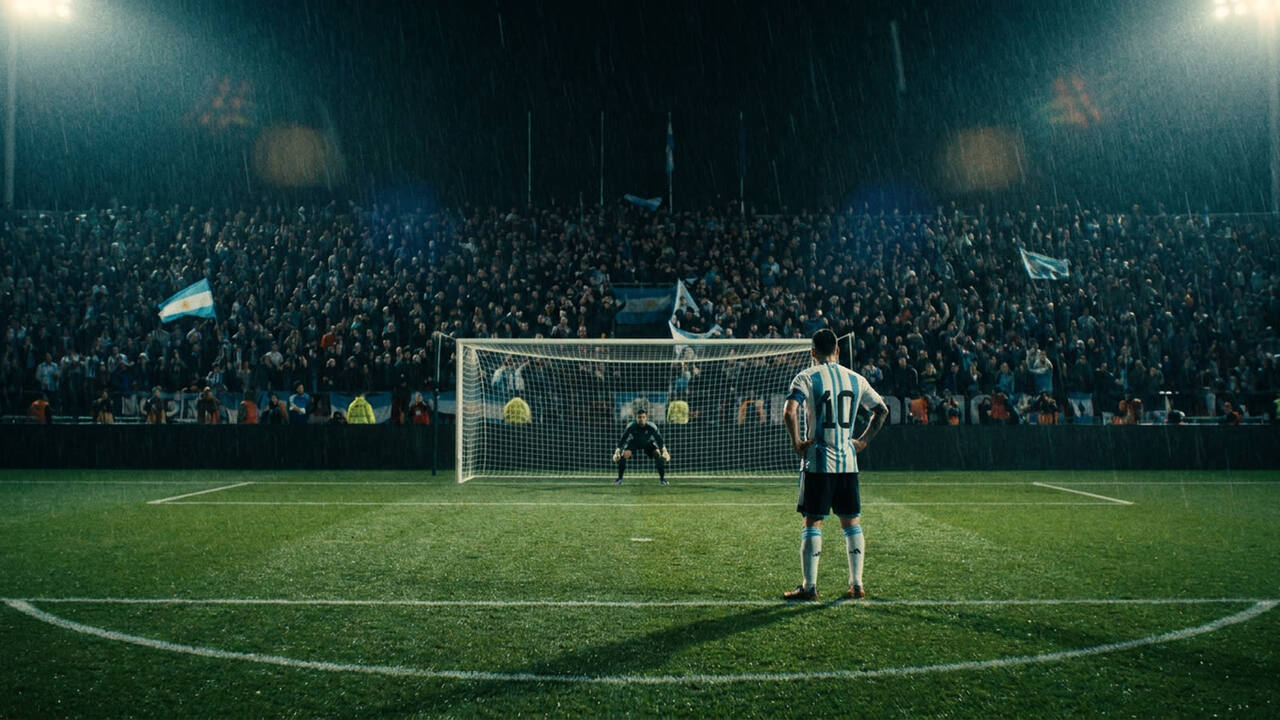
The walk from the centre circle to the penalty spot takes approximately fifteen seconds. In that quarter-minute, a footballer must transition from the collective anonymity of team sport to the loneliest stage in athletics — one person, one ball, one goalkeeper, and several hundred million witnesses. It is, by any reasonable measure, absurd that major tournaments are decided this way. It is also, perhaps, inevitable.
The penalty shootout entered World Cup competition in 1982, replacing the coin toss and replay system that had previously settled drawn knockout matches. The logic was unimpeachable: let the players decide. What the rule-makers perhaps underestimated was how comprehensively the shootout would expose the gap between technical ability and psychological fortitude. A player who can strike a dead ball past a goalkeeper in training, in a league match, even in a cup final, may find the same task impossible when the weight of national expectation settles on their shoulders.
The paradox of simplicity
From twelve yards, with the goalkeeper rooted to the line until the ball is struck, a penalty should be unstoppable. The mathematics are brutal: a well-struck shot to either corner gives the goalkeeper essentially no chance. The goal is eight yards wide and eight feet tall. The ball travels faster than human reaction time permits. And yet, in World Cup shootouts, roughly one in four penalties fails to find the net — missed, saved, or struck against the frame.
This conversion rate has remained remarkably stable across decades, despite advances in sports science, video analysis, and goalkeeper coaching. The implication is clear: the technical challenge is not the limiting factor. What fails is something more fundamental — the capacity to execute a practised skill when the mind is screaming that everything depends on it.
National mythologies and self-fulfilling prophecies
Certain footballing nations have developed reputations in shootouts that seem almost deterministic. Germany, until their exit from the 2006 World Cup, had never lost a shootout in a major tournament. England, by contrast, became synonymous with shootout failure, a pattern so consistent it spawned academic research and national hand-wringing in roughly equal measure.
The explanations offered — German efficiency, English nervousness, Latin flair, Nordic composure — verge on cultural stereotype. Yet the patterns persisted long enough to suggest something real was operating beneath the clichés. When a nation's players grow up watching their predecessors fail from twelve yards, when the media narrative before every tournament includes the inevitable shootout anxiety, the weight of history becomes its own variable. The English players who stepped up in the 2018 World Cup spoke explicitly about breaking the cycle, about refusing to inherit their predecessors' trauma. They won that shootout. The curse, if it ever existed, was at least partially psychological.
What the spot reveals
Watch enough shootouts and patterns emerge that no coaching manual would predict. The best penalty takers are not necessarily the best players. They tend to share a particular quality — the ability to narrow focus to the immediate technical task while remaining loose enough to execute it. The worst penalty takers are often those who think too much, who see the goalkeeper, the crowd, the consequences, rather than simply the ball and the corner they have chosen.
Goalkeepers, meanwhile, operate in a realm of educated gambling. They must commit to a direction before they can possibly know where the ball is going. Their success rate suggests they are doing something more than guessing — reading body language, exploiting tendencies, creating doubt through movement and presence — but the fundamental asymmetry remains. The taker controls the outcome. The goalkeeper can only hope to disrupt it.
Our take
There have been periodic calls to abolish the shootout, to extend extra time, to decide matches through corner counts or other accumulated statistics. All of these proposals miss the point. The shootout endures not despite its cruelty but because of it. Sport exists, in part, to create moments of unbearable pressure and see how humans respond. The penalty spot is simply the most distilled version of that examination. It strips away the complexity of football — the tactics, the teamwork, the fitness — and asks a single question: can you do the simple thing when it matters most? The answer, it turns out, tells us everything.