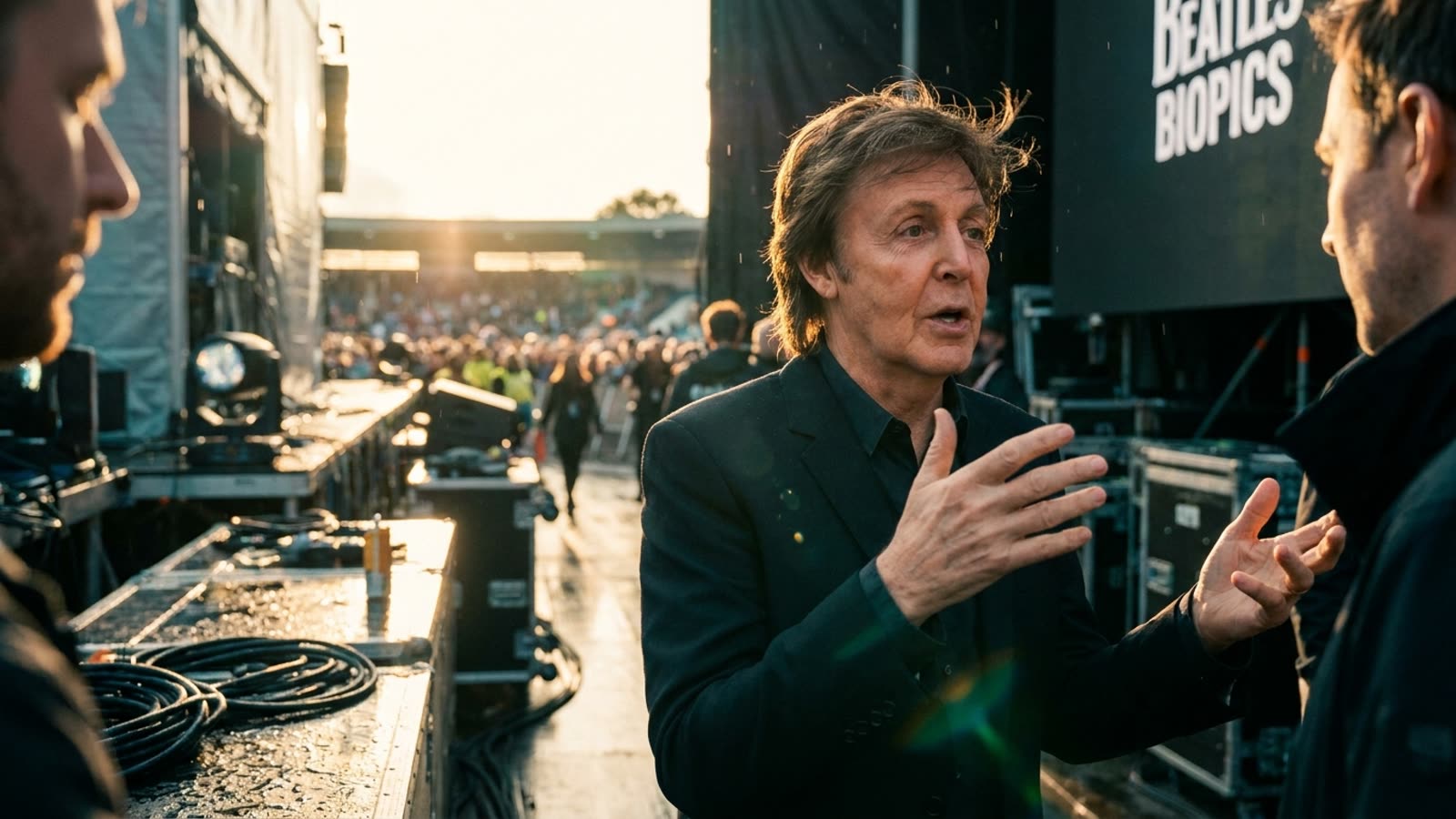
Paul McCartney has texted Sam Mendes with a two-word directive about the director's ambitious four-film Beatles project: "Don't do this." The offense in question is not a disputed song credit, a misremembered Hamburg anecdote, or an unflattering portrayal of Linda. It is that Paul Mescal, the Oscar-nominated actor cast as McCartney, stands shorter than Harris Dickinson, who will play John Lennon. In real life, McCartney was taller than Lennon by roughly an inch. To the 84-year-old knight of the realm, this inversion is apparently intolerable.
The complaint sounds petty until you remember that McCartney has spent six decades managing a narrative. The Beatles' internal dynamics — who led, who followed, who wrote the bridge on "A Day in the Life" — remain the most dissected power struggle in popular music. Height is not incidental to that story. Lennon's myth rests partly on his perceived dominance, the caustic wit, the bed-ins, the martyrdom. McCartney's rests on melodic genius paired with a reputation, fair or not, for being the eager-to-please partner. Letting a film literally look up at a fictional Lennon while looking down at a fictional McCartney is, in Paul's view, a thumb on the scale.
The Mendes gamble
Sam Mendes is not making a single biopic; he is making four simultaneous features, each told from one Beatle's perspective, scheduled to shoot concurrently and release in 2027. The logistical audacity has already drawn comparisons to Clint Eastwood's "Letters from Iwo Jima" diptych, though Mendes is doubling that ambition. Casting four leads who must share scenes across four films while satisfying four estates — only two of which belong to living subjects — was always going to be a diplomatic minefield. McCartney's height grievance is the first public detonation.
Mescal, for his part, is five-foot-ten; Dickinson is six-one. The real Lennon was five-foot-eleven; the real McCartney, just over six feet. Mendes could, theoretically, solve this with apple boxes and camera angles, the way Tom Cruise has navigated Hollywood for decades. Whether he will capitulate to McCartney's complaint remains unclear. A representative for the production declined to comment.
Why biopics keep getting bodies wrong
Hollywood has long treated physical resemblance as negotiable. Rami Malek won an Oscar playing Freddie Mercury despite being five inches shorter and bearing only passing facial similarity. Austin Butler bulked up for Elvis but could not replicate Presley's singular bone structure. Audiences accept these gaps because biopics sell transformation, not duplication. Yet the subjects themselves — or their heirs — often disagree. The Presley estate famously clashed with early Elvis projects; the Queen of Soul's family delayed "Respect" for years over creative control.
McCartney's intervention is notable because he is alive, lucid, and unafraid to text a two-time Oscar-winning director directly. Most rock legends cede control posthumously. Paul is not most rock legends.
Our take
McCartney is being ridiculous, and he is also being right. Height is a proxy for something he cannot say outright: that he fears these films will, once again, frame Lennon as the soul of the band and him as the craftsman. That framing has irritated him since 1970. At 84, with nothing left to prove commercially, he is finally saying so — in the pettiest, most irrefutable way possible. Mendes should probably find a taller Lennon. Or a shorter one. Either way, he should answer Paul's texts.