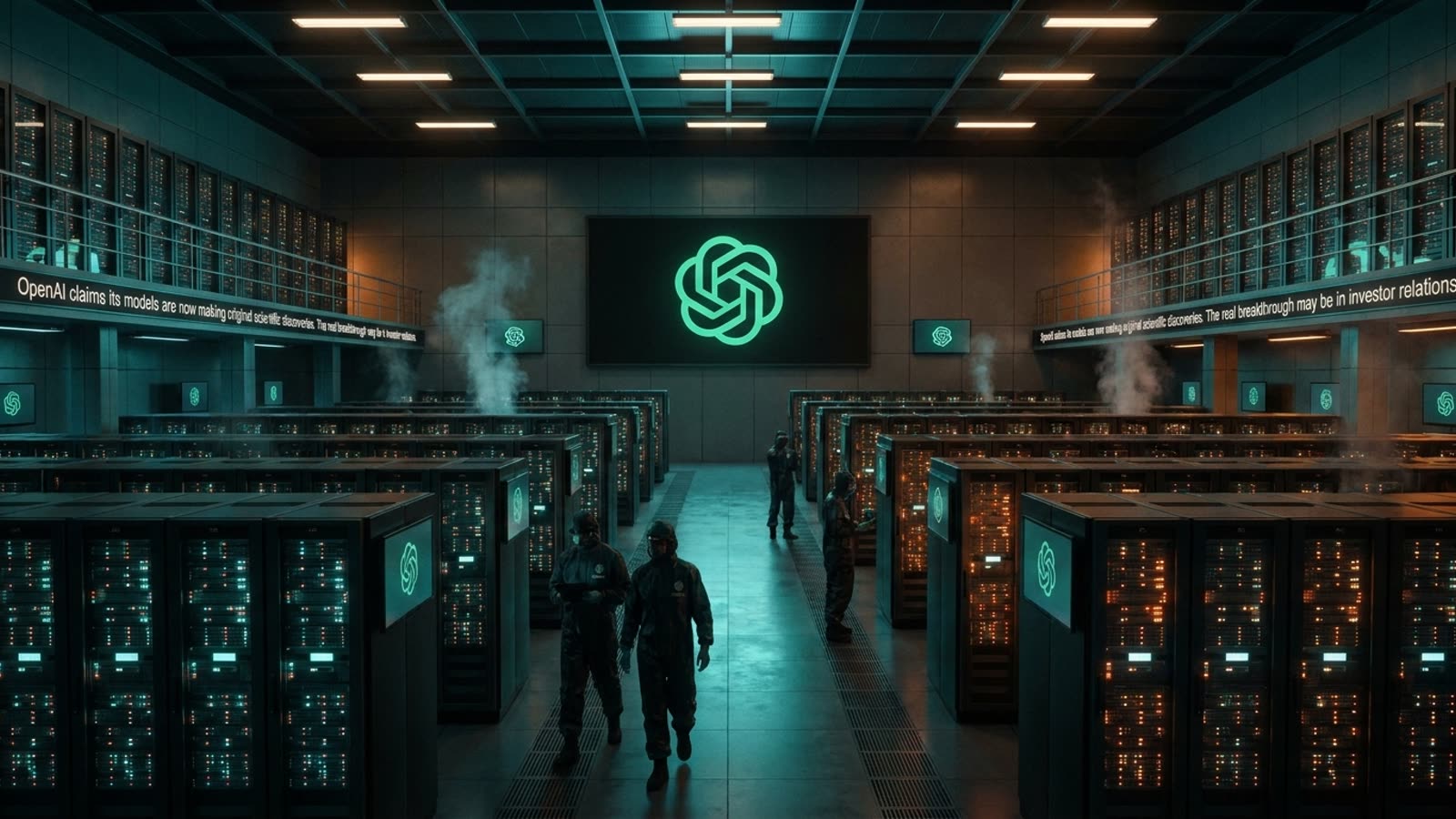
OpenAI's latest announcement—that its AI systems have produced genuine discoveries across mathematics, computer science, and physics—lands with the unmistakable thud of a company trying very hard to change the conversation. The timing, days after Anthropic's IPO filing sent markets surging on renewed AI optimism, suggests these claims are as much about capital markets as they are about the frontiers of human knowledge.
The substance, to the extent it can be verified, appears real but modest. According to OpenAI's disclosures, their models have identified novel mathematical conjectures, optimised certain algorithmic approaches, and proposed testable hypotheses in theoretical physics. What remains conspicuously absent is peer review, independent replication, or the kind of rigorous verification that typically precedes such announcements in actual scientific circles.
The discovery-to-press-release pipeline
Scientific breakthroughs historically announce themselves through journals, conferences, and the slow accumulation of expert consensus. OpenAI's approach inverts this entirely: the press release arrives first, the scrutiny later—if ever. This is not how DeepMind handled AlphaFold, which underwent extensive validation before its creators claimed it had "solved" protein folding. The difference in approach tells you something about the difference in institutional cultures.
OpenAI's claims join a growing list of AI-attributed scientific advances that range from the genuinely transformative to the aggressively overstated. The challenge for observers is that distinguishing between the two requires precisely the kind of domain expertise that most investors, journalists, and policymakers lack. The company knows this.
What "discovery" means in the age of foundation models
There is a philosophical question lurking beneath the hype: what does it mean for an AI to "discover" something? If a model generates millions of mathematical conjectures and a handful prove interesting to human mathematicians, who made the discovery? The machine that produced the candidates, or the humans who recognised their significance? OpenAI's framing—that the AI itself is discovering—elides this distinction in ways that serve its commercial interests.
More practically, the announcement arrives as the AI industry faces mounting questions about when, exactly, the enormous capital expenditures will translate into proportionate returns. Last week's Apollo-Economist analysis suggesting corporate America has seen "zero payoff" from AI investments clearly stung. Nothing answers that critique quite like claiming your technology is now doing science.
Our take
OpenAI may well have built systems capable of accelerating scientific research in meaningful ways. But the company's chronic inability to let its work speak for itself—to submit to normal scientific scrutiny before claiming revolutionary breakthroughs—corrodes trust precisely when trust matters most. When your business model depends on convincing the world that artificial general intelligence is imminent, every announcement becomes suspect. The discoveries may be real. The theatre around them certainly is.