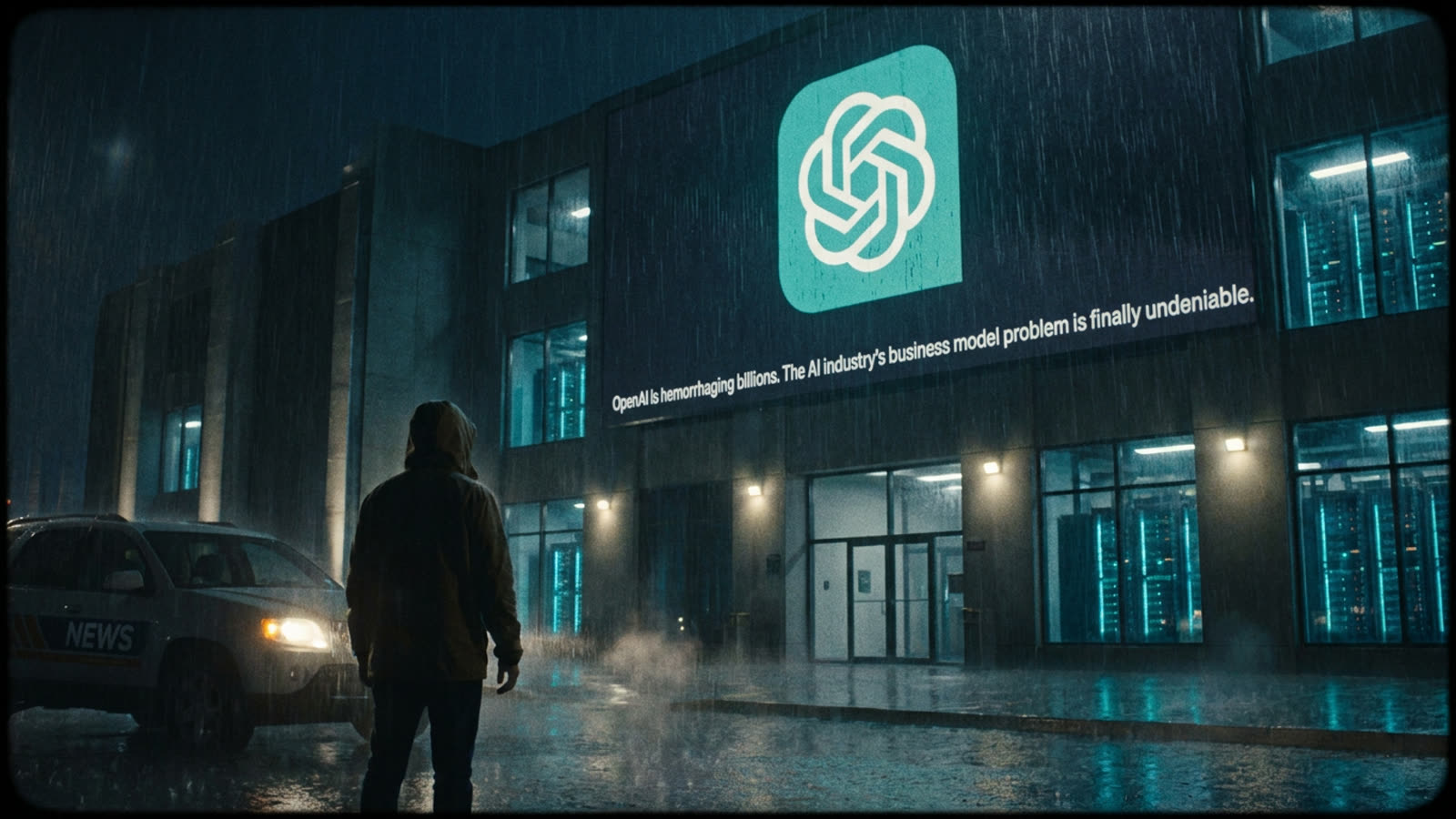
The generative AI revolution has a dirty secret that leaked financial documents have now dragged into daylight: OpenAI, the company that sparked the entire boom, is burning through cash at a rate that makes WeWork's profligacy look almost quaint. The firm reportedly lost billions of dollars last year alone, a figure that should prompt serious questions about whether the most hyped technology sector since the dot-com era has any viable path to profitability.
This isn't a startup finding its footing. OpenAI has raised over $10 billion from Microsoft and commands valuations that would make it one of the most valuable private companies on Earth. ChatGPT has become a household name. And yet the economics remain stubbornly, almost comically, upside down.
The compute trap
The fundamental problem is infrastructural. Running large language models requires staggering amounts of computing power — expensive GPUs, massive data centers, electricity bills that would make a small country wince. Every query costs money. Every improvement to the model demands more training, more compute, more capital. OpenAI's subscription fees and API charges, while substantial, apparently cannot keep pace with the cost of actually delivering the product.
This creates what might be called the AI utility problem. Unlike software, which historically scaled beautifully (write once, sell infinitely), AI services have marginal costs that refuse to shrink. Each user interaction consumes real resources. The more successful the product, the more money it loses — at least until some theoretical future where efficiency gains or pricing power changes the equation.
The broader reckoning
OpenAI's losses matter beyond its own balance sheet because they illuminate the entire sector's fragility. Oracle just laid off 21,000 employees partly to fund its AI infrastructure bets. Nvidia is raising $25 billion in bonds to meet demand for chips that AI companies are buying with investor money, not profits. The whole ecosystem resembles a magnificent Rube Goldberg machine where venture capital flows in one end and GPU purchases flow out the other, with actual sustainable businesses remaining conspicuously absent.
The comparison to earlier tech bubbles is imperfect but instructive. Amazon lost money for years before its business model proved out. But Amazon was building warehouses and logistics networks that would eventually generate cash. The question for AI companies is whether their current spending is similarly foundational or whether they're simply subsidizing a service that users won't pay full freight for.
Our take
None of this means generative AI is worthless or that OpenAI will fail. It means the industry is operating on faith — faith that costs will fall, that killer applications will emerge, that someone will figure out how to charge enough. That faith may prove justified. But leaked documents showing billions in losses at the sector's flagship company should give pause to anyone who assumed the hard part was building the technology. The hard part, it turns out, is building a business.