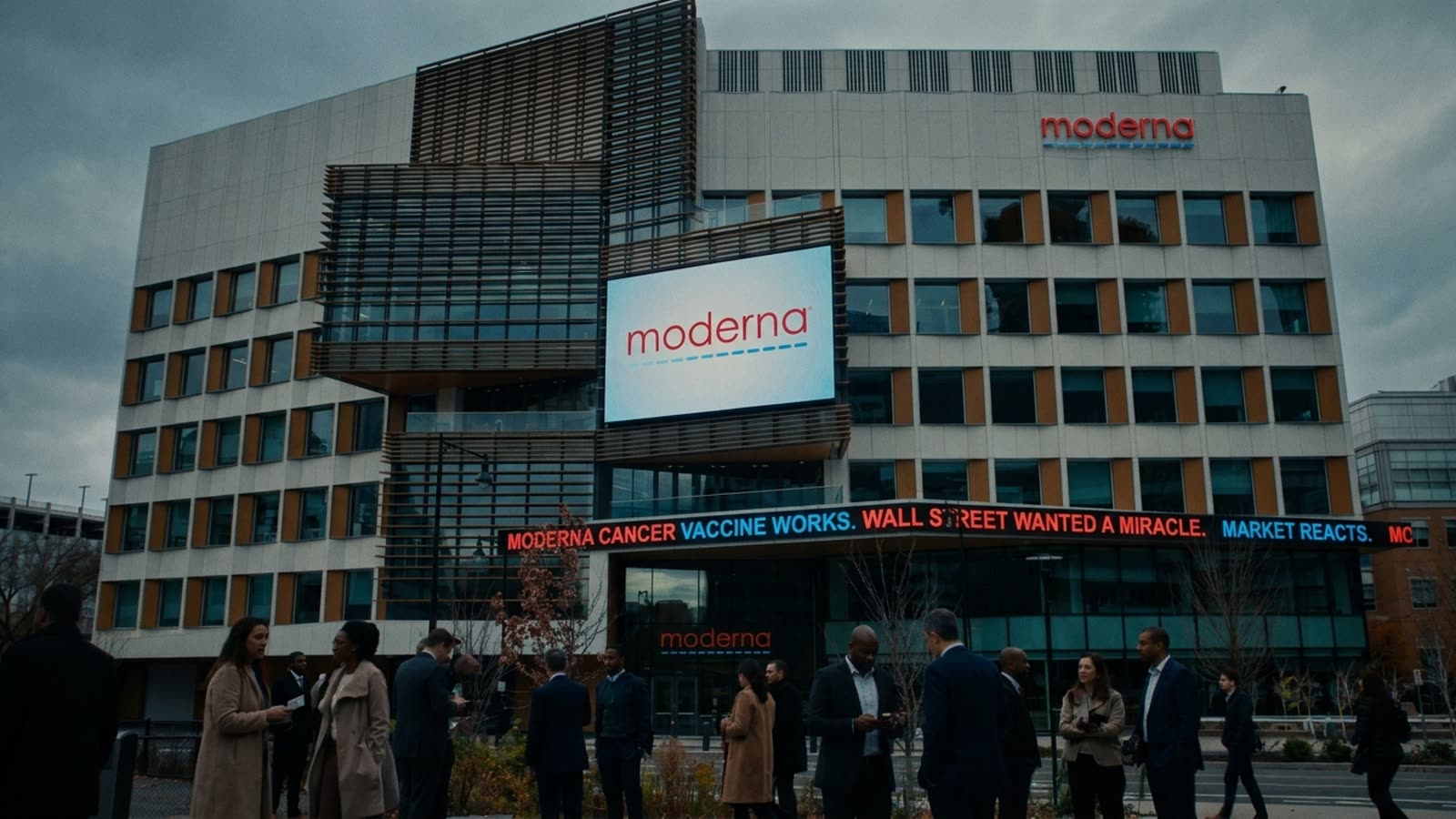
The data, by any clinical standard, is excellent. Moderna's experimental melanoma vaccine, developed in partnership with Merck, reduced the risk of cancer recurrence or death by 58 percent in late-stage trials. For patients facing one of the deadliest skin cancers, that number represents something close to a second chance at life. For Moderna shareholders, it represented a reason to sell.
The company's stock sank sharply after the results leaked, with investors apparently disappointed that the vaccine failed to clear the impossibly high bar that speculative positioning had set. Analysts had whispered about efficacy rates north of 65 percent; some bulls had modeled even more aggressive scenarios. When reality arrived at 58 percent—a figure that would make most oncology researchers weep with joy—the market responded with the cold logic of unmet expectations.
The expectations trap
Moderna finds itself caught in a peculiar purgatory. The company proved during the pandemic that mRNA technology could be manufactured at scale and deployed with unprecedented speed. That success created a valuation predicated not on solid incremental progress but on the assumption that Moderna would revolutionize multiple disease categories simultaneously. Cancer vaccines, respiratory syncytial virus, influenza, rare diseases—each pipeline candidate carries the weight of justifying a market capitalization built on Covid-era euphoria.
The melanoma results are genuinely promising. Personalized cancer vaccines that train the immune system to recognize tumor-specific mutations represent one of the most exciting frontiers in oncology. But "exciting" and "immediately accretive to earnings" are different things, and Moderna's investors have grown impatient with the distinction.
The biotech valuation problem
This dynamic extends well beyond one company. Biotech valuations have become increasingly disconnected from the grinding, probabilistic reality of drug development. Positive Phase 3 data that would have sent shares soaring a decade ago now triggers selloffs if the confidence intervals don't align with the most optimistic projections embedded in the stock price. The sector has trained investors to expect moonshots, then punishes companies for merely hitting doubles.
Moderna's cash position remains substantial, its pipeline deep, and its technology platform validated. The melanoma vaccine will likely proceed toward regulatory approval and eventual commercialization. None of that mattered on Thursday, when the only relevant question was whether 58 percent was bigger than the number traders had written on their napkins.
Our take
There is something faintly absurd about a market that treats a breakthrough cancer treatment as a disappointment because it failed to exceed whispered expectations. Moderna built a vaccine that meaningfully extends lives; the reward was a collapsing share price. This is the biotech sector's version of the hedonic treadmill—no matter how good the data, the goalpost has already moved. For long-term investors with the stomach for volatility, the disconnect between clinical reality and market sentiment may eventually resolve in their favor. For everyone else, it's a reminder that Wall Street and the oncology ward operate on very different definitions of success.