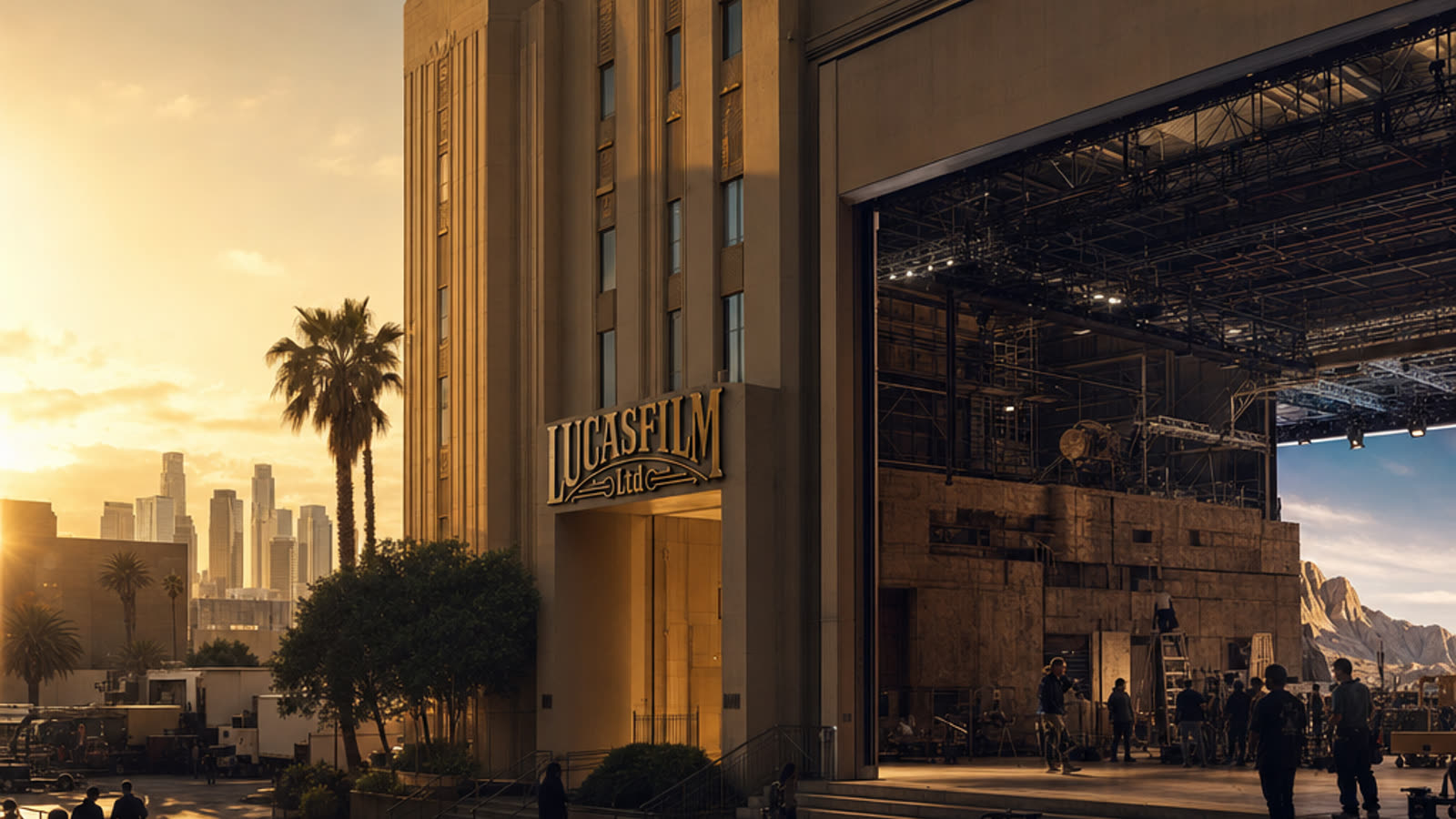
For a saga that invented the modern blockbuster, Star Wars has always been a tourist. Tunisia stood in for Tatooine. Norway doubled as Hoth. Pinewood Studios in England housed the Death Star's corridors. Even when Lucasfilm moved under Disney's roof in Burbank, production kept wandering—London, Atlanta, the Volume stages of Manhattan Beach. Now, nearly fifty years after George Lucas rolled cameras on the original, a Star Wars feature has finally been shot entirely in Los Angeles.
Jon Favreau's The Mandalorian and Grogu, which premiered at Cannes this week to divided but lively reactions, earned that distinction thanks to California's beefed-up film tax incentive. Favreau was blunt about the arithmetic: without the credit, the production would have landed elsewhere. The director thanked the California Film Commission on stage, a gesture that read less like civic boosterism and more like an acknowledgment that tentpole movies now migrate to whichever jurisdiction writes the fattest check.
The incentive arms race
California's film tax credit program, expanded repeatedly since 2014, now offers rebates of up to 25 percent on qualified spending, with additional bumps for productions that shoot outside the so-called studio zone. Georgia, the United Kingdom, Australia, and a half-dozen other jurisdictions have run similar or more aggressive schemes for years, siphoning work from Los Angeles even as the city remained the spiritual capital of the industry. That a Star Wars picture—owned by the most valuable entertainment company on Earth—needed a subsidy to stay local underscores how normalized the incentive calculus has become. Studios no longer ask where a story should be set; they ask where the math works.
What the early reactions say
Critics who caught the Cannes premiere are calling the film everything from "a thrilling adventure" and "a perfect summer movie" to "one of the weakest Star Wars movies" and, less charitably, "a snooze fest." The polarization is familiar territory for the franchise, which has not released a universally beloved theatrical entry since the original trilogy. What is new is the context: Disney is betting that theatrical Star Wars can coexist with streaming Star Wars, and that the goodwill built by The Mandalorian series translates to a two-hour, premium-ticket experience. Early box-office tracking suggests curiosity is high, but so is skepticism among fans who have grown accustomed to watching Din Djarin and Grogu on their sofas.
A franchise in search of direction
The Mandalorian and Grogu arrives at a moment when Star Wars is simultaneously everywhere and nowhere. The sequel trilogy ended in 2019 to mixed reception. Announced spinoffs have been delayed, reworked, or quietly shelved. Lucasfilm's leadership has cycled through creative executives and shifted strategy repeatedly. Favreau's corner of the galaxy—the interconnected streaming shows—has been the steadiest revenue engine, which is precisely why Disney elevated it to the big screen. Whether that elevation rejuvenates theatrical Star Wars or merely extends a television brand into a different format remains the open question.
Our take
The real headline is not that Mando and Grogu are back; it is that Los Angeles had to pay to keep them. When the home of Hollywood must compete with Tbilisi and Brisbane for its own flagship franchises, the industry's center of gravity has shifted in ways no amount of premiere-night glamour can obscure. The film itself may or may not satisfy the faithful, but its production story is a sharper drama: a parable about capital, loyalty, and the price of staying put.