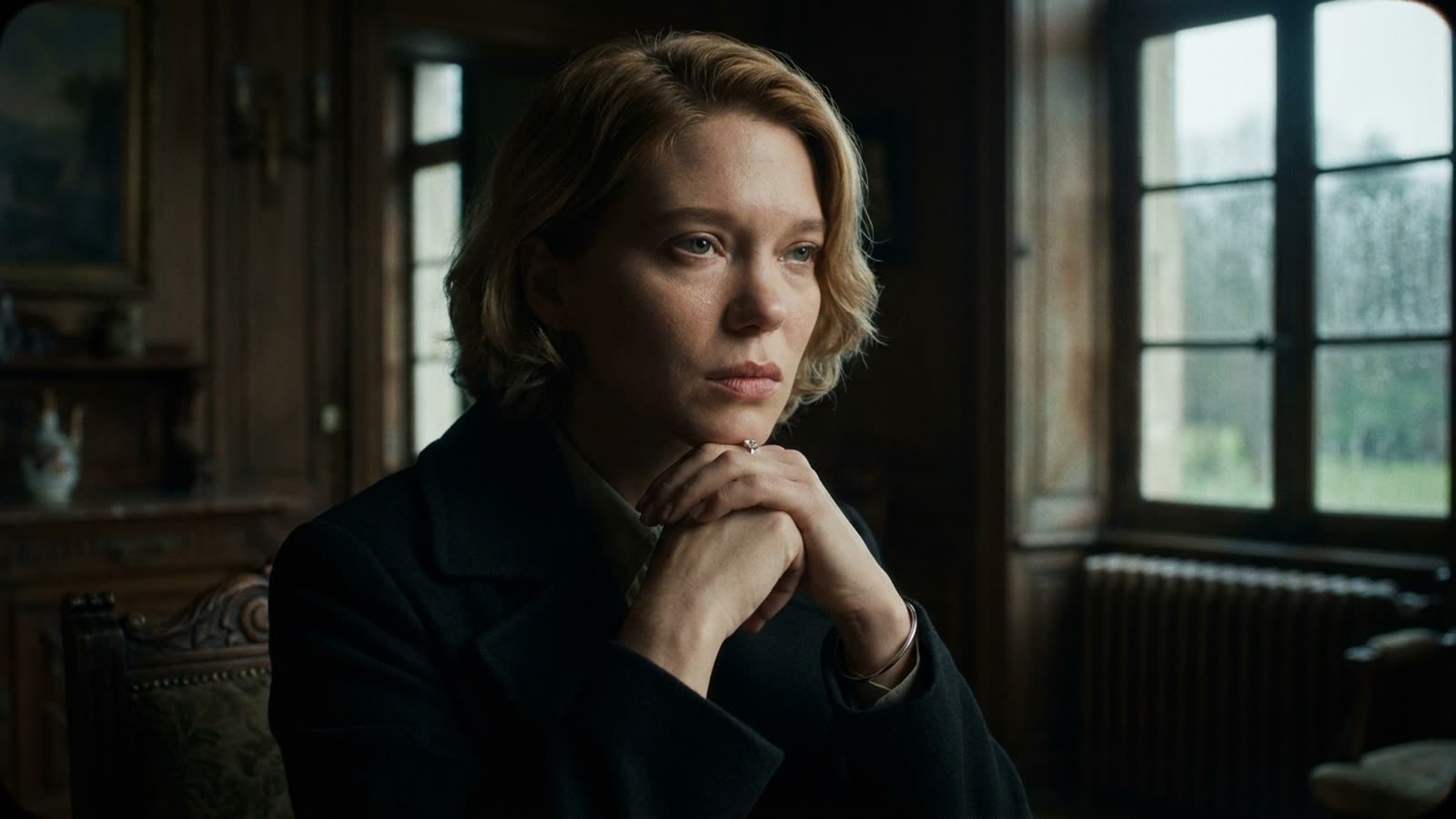
Marie Kreutzer has never been interested in comfort. The Austrian filmmaker who deconstructed royal mythology in "Corsage" returns to Cannes with "Gentle Monster," a family drama that treats domestic collapse like a slow-motion avalanche. Léa Seydoux anchors the film as a woman whose world implodes when she discovers her husband's dark secret, setting off a chain reaction that exposes the rot beneath bourgeois respectability.
The weight of revelation
Seydoux plays her role with characteristic restraint, allowing devastation to seep through micro-expressions rather than grand gestures. When her character learns what her husband has done (the film wisely delays this revelation), she doesn't scream or throw things. Instead, she sits very still, as if movement might cause her entire life to shatter. It's this stillness that gives the film its power. Kreutzer and cinematographer Judith Kaufmann frame Seydoux in increasingly claustrophobic compositions, using the architecture of the family home as a visual prison. Catherine Deneuve appears as the matriarch who has spent decades perfecting the art of not seeing what she doesn't want to see.
Beyond the nuclear family
What elevates "Gentle Monster" above typical domestic melodrama is Kreutzer's refusal to contain the damage. The husband's secret (revealed midway through as involving systematic abuse) doesn't just destroy one marriage; it forces three generations of women to confront their complicity in maintaining harmful structures. Laurence Rupp plays the husband with unsettling banality, while Jella Haase brings raw energy as a family friend who refuses to participate in collective amnesia. The film's 118-minute runtime feels both necessary and punishing, mirroring how trauma doesn't resolve itself in neat three-act structures.
Our take
Kreutzer has crafted something more complex than a #MeToo parable. "Gentle Monster" interrogates how families become accomplices to their own destruction, how love can coexist with monstrosity, and how the urge to preserve appearances can become its own form of violence. The film's bleakness will limit its commercial appeal, but Seydoux's performance and Kreutzer's formal control mark it as essential viewing for those willing to stare into uncomfortable truths. This is cinema as excavation, digging through layers of denial to find something harder than forgiveness: recognition.