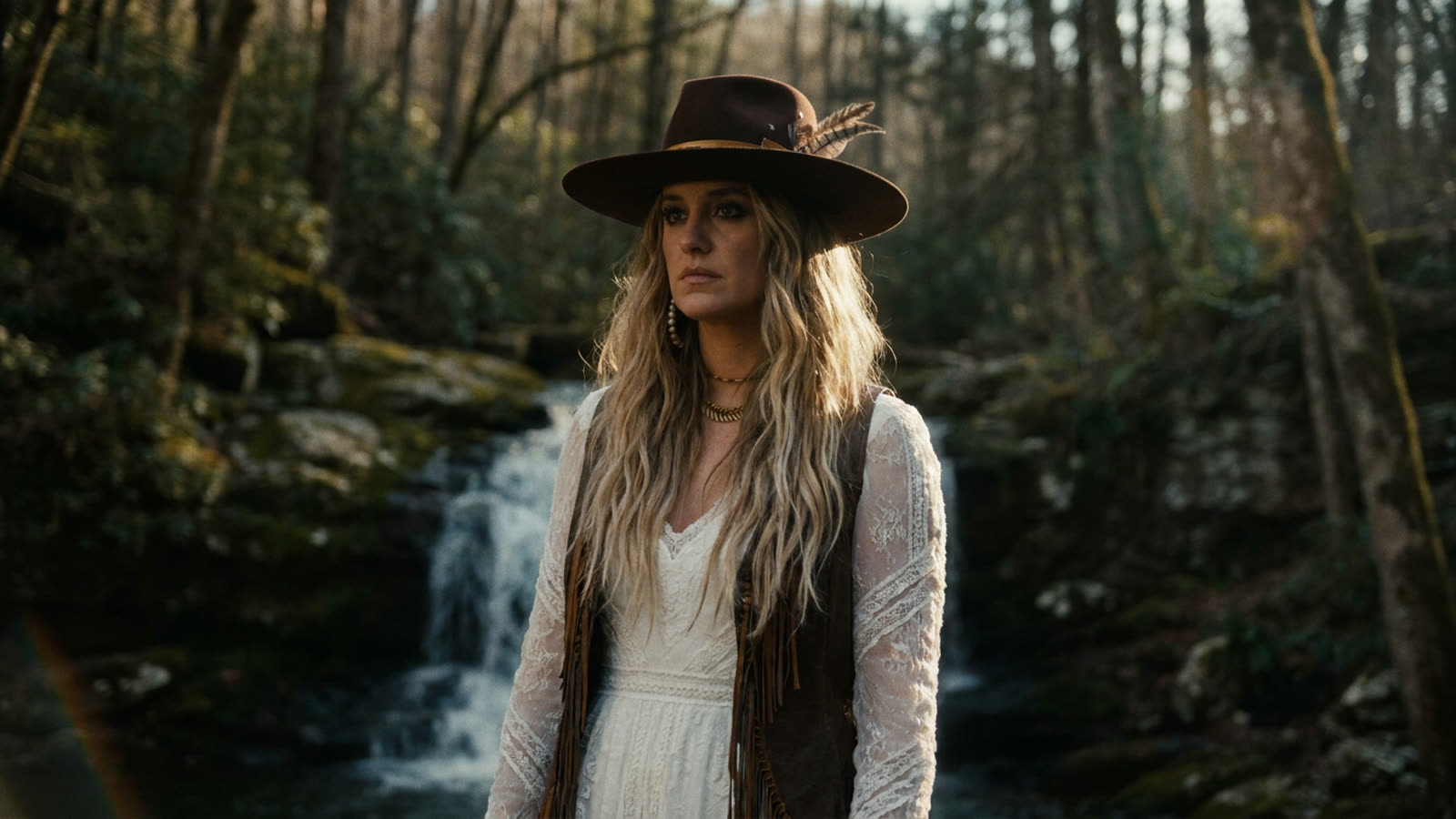
For a woman who once told interviewers she didn't own a single dress, walking down the aisle in one required more than romance—it required a reckoning with identity itself. Lainey Wilson, the Grammy-winning country singer whose aesthetic has become synonymous with vintage denim and cowboy boots, married Devlin "Duck" Hodges beneath a waterfall in the Tennessee hills wearing a custom Oscar de la Renta gown. The choice wasn't just a wedding decision; it was a statement about what happens when personal branding meets personal life.
Wilson has spent years cultivating an image that deliberately rejects the polished femininity expected of Nashville's leading ladies. Her bell-bottoms aren't a costume—they're a manifesto, a visual shorthand for the blue-collar authenticity she sings about. When she accepted her CMA Entertainer of the Year award, she did so in flared jeans. When she performed at the Super Bowl, same story. The dress-free existence became as much a part of her mythology as her Louisiana drawl.
The Oscar de la Renta factor
That Wilson chose Oscar de la Renta—a house synonymous with American occasion dressing and old-money elegance—signals something interesting about the current state of country music's relationship with fashion. The genre's biggest female stars have increasingly found themselves courted by luxury houses eager to tap into country's commercial surge. Wilson's wedding gown represents a kind of détente: she gets the craftsmanship and prestige of a storied atelier, while de la Renta gets proximity to the genre's most bankable new star.
The ceremony itself leaned into Wilson's established aesthetic even as the dress departed from it. A waterfall setting deep in Tennessee, far from Nashville's event spaces and their inevitable paparazzi. Hodges, the former Pittsburgh Steelers quarterback who became a folk hero during his brief NFL stint, reportedly wore boots. The guest list remained private.
What the dress means for the brand
Wilson's team has been careful to frame the gown as an exception rather than an evolution. The messaging around the wedding emphasizes that this was a singular moment, a once-in-a-lifetime concession to tradition and to the gravity of marriage itself. It's a smart play. The bell-bottoms will return for the next tour, the next awards show, the next album cycle. The dress becomes a kind of inverse publicity—proof that Wilson's casual uniform is a genuine choice rather than a limitation.
But there's also something refreshingly uncalculated about a woman in her early thirties deciding that her wedding day might warrant a departure from the personal brand she's spent a decade building. In an era when artists are coached to maintain visual consistency across every platform and appearance, Wilson's willingness to simply wear what she wanted to wear—even if it contradicted her image—reads as quietly radical.
Our take
The wedding dress is not the beginning of a Lainey Wilson rebrand, nor should anyone expect her to suddenly start showing up to the CMAs in couture. What it demonstrates is something more nuanced: that the most durable personal brands are the ones flexible enough to accommodate genuine human moments without collapsing under the weight of their own mythology. Wilson wore a dress because she was getting married and she wanted to. That's the whole story, and it's enough.