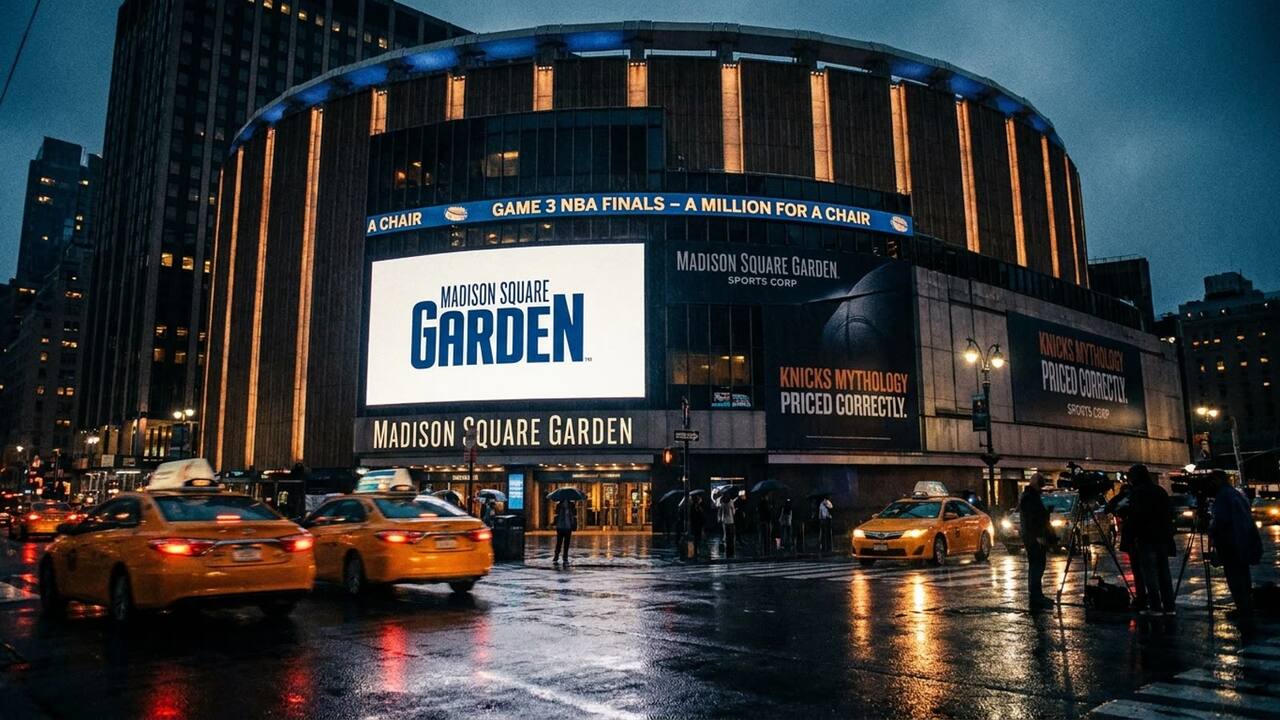
The winning bid for courtside seats at Monday's Knicks-Spurs Game 3 reportedly reached $1 million, a sum that would purchase a respectable apartment in most American cities but in Manhattan merely buys you four hours of proximity to Spike Lee's elbow and the right to be photographed looking nervous when Victor Wembanyama drives the lane.
The figure, first reported by ESPN, represents the high-water mark for NBA Finals ticket pricing in the post-pandemic era and perhaps the clearest possible illustration of what economists delicately call "Veblen goods" — items whose appeal increases precisely because they cost more. Nobody needs to sit courtside. The view from the lower bowl is arguably better. But the view from the lower bowl doesn't get you on the broadcast, and in 2026, being seen has its own elaborate economy.
The Garden premium
Madison Square Garden has always charged a tax for sentimentality. The arena is cramped by modern standards, its sightlines compromised, its concourses narrow. What it offers instead is density — of history, of celebrity, of the particular New York conviction that events matter more when they happen here. The Knicks haven't won a championship since 1973, a drought that would have bankrupted the mythology of most franchises. Instead, it has somehow inflated it. Scarcity, real estate agents will tell you, creates value.
The million-dollar seats exist in a different market than ordinary tickets. They are not really sports purchases at all but rather access purchases, the kind of transaction more familiar to art auctions and political fundraisers. The buyer — whose identity has not been disclosed — is purchasing adjacency to a cultural moment, a photograph, a story to tell at the next dinner party. The basketball is almost incidental.
What the number actually means
Secondary-market data suggests the average resale price for Game 3 lower-bowl seats hovered around $8,500, itself a record for a non-closeout Finals game. The gap between that figure and the celebrity-row bid — roughly 117 times higher — illustrates the peculiar economics of front-row seating. You are not paying for a better view of the game. You are paying for the game to have a better view of you.
This is not new, exactly. Jack Nicholson's Lakers seats were famous long before Instagram existed. But the formalization of the market — the existence of a "winning bid" rather than a quiet arrangement with the team — suggests something has shifted. Courtside access has become a tradable asset, its price discovered through auction rather than relationship. The Knicks, to their credit or their shame, have simply made the transaction transparent.
Our take
There is something almost admirable about the honesty of a million-dollar ticket. It dispenses with the polite fiction that professional sports are primarily about athletic competition rather than spectacle, status, and the ancient human desire to be present when something memorable happens. The Knicks are selling proximity to history — or at least to the possibility of history — and someone decided that possibility was worth seven figures. Whether the basketball justifies the price is, as it has always been, entirely beside the point.