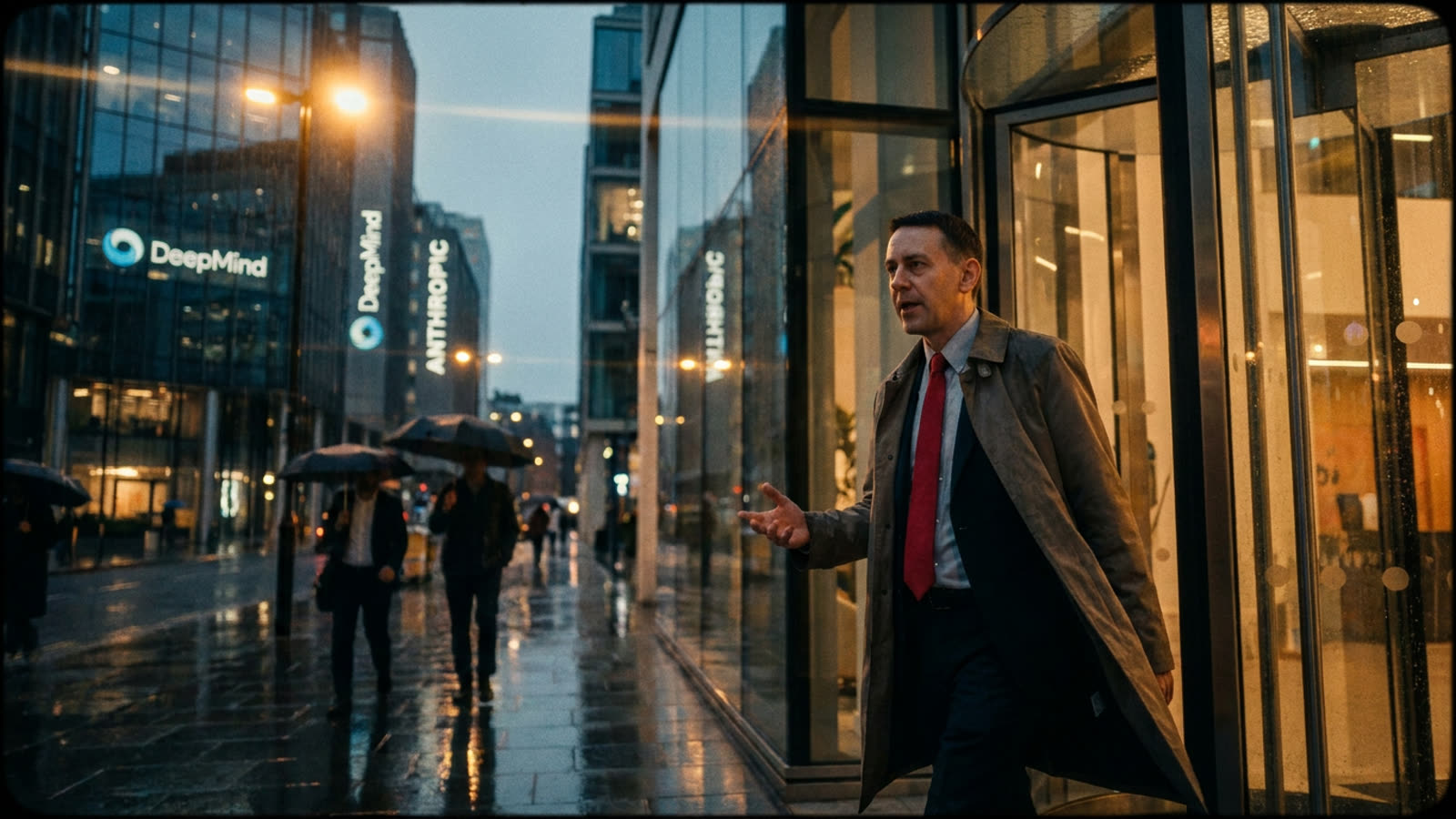
The most decorated scientist in artificial intelligence is switching sides, and the implications extend far beyond a single hire.
John Jumper, the computational biologist who led DeepMind's AlphaFold project and shared the 2024 Nobel Prize in Chemistry for revolutionizing protein structure prediction, is departing Google's AI research division for Anthropic, the safety-focused startup founded by former OpenAI executives. The move represents perhaps the highest-profile defection in the brief but intense history of the AI talent wars — and it arrives at a moment when the philosophical divide between the industry's major players has never been starker.
Why Jumper matters beyond the Nobel
AlphaFold was not merely a technical achievement; it was proof that deep learning could solve problems that had stumped biologists for half a century. The system's ability to predict how proteins fold from their amino acid sequences has since been applied to drug discovery, enzyme design, and basic biological research worldwide. Jumper was the project's technical leader and its public face, the rare AI researcher whose work translated directly into something the broader scientific community could immediately use.
His departure strips DeepMind of irreplaceable institutional knowledge. More significantly, it suggests that even researchers who have achieved the field's highest recognition are questioning whether Google's approach to AI development aligns with their values. DeepMind has long positioned itself as the thinking person's AI lab, more interested in fundamental breakthroughs than chatbot market share. If that narrative no longer holds for its own Nobel laureate, it may not hold at all.
The Anthropic pitch
Anthropic has built its identity around the premise that AI systems are becoming powerful enough to pose genuine risks, and that the companies building them have a responsibility to understand those risks before they materialize. The company's founders, Dario and Daniela Amodei, left OpenAI in 2021 over disagreements about safety practices and commercialization speed.
For a scientist of Jumper's stature, the appeal is likely less about safety rhetoric than about research freedom. Anthropic has reportedly offered him latitude to build a biological AI research program from scratch, unconstrained by the product pressures that increasingly define life at Google. The company's recent regulatory troubles — including a Trump administration directive restricting access to certain Claude models — have paradoxically enhanced its credibility among researchers who view government scrutiny as evidence that the work matters.
What Google loses
DeepMind has suffered high-profile departures before, but none quite like this. Previous exits involved executives or researchers who left to start their own ventures or joined competitors for financial reasons. Jumper's move carries a different valence: he is leaving a lab that made him famous, that gave him the resources to win a Nobel Prize, for a smaller organization with a fraction of the compute budget.
The message to DeepMind's remaining talent is unmistakable. If the lab cannot retain the person who delivered its greatest scientific triumph, who can it retain? Google has reportedly begun circulating retention packages to senior researchers, a tacit admission that the Jumper defection has spooked the ranks.
Our take
Talent follows conviction, and conviction in AI increasingly means choosing a side. Jumper's departure suggests that the field's most serious scientists are growing uncomfortable with the ambiguity of working inside a search advertising company, however prestigious its research arm. Anthropic may be smaller, more precarious, and more politically exposed, but it has something Google cannot easily manufacture: a coherent story about why the work matters beyond quarterly earnings. That story just got considerably more credible.