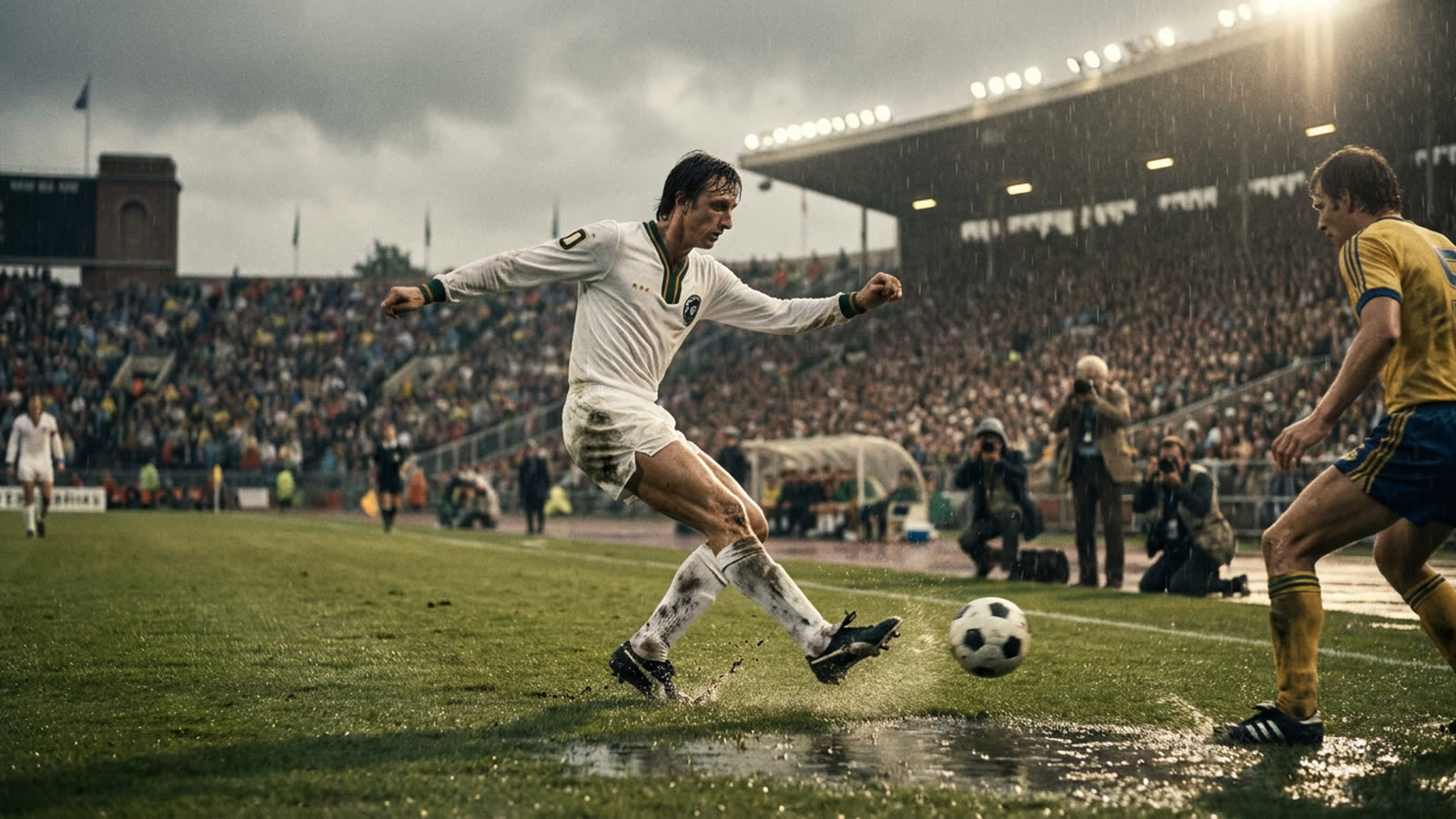
Football's most influential moment contains no goal. On June 19, 1974, in Dortmund's Westfalenstadion, Johan Cruyff received the ball with his back to goal, Swedish defender Jan Olsson closing tight. What happened next took perhaps 0.7 seconds: Cruyff shaped to cross, dragged the ball behind his standing leg with his instep, pivoted 180 degrees, and accelerated into the space Olsson had just vacated. The defender lunged at air. The crowd gasped. A move that had no name suddenly needed one.
The Cruyff Turn was not invented that afternoon—Cruyff himself had used variations for years, and similar feints existed in South American football—but its execution on the World Cup stage, captured by global television, crystallized something larger. Here was proof that football's highest currency was not pace or power but the ability to make an opponent's brain lag behind reality.
The geometry of deception
What makes the turn endure is its elegant economy. It requires no exceptional speed, no unusual flexibility, no years of specialized drilling. A competent youth player can learn the mechanics in an afternoon. Yet its effectiveness depends entirely on selling the fake—the exaggerated wind-up of the crossing motion, the weight shift that commits the defender, the precise timing that exploits the millisecond gap between stimulus and response. Cruyff understood that football is played in opponents' minds before it is played on grass.
The move also embodied the Dutch philosophy Cruyff would later codify as a manager: space is created, not found. Olsson was not poorly positioned; he was exactly where defensive logic demanded. Cruyff simply rejected the premise that the space in front of him was the only space available. By manufacturing a new angle, he turned a cul-de-sac into a highway.
A pedagogy in miniature
Cruyff's subsequent career as Barcelona's architect—first as a player, then as the manager who built the Dream Team, finally as the spiritual godfather of La Masia—can be read as an extended footnote to that Dortmund feint. The principles are identical: intelligence over industry, positional superiority over physical dominance, the conviction that football should be played with the ball, not despite it. Pep Guardiola, who played under Cruyff and has spent two decades refining his ideas, once noted that everything he knows about the game traces back to conversations in the Camp Nou tunnel.
The turn's influence extends beyond tactics into aesthetics. It established that football could be beautiful not merely in its outcomes but in its processes—that a defender left grasping at nothing was as satisfying as a goal. This was not universally accepted in 1974, when British and German football still valorized directness and effort. Cruyff's Netherlands lost that World Cup final to the hosts, but they won the longer argument about what the sport should aspire to be.
Our take
The Cruyff Turn endures because it answers a question every sport eventually asks: what separates the great from the merely excellent? In football, the answer is rarely physical. The margins at the top are too small, the athletes too finely tuned. What remains is cognition—the ability to see a pass before it exists, to understand where a defender will be rather than where he is. Cruyff, in less than a second, demonstrated that the brain is the most important muscle on the pitch. Half a century later, every academy in the world is still teaching that lesson.