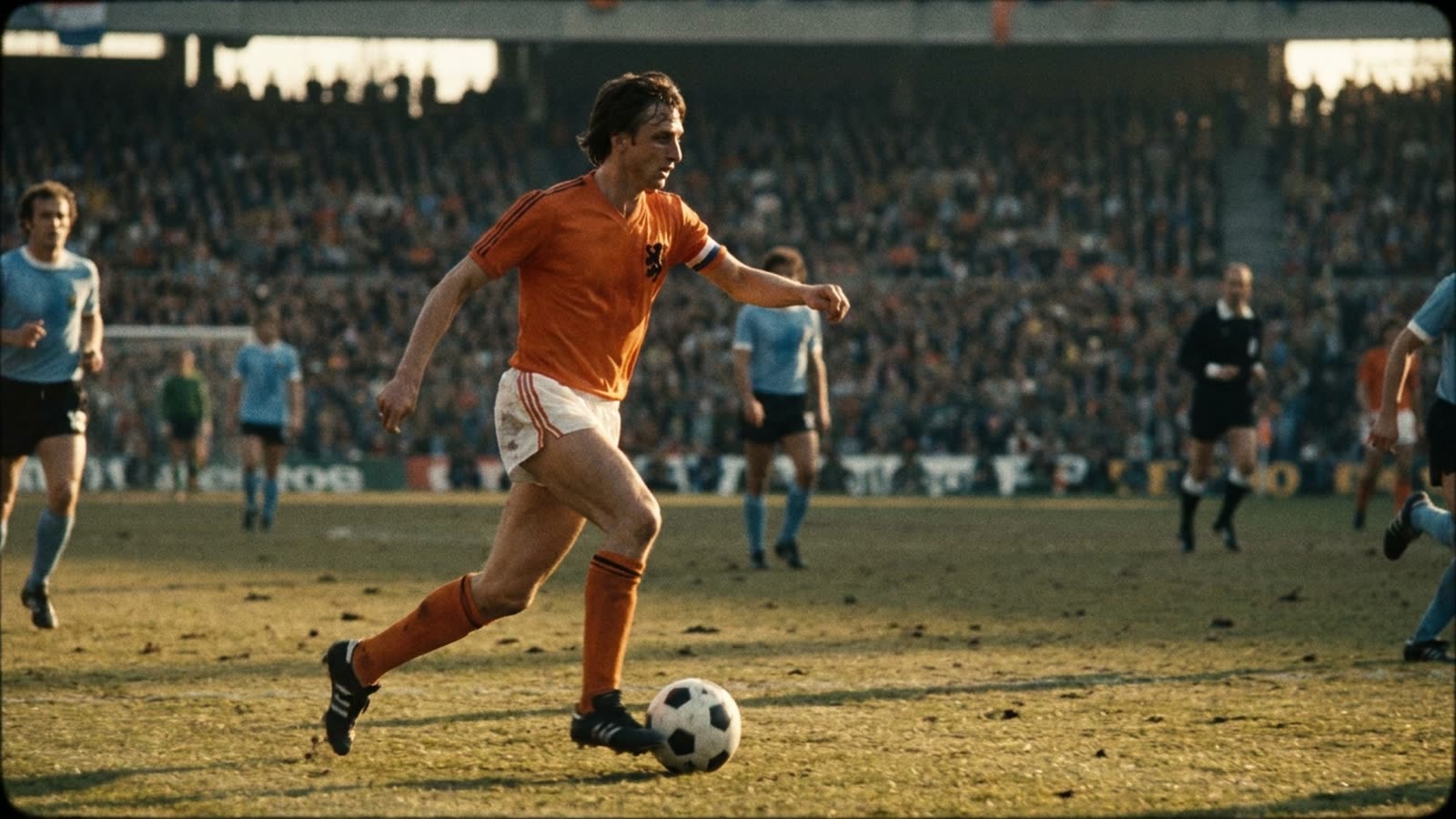
There is a particular kind of genius that doesn't merely excel within existing rules but exposes those rules as arbitrary constraints. Johann Sebastian Bach did this with counterpoint. Coco Chanel did it with women's fashion. And Johan Cruyff did it with football, a sport that had existed for a century before he arrived and has spent the decades since his departure trying to fully absorb what he demonstrated.
The Cruyff Turn—that balletic feint where he dragged the ball behind his standing leg and pivoted away from a bewildered Swedish defender at the 1974 World Cup—remains the most famous single piece of skill in football history. But reducing Cruyff to that moment is like reducing Einstein to E=mc². The turn was merely the visible expression of a deeper revolution: the radical proposition that football space is not fixed but created, that a player's position on the pitch matters less than his movement through it, and that the beautiful and the effective are not opposing values but the same value.
The philosopher who could actually play
Cruyff was not the first footballer to think deeply about the game. But he was perhaps the first whose physical gifts matched his intellectual ambitions. At Ajax and Barcelona, he played as a nominal center-forward who might appear anywhere—dropping into midfield, drifting to the wings, occasionally defending. This was not indiscipline but its opposite: a systematic rejection of the rigid positional football that had dominated the sport since the 1930s.
What made Cruyff singular was his ability to articulate what he intuited. "Playing football is very simple," he once observed, "but playing simple football is the hardest thing there is." This was not false modesty. He understood that the apparent complexity of football—twenty-two players, infinite possible positions, constant motion—actually concealed a simpler underlying logic. Find space, create passing angles, move the ball faster than defenders can adjust. Everything else was ornamentation.
Total Football and its discontents
The Dutch national team of 1974, with Cruyff as its avatar, introduced the world to "Total Football"—a system where any outfield player could occupy any position, where the goalkeeper swept behind a high defensive line, where possession was not merely a means to scoring but an end in itself. They lost the final to West Germany, a result that has somehow only burnished their legend. Winning, after all, is common. Changing how people see is rare.
The influence proved more durable than any trophy. When Cruyff became Barcelona's manager in the late 1980s, he built the team that would evolve into Pep Guardiola's tiki-taka dynasty. Guardiola played under Cruyff, managed the youth academy Cruyff created, and has spent his subsequent career at Bayern Munich and Manchester City essentially writing elaborate footnotes to Cruyff's original thesis. The possession-based football that has dominated the Champions League for two decades is Cruyff's football, refined but not fundamentally altered.
Our take
The deepest compliment one can pay Cruyff is that his ideas now seem obvious. Of course space matters more than position. Of course the best teams control the ball. Of course beauty and effectiveness converge at the highest level. But these insights were not obvious before he made them so. He saw football clearly, and then he made the rest of us see it too. That is not merely athletic greatness. That is something closer to art.