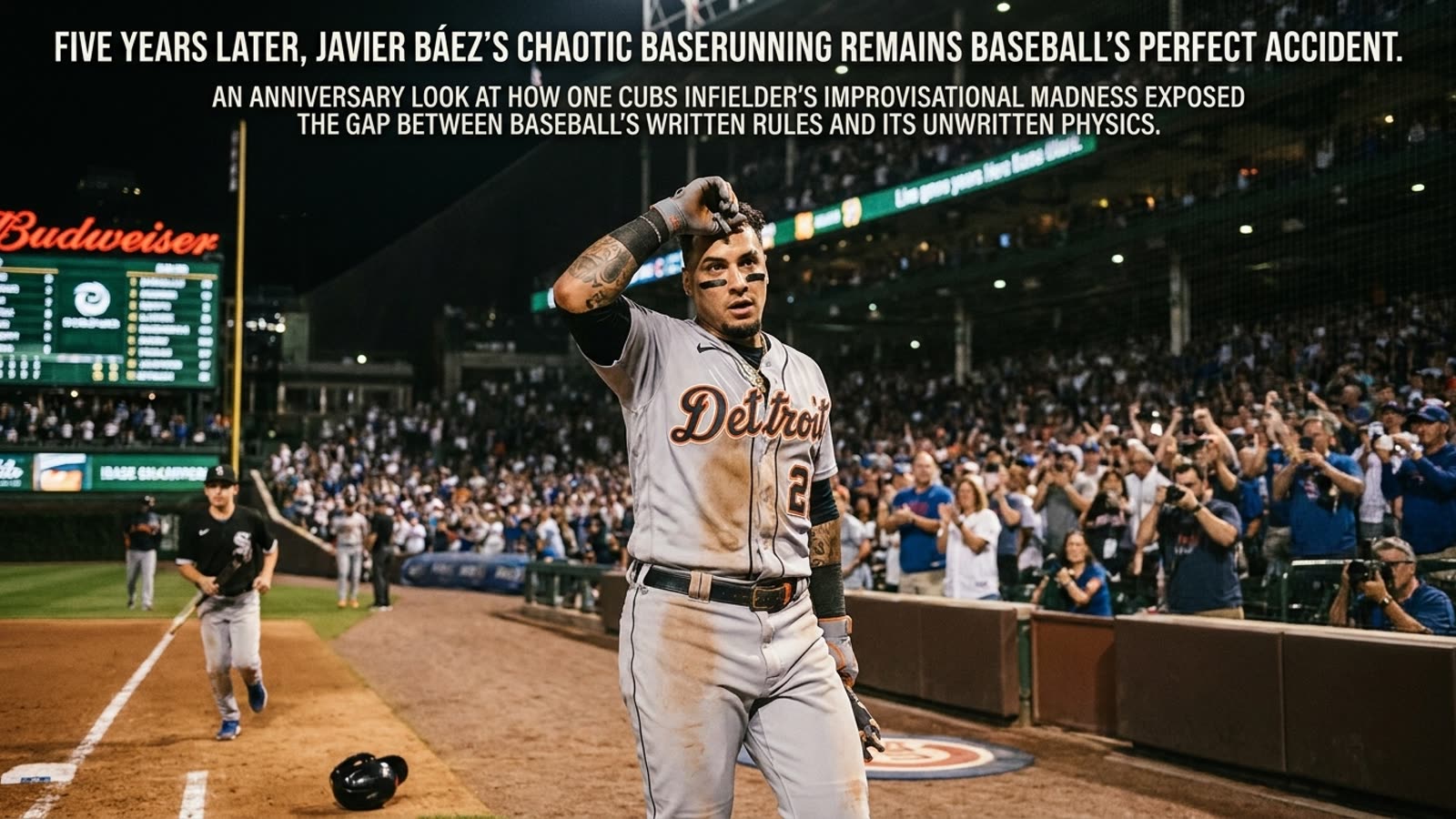
On May 27, 2021, Javier Báez did something that shouldn't have worked. Trapped between third base and home plate against the Pirates, he initiated a rundown so absurdly prolonged, so flagrantly chaotic, that it collapsed Pittsburgh's defensive coherence entirely. By the time the dust settled, the Cubs had scored two runs on a play that featured no hits, multiple throwing errors, and Báez himself dancing between bases like a man who had discovered baseball's cheat code.
The anniversary matters because the play hasn't aged. If anything, it has calcified into something approaching mythology—a reminder that baseball, despite its obsession with analytics and optimization, still contains vast territories of improvisation that no spreadsheet can map.
The anatomy of controlled chaos
What made the play extraordinary wasn't just Báez's athleticism. It was his apparent understanding that defensive players, conditioned to execute rundowns through rote repetition, would short-circuit when confronted with someone who refused to follow the script. He ran toward fielders instead of away from them. He stopped when he should have sprinted. He created so many decision points that the Pirates' infield essentially suffered a collective processing failure.
The final sequence—Báez retreating to third while Willson Contreras scored, then advancing home himself when the throw sailed into left field—looked like slapstick. It was actually game theory performed at sprint speed.
Why it still resonates
Baseball in 2026 is more systematized than ever. Shifts are regulated, pitch clocks enforced, and defensive positioning increasingly dictated by front-office algorithms. The Báez play endures precisely because it represents the opposite impulse: a player trusting instinct over instruction, creating value through chaos rather than order.
Báez himself has had an uneven career since leaving Chicago, his aggressive approach at the plate often working against him. But the baserunning play transcends his statistical profile. It's become a teaching tool, a viral clip, and a philosophical statement about the limits of preparation.
Our take
Some plays are great because they're perfect. The Báez rundown is great because it's perfectly imperfect—a glorious mess that succeeded by embracing uncertainty rather than eliminating it. Five years on, it remains the best argument that baseball's most memorable moments often come from players who treat the rulebook as a suggestion rather than a constraint. In an era of optimization, that's worth celebrating.