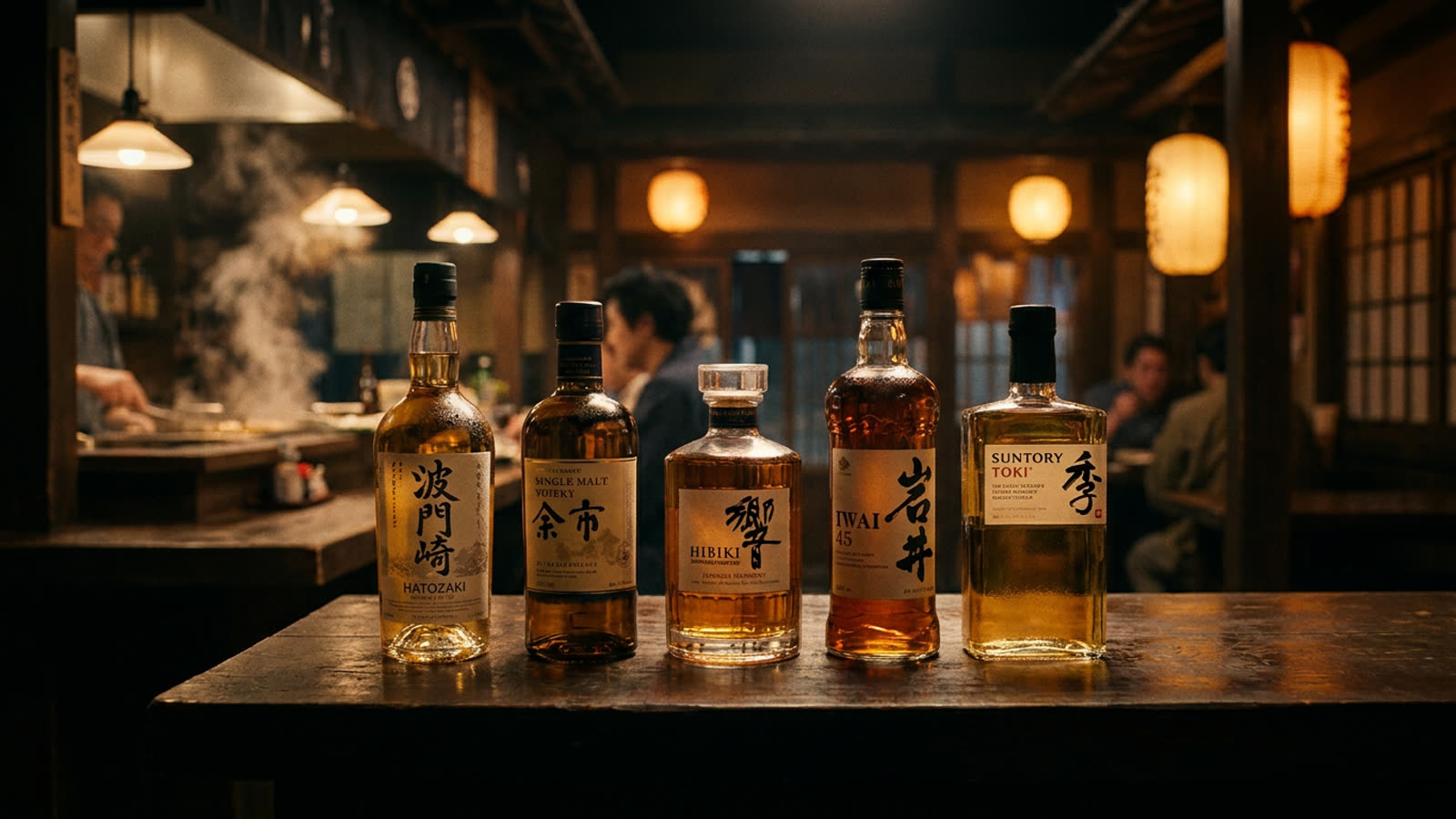
The most valuable bottles of whisky in the world are not Scottish. They are Japanese, and they were never supposed to leave Japan at all.
This is the central paradox of Japanese whisky's global dominance: an industry built on domestic consumption, with no interest in export markets, became the most sought-after spirit category precisely because it seemed indifferent to foreign attention. While Scottish distilleries spent decades building international distribution networks and American bourbon marketed itself as the democratic drink of the everyman, Japanese producers did something far more radical. They made exceptional whisky, sold it locally at reasonable prices, and assumed the rest of the world would never notice.
The accidental scarcity
The Japanese whisky shortage that began in the early 2010s was not a marketing strategy. It was a miscalculation of historic proportions. During the 1980s and 1990s, domestic consumption collapsed as younger Japanese drinkers abandoned whisky for shochu, beer, and wine. Distilleries mothballed production, reduced inventory, and in some cases shut down entirely. Suntory and Nikka, the industry's twin giants, dramatically scaled back their aging stocks.
Then the awards started arriving. International competitions began recognizing Japanese single malts as equals or superiors to the finest Scottish expressions. Western bartenders discovered the elegant, balanced profiles that had been perfected for Japanese palates. By the time global demand materialized, there was almost nothing left to sell. Age-stated expressions vanished from shelves. Prices quintupled, then quintupled again. A bottle of Yamazaki 18-Year-Old that once retailed for modest sums became a collector's item commanding thousands.
The philosophy of restraint
What makes Japanese whisky distinctive is not merely technique but temperament. The founding mythology centers on Masataka Taketsuru, who traveled to Scotland in 1918 to learn distillation, returned home, and spent the rest of his life adapting those methods to Japanese sensibilities. But adaptation is too weak a word. Japanese distillers pursued a different aesthetic entirely—one that prized harmony over intensity, subtlety over statement.
This philosophy extended to business practices. Unlike Scottish distilleries, which freely trade casks and share resources, Japanese producers historically operated in isolation. Suntory and Nikka built their own cooperages, grew their own barley, and refused to sell whisky to competitors. The result was vertical integration so complete that each company developed entirely distinct house styles, with no cross-pollination. What looked like corporate rivalry was actually a form of artistic purity.
The authenticity question
Success brought complications. As demand outstripped supply, a secondary market emerged for products labeled "Japanese whisky" that contained significant portions of imported Scottish or Canadian spirit. The category had no legal definition, no protected designation of origin, no regulatory framework to prevent opportunists from bottling foreign whisky with Japanese labels and selling it at premium prices.
The industry's response was characteristically Japanese: self-regulation through consensus. Major producers voluntarily adopted stricter standards, requiring that whisky labeled as Japanese be distilled, aged, and bottled entirely within the country. The standards have no legal force, but reputational pressure in a culture that prizes authenticity has proven remarkably effective. The question of what constitutes "real" Japanese whisky remains contested, but the conversation itself reflects an industry grappling seriously with its own identity.
Our take
Japanese whisky's triumph offers a counterintuitive lesson for an era obsessed with growth hacking and viral marketing: sometimes the most powerful brand strategy is having no strategy at all. The category's mystique derives entirely from genuine scarcity, authentic craftsmanship, and a century of producers who cared more about the liquid in the bottle than the logo on the label. That this indifference to global markets produced the most globally coveted spirit is either a beautiful accident or proof that quality, given enough time, markets itself. The cynical reading is that Japanese distillers have now learned to weaponize their own mythology. The generous reading is that they still do not care what we think. Both readings might be true.