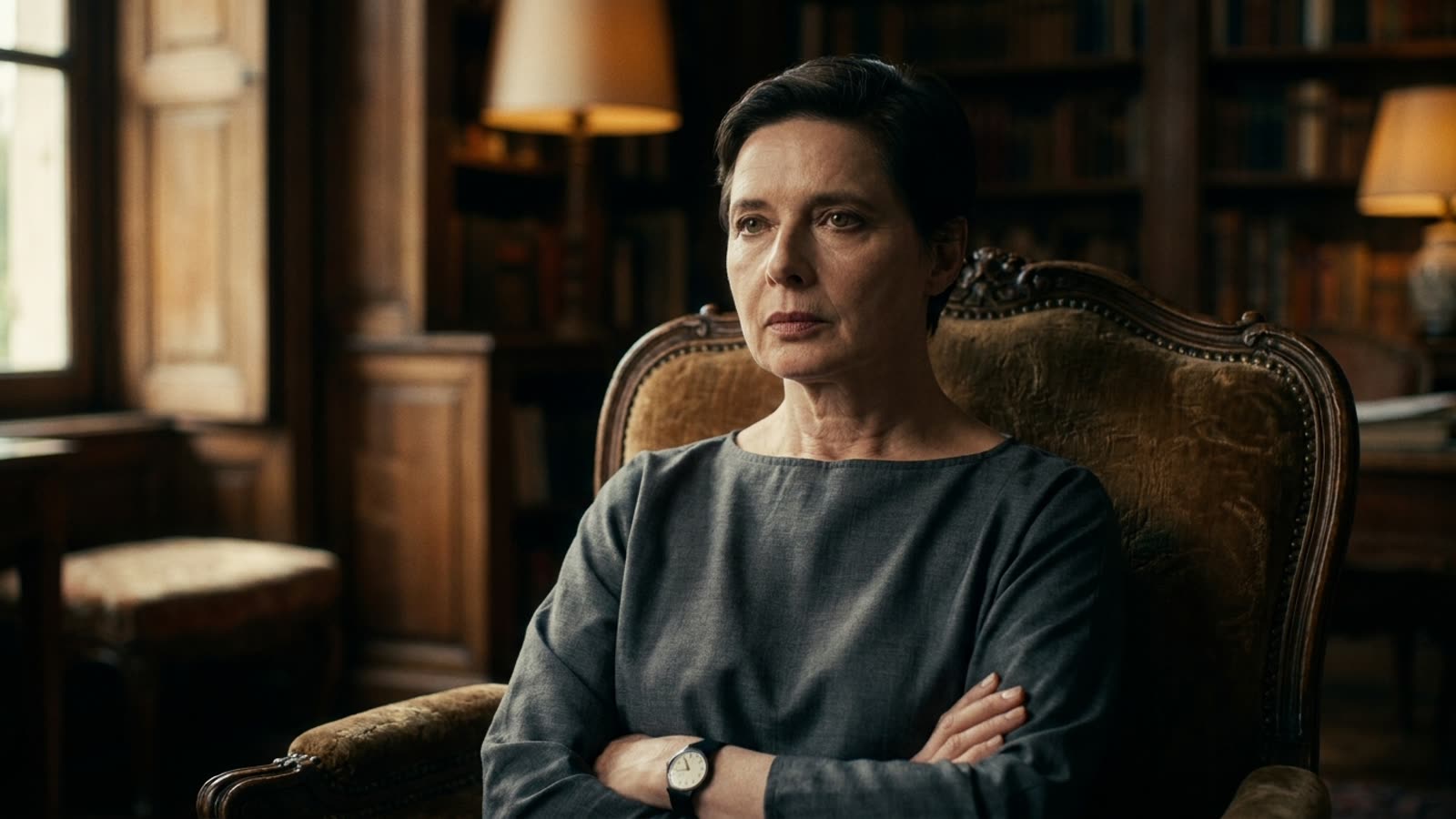
The Locarno Film Festival has announced that Isabella Rossellini will receive its Excellence Award this August, a recognition that arrives not as a lifetime achievement afterthought but as a real-time acknowledgment of an artist operating at peak creative velocity.
The festival's statement called her "joyfully unconventional, consistently brilliant" — language that captures something essential about Rossellini's refusal to follow the trajectory Hollywood typically scripts for its leading ladies. Where the industry tends to shuffle aging actresses toward grandmother roles and prestige limited series, Rossellini has spent the past decade building an entirely different kind of career.
The Conclave effect
Her Oscar-nominated turn as a shrewd nun in Edward Berger's papal thriller last year wasn't a comeback so much as a coronation. Rossellini had never stopped working, but "Conclave" reminded audiences and executives alike that she possesses something rarer than beauty or even talent: the ability to command attention through sheer presence. The film grossed over $150 million worldwide and earned her first Academy Award nomination since — remarkably — never. She had somehow gone her entire career without one.
That changed at 72, an age when most actresses are considered commercially invisible. The nomination led directly to her casting in Alice Rohrwacher's upcoming film, continuing a collaboration with European auteurs that has defined her recent work.
A European homecoming
Locarno's choice feels particularly apt given Rossellini's lineage. The daughter of Ingrid Bergman and Roberto Rossellini, she has always existed at the intersection of Hollywood glamour and European art cinema. Her father essentially invented Italian neorealism; her mother abandoned a studio contract to make films with him, scandalizing 1950s America in the process.
Isabella inherited both their beauty and their willingness to confound expectations. After a modeling career that made her one of the most recognizable faces of the 1980s, she pivoted to acting and immediately sought out directors like David Lynch, who cast her in "Blue Velvet" — a film that remains genuinely disturbing nearly four decades later. She could have coasted on cosmetics contracts. Instead, she chose Dennis Hopper inhaling nitrous oxide.
The age question
What makes Rossellini's current moment significant extends beyond her individual achievements. She represents a small but growing cohort of actresses in their sixties and seventies who are finding that the industry's rigid age hierarchies have begun, ever so slightly, to crack. Michelle Yeoh won an Oscar at 60. Jamie Lee Curtis at 64. The success of these performers hasn't revolutionized casting practices, but it has created space for stories that acknowledge women don't simply evaporate after menopause.
Rossellini has been characteristically direct about the absurdity of age discrimination in Hollywood. "They didn't fire me because I ugly," she once said of Lancôme's decision to drop her as a spokesmodel at 42. "They fired me because I old." The company eventually rehired her at 63, a reversal that said more about shifting consumer demographics than any moral awakening.
Our take
Locarno's Excellence Award typically honors figures whose influence on cinema is beyond dispute. Rossellini qualifies, but what makes this particular recognition feel timely rather than valedictory is the sense that she's still ascending. At 73, she has an Oscar campaign behind her, an Alice Rohrwacher film ahead, and the kind of cultural cachet that younger actresses spend entire careers trying to manufacture. The award isn't celebrating what she was. It's acknowledging what she's becoming.