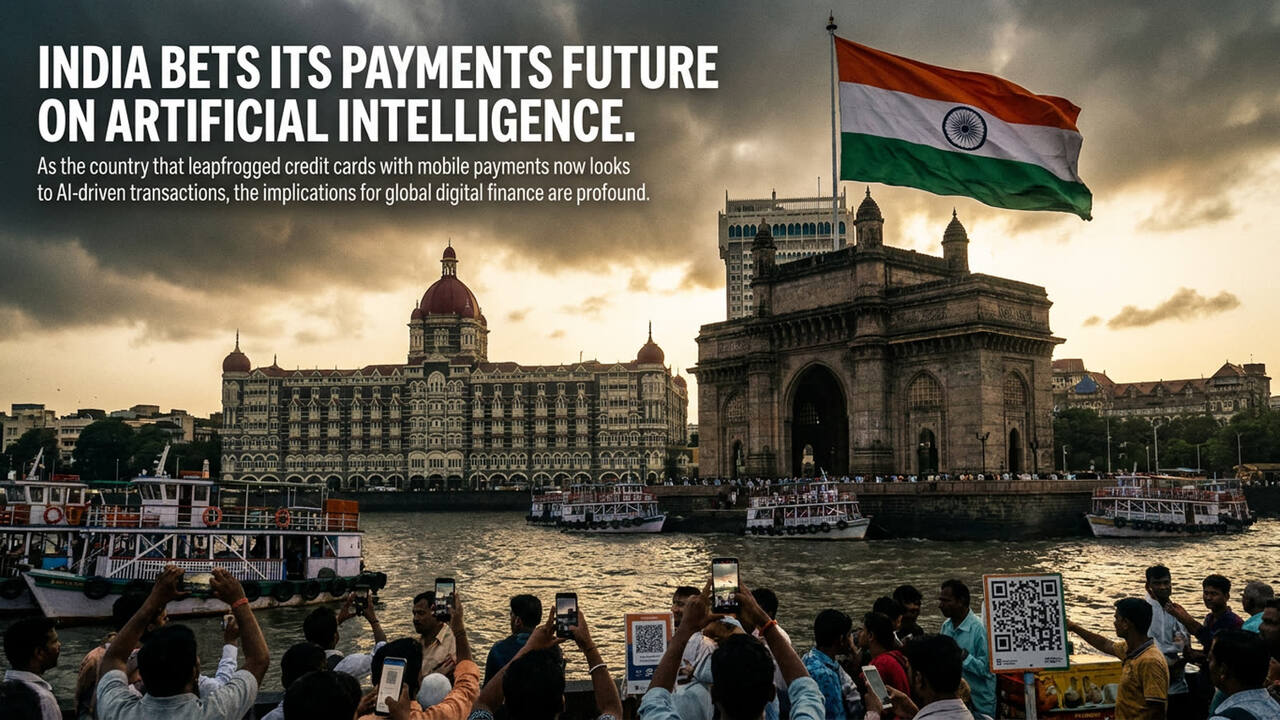
India's top payments regulator believes artificial intelligence will fundamentally reshape how the country's 1.4 billion people move money—and if the past decade is any guide, the rest of the world should pay attention.
The statement, from a senior official overseeing India's digital payments infrastructure, signals that the next phase of the country's fintech revolution will be built on machine learning and predictive systems rather than simply expanding the mobile rails that already process billions of transactions monthly. It's a logical evolution for a nation that effectively skipped the credit card era entirely, vaulting from cash to smartphone payments through the Unified Payments Interface in ways that left Western banking executives scrambling to understand what happened.
The scale beneath the ambition
India's UPI processed over 14 billion transactions in a single month earlier this year, dwarfing the combined volume of Visa and Mastercard in the country. That infrastructure—free, instant, interoperable—created the foundation. Now the question is what gets built on top of it.
AI integration could mean fraud detection systems that operate in real-time across hundreds of millions of daily transactions, credit scoring for the unbanked based on payment behavior rather than traditional financial history, and automated merchant services that eliminate the friction of small business finance. The technology exists; India's unique position is having the transaction volume and regulatory willingness to deploy it at population scale.
Why this matters beyond India
The country has become an unlikely laboratory for digital finance. Its success with UPI has already inspired similar systems in Singapore, the UAE, and parts of Africa. If AI-enhanced payments work at Indian scale—with all the complexity of multiple languages, rural connectivity challenges, and a merchant base ranging from street vendors to multinational corporations—the model becomes exportable.
Western financial institutions, still wrestling with legacy systems and regulatory fragmentation, may find themselves studying New Delhi's approach the way they once studied Silicon Valley's. The irony is not lost on anyone: the country that was supposed to be a developing market is now piloting the infrastructure that developed markets cannot seem to build.
Our take
India's payments chief is making a bet that sounds obvious but is actually quite bold: that AI can be deployed responsibly in financial infrastructure serving a billion people, most of whom have no recourse if the systems fail. The country's track record suggests it might pull this off. The UPI experiment worked not because India had better technology, but because it had the regulatory courage to mandate interoperability and the political will to make digital payments a public good rather than a private toll road. If that same approach extends to AI—treating it as infrastructure rather than product—India may once again show the world something it didn't know it needed.