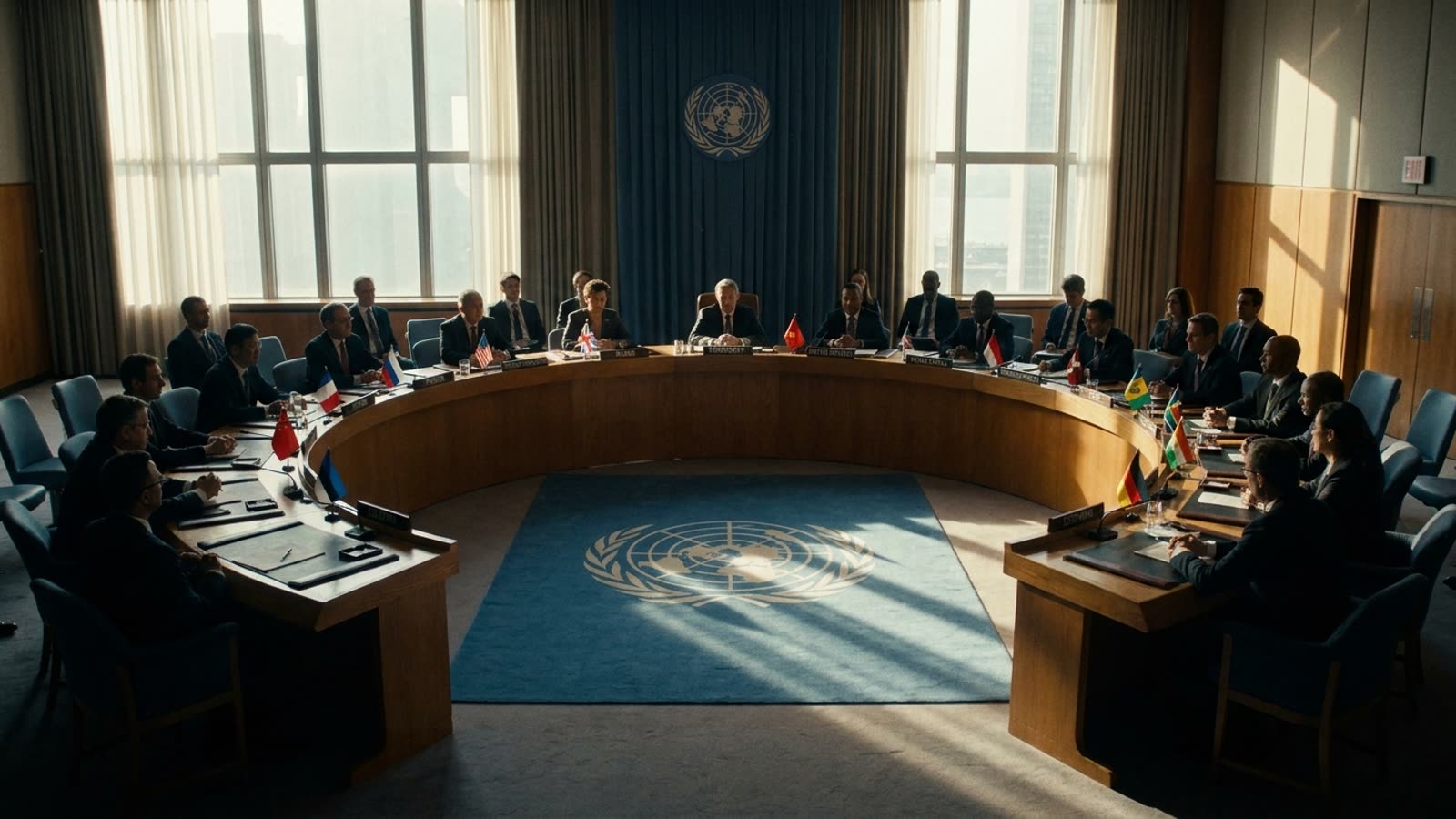
The United Nations Security Council has failed to act on virtually every major conflict of the past three decades, from Rwanda to Syria to Ukraine. Critics call this dysfunction. They are wrong. The Council is working precisely as intended.
The veto power held by the five permanent members—the United States, the United Kingdom, France, Russia, and China—was not an oversight or a compromise that went too far. It was the foundational bargain that made the UN possible at all. The architects at San Francisco in 1945 understood something their critics often forget: an international body that could compel great powers to act against their interests would either be ignored or would trigger the very world wars it was meant to prevent.
The price of the table
The League of Nations collapsed not because it lacked enforcement mechanisms but because major powers simply walked away when those mechanisms threatened their interests. Japan left after the League condemned its invasion of Manchuria. Germany and Italy followed. The League became a club of the aggrieved, powerless to stop the slide toward global war.
The UN's founders—particularly the American, British, and Soviet delegations—were determined not to repeat this mistake. Their solution was elegant in its cynicism: give the most powerful nations a permanent stake in the institution by guaranteeing they could never be bound by it against their will. The veto was not a privilege granted to the powerful; it was the price of their participation.
Smaller nations protested bitterly at San Francisco. Australia's foreign minister called the veto "a flagrant violation of the principle of the sovereign equality of states." He was right. But the alternative was no organization at all, or one that the great powers would abandon the moment it inconvenienced them.
The mathematics of paralysis
Since 1946, vetoes have been cast hundreds of times. The Soviet Union and later Russia have used the veto most frequently, followed by the United States. But the raw numbers obscure a more important dynamic: most vetoes are never cast because they do not need to be. The mere threat of a veto shapes what resolutions are drafted, debated, and brought to a vote.
This is the veto's true function. It operates as a sorting mechanism, filtering out any action that would seriously threaten the core interests of a permanent member. The Security Council can authorize peacekeeping missions in places no great power cares deeply about. It can impose sanctions on pariah states with no powerful patron. It cannot, by design, do anything meaningful about conflicts where permanent members are directly involved or have chosen sides.
Why reform fails
Proposals to reform the Security Council appear with metronomic regularity. Add more permanent members. Limit the veto to certain categories of action. Require multiple vetoes to block a resolution. Allow the General Assembly to override a veto with a supermajority.
Every such proposal founders on the same rock: any change to the UN Charter requires ratification by all five permanent members. No permanent member has any incentive to dilute its own power. The veto protects itself.
This is not mere stubbornness. Each permanent member can point to specific scenarios where an expanded or weakened veto would threaten its vital interests. The United States would never accept a Council that could authorize binding action on Israel over American objection. Russia would never accept one that could mandate intervention in its near abroad. China would never accept one that could rule on Taiwan.
Our take
The Security Council's paralysis is not a failure of political will or institutional design. It is the institution working as designed—preserving great-power participation at the cost of great-power accountability. Reformers who imagine a more effective Council are really imagining a different world, one where major powers have agreed to constrain their own freedom of action in ways they have never, in the history of international relations, been willing to accept. The veto is not the problem. The veto is the honest acknowledgment that no such world exists.