When a large language model generates text or an image classifier identifies a photograph, what's actually happening bears little resemblance to human thought. The system isn't consulting an internal encyclopedia or applying logical rules. It's performing vast mathematical operations on numbers that represent patterns it has seen millions of times before.
The weight of experience
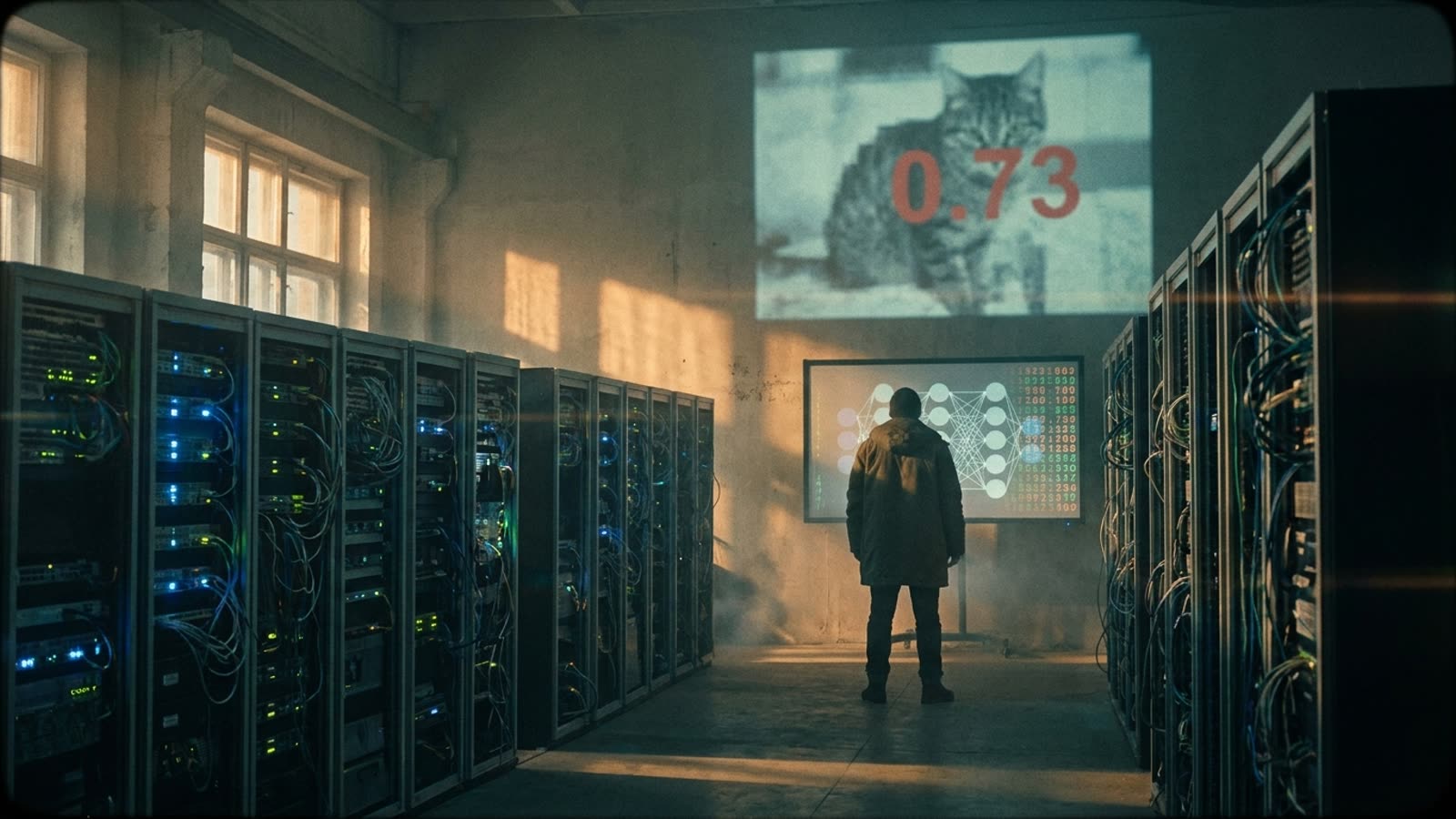
At its core, a neural network is a collection of numbers called weights. These weights start as random values, like dice rolls. During training, the system sees millions of examples — say, images of cats paired with the label "cat." Each time it guesses wrong, an algorithm called backpropagation adjusts thousands or millions of these weights by tiny amounts, nudging the network toward correct answers.
After enough examples, patterns emerge in the weights. Certain combinations fire strongly when the input contains fur-like textures, triangular shapes that could be ears, or paired circles that might be eyes. The network hasn't learned what a cat is in any meaningful sense. It has learned that certain mathematical patterns in pixel data correlate with the label "cat" in its training data.
Intelligence without understanding
This distinction explains both the remarkable capabilities and bizarre failures of modern AI. A language model can write sophisticated prose because it has encoded vast statistical patterns about which words tend to follow other words. It can discuss philosophy or explain quantum mechanics not because it understands these concepts, but because it has seen millions of examples of how humans discuss them.
Yet the same system might confidently assert that there are three r's in "strawberry" or fail at simple logic puzzles that weren't well-represented in its training data. It has no internal model of spelling or reasoning — just patterns.
The representation problem
The fundamental challenge is representation. Humans compress the world into concepts: "cat," "justice," "seventeen." We manipulate these symbols according to rules we can articulate. Neural networks compress the world into high-dimensional vectors — lists of numbers that capture statistical regularities but don't map cleanly onto human concepts.
This is why AI can translate languages without understanding meaning, create art without aesthetic sense, and diagnose diseases without knowing what a cell is. The patterns are there in the data, and the mathematics can find them.
Our take
The real breakthrough of modern AI isn't that machines have become intelligent in any human sense. It's that we've discovered just how much of what we consider intelligence can be approximated through pattern matching at massive scale. This should make us both more ambitious about what these systems can achieve and more realistic about what they fundamentally are: powerful statistical engines, not thinking minds. Understanding this distinction is essential as we integrate these tools into critical domains from medicine to law to education.