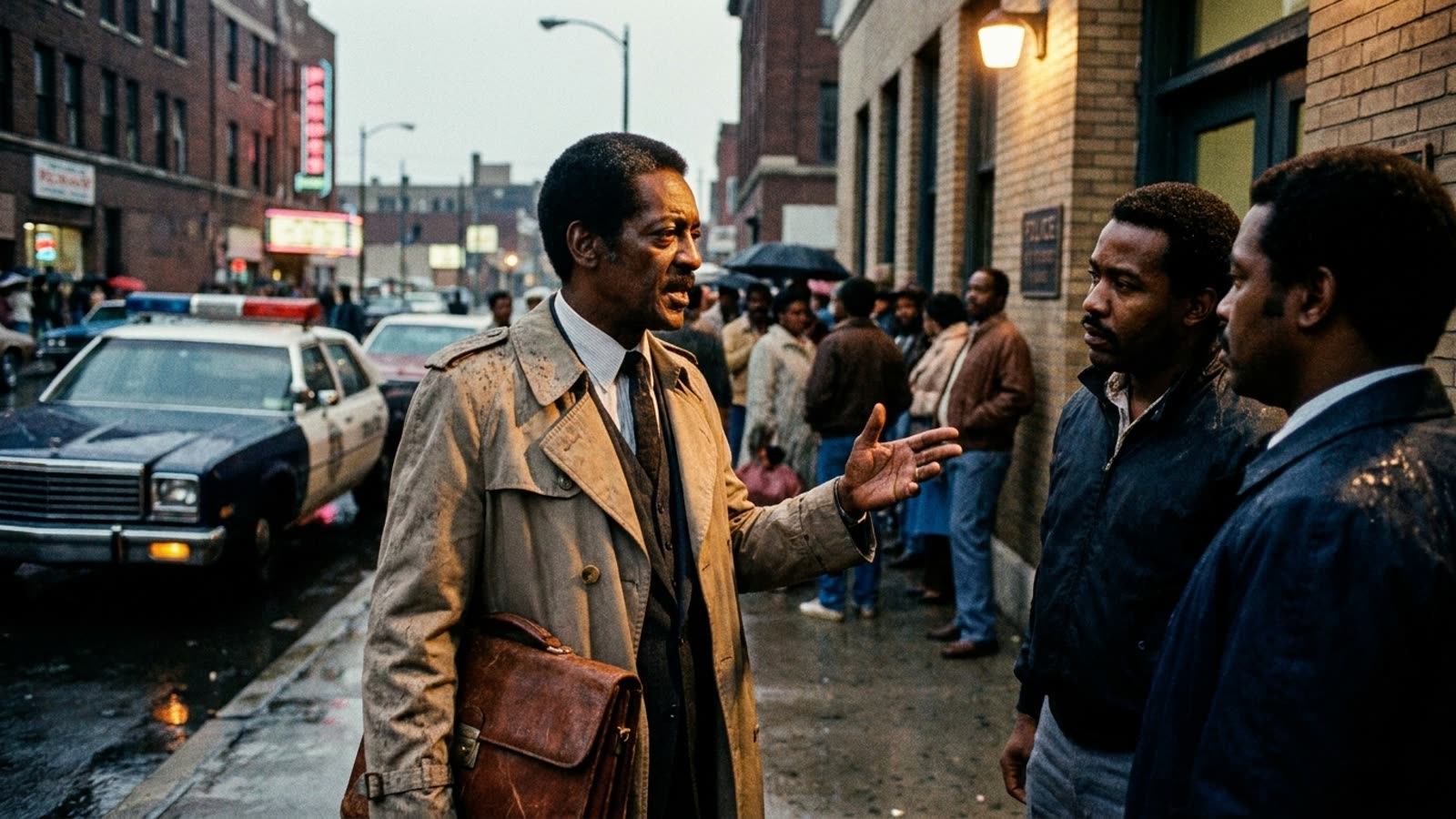
Before Eddie Murphy made Axel Foley a household name, Gilbert Hill had already spent two decades catching actual murderers in Detroit. That the real detective ended up playing a fictional one — and then leveraged that bit part into a seat on the Detroit City Council — remains one of Hollywood's most improbable second acts.
Hill died in 2016, but his peculiar career arc has resurfaced in cultural memory as the original Beverly Hills Cop trilogy enjoys a streaming renaissance and a new generation discovers the gruff Captain (later Inspector) Foster barking orders at Murphy's wisecracking protagonist. What they don't know is that the man delivering those lines had investigated over 5,000 homicide cases and supervised the unit that tracked down some of Detroit's most notorious killers.
The accidental actor
Hill never sought Hollywood. A location scout for the 1984 production wanted authentic Detroit texture and wandered into the homicide bureau, where Hill's commanding presence caught attention. Director Martin Brest cast him on the spot. Hill had no training, no agent, no ambitions beyond his pension. He simply showed up, played himself with minor fictional embellishments, and returned to his desk.
The performance worked precisely because it wasn't a performance. Hill's weary authority, his refusal to be impressed by Foley's antics, his bureaucratic exhaustion — all of it was muscle memory from years of managing egos and corpses. He reprised the role in both sequels, each time returning to active duty between shoots.
From precinct to politics
Hill retired from the Detroit Police Department in 1989 with the rank of inspector. A year later, he ran for Detroit City Council and won, serving until 2001. His campaign leaned heavily on name recognition from the films, but his credibility rested on genuine law enforcement credentials. He represented a district ravaged by the crack epidemic, and voters trusted the man who had seen the bodies.
His political career was competent if unremarkable — he championed public safety initiatives and avoided major scandal. But the fact that it happened at all illustrates a peculiarly American phenomenon: the celebrity-to-politician pipeline that would later produce governors, senators, and presidents. Hill walked so that others might run.
Our take
Gilbert Hill's story is a reminder that authenticity remains Hollywood's most undervalued commodity. Studios spend fortunes teaching actors to seem like cops; Hill simply was one. That his brief screen appearances opened doors to a decade of public service suggests audiences — and voters — can smell the real thing. In an era of manufactured personas and parasocial relationships, there's something refreshing about a man who stumbled into fame, used it modestly, and never pretended to be anything other than what he was: a Detroit homicide detective who happened to yell at Eddie Murphy a few times.