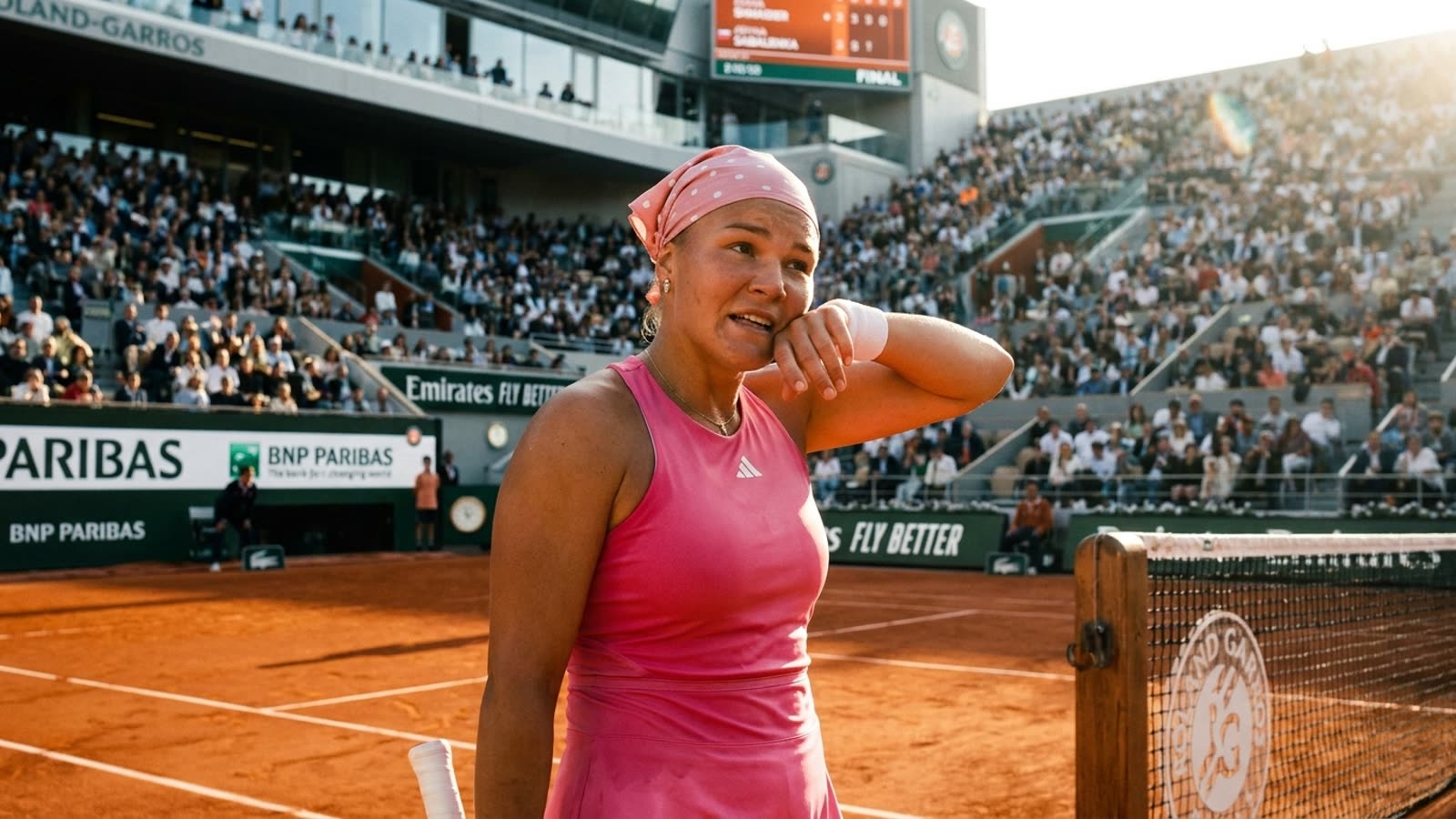
The world number one arrived at Roland-Garros as the prohibitive favorite, her power game finally calibrated for clay after years of Parisian frustration. She left on Tuesday afternoon having won just eight games against an opponent ranked outside the top twenty.
Diana Shnaider's 6-3, 6-5 demolition of Aryna Sabalenka was not a fluke born of a bad day at the office. It was a tactical masterclass delivered by a player who understood exactly how to neutralize the Belarusian's bludgeoning baseline game. Shnaider, competing under a neutral flag due to the ongoing restrictions on Russian players, absorbed Sabalenka's pace and redirected it with surgical angles that left the favorite lunging and flailing across the red dirt.
The anatomy of an upset
Sabalenka entered the match having dropped just one set in the tournament. Her serve, which had been landing at nearly 70 percent in previous rounds, abandoned her completely—she won barely half her first-serve points and committed a cascade of unforced errors that suggested mounting panic rather than mere inconsistency. Shnaider, by contrast, played with the eerie composure of someone who had already visualized every point. Her backhand, struck flat and early, denied Sabalenka the rhythm she needs to generate her heaviest groundstrokes.
The significance extends beyond the bracket. Sabalenka had positioned this French Open as her coronation, the missing major that would cement her status atop the sport. At 28, she remains formidable, but windows close quickly in women's tennis, and younger players like Shnaider are no longer intimidated by reputation.
What it means for the draw
The bottom half of the women's bracket is now wide open. Shnaider becomes the de facto favorite in her section, though she will face increasingly desperate opponents who smell an opportunity that rarely presents itself at a major. The neutral flag under which she competes adds a layer of complexity—Russian players remain barred from representing their country, yet continue to produce results that embarrass the sport's attempts to sideline them.
Our take
Upsets at majors are often explained away as aberrations—a star having an off day, a qualifier riding an unsustainable hot streak. This was different. Shnaider did not merely survive Sabalenka's firepower; she made it look pedestrian. The women's game has been searching for its next generational rivalry since the Williams era concluded. Tuesday in Paris suggested we may have found one of its principals.