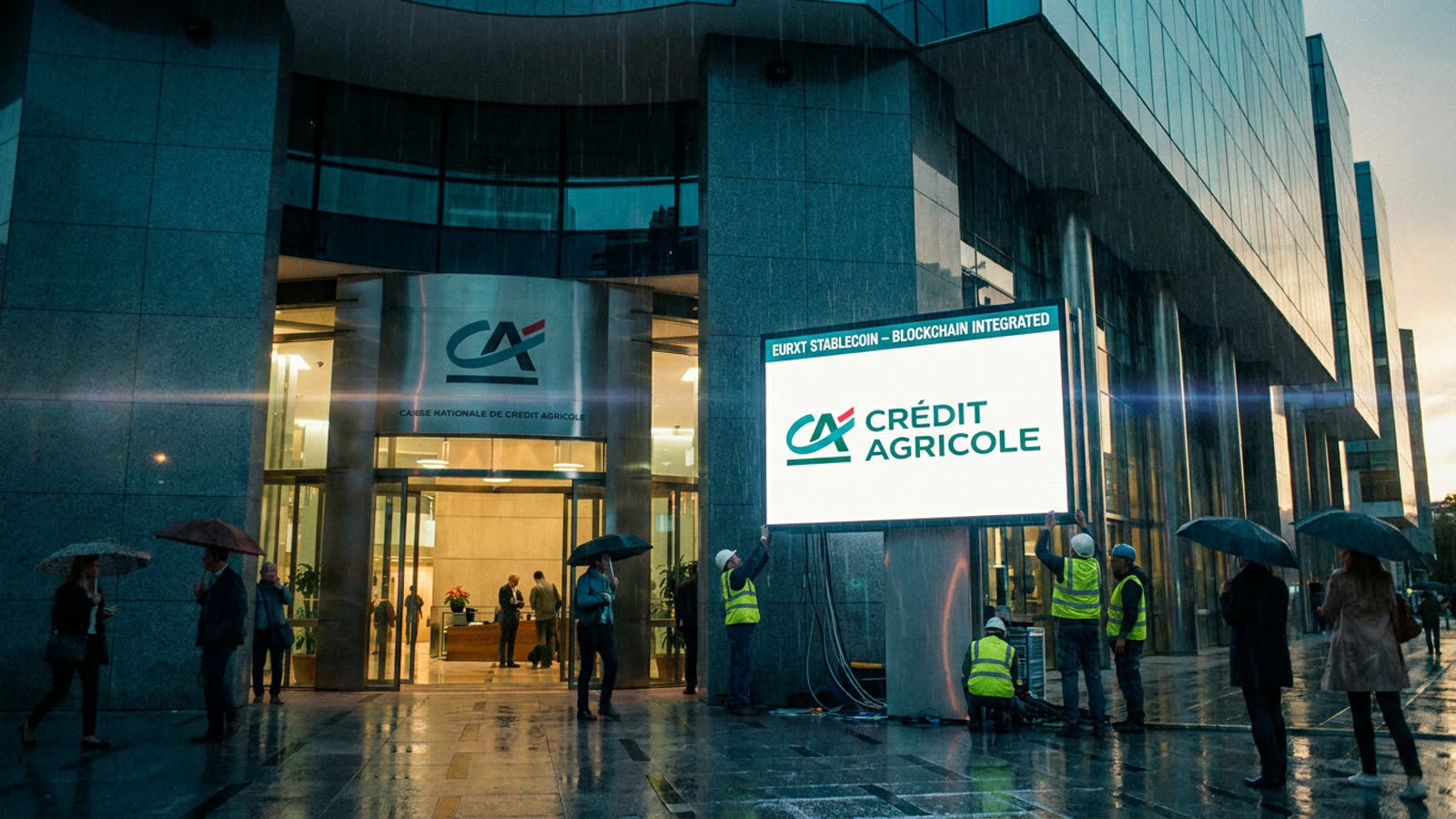
When one of Europe's largest banks issues its own stablecoin, the conversation shifts from whether traditional finance will embrace blockchain to how quickly the old guard can catch up.
Crédit Agricole, France's second-largest bank by assets and a cooperative institution serving tens of millions of customers, has rolled out EURXT—a euro-denominated stablecoin designed for institutional and eventually retail use. The move places a 130-year-old agricultural lender at the frontier of digital money, and it signals that European banking has crossed a psychological threshold that American competitors have been slower to approach.
Why this matters more than previous bank experiments
Banks have dabbled in blockchain for years, but most efforts were sandboxed pilots, proof-of-concepts designed to satisfy curious boards rather than serve actual customers. EURXT is different. Crédit Agricole built it through its fintech subsidiary in partnership with blockchain infrastructure providers, and it's launching under the European Union's Markets in Crypto-Assets (MiCA) regulatory framework—the most comprehensive crypto rulebook any major economy has enacted.
MiCA gives European issuers something American banks lack: legal clarity. While U.S. regulators continue their turf wars over stablecoin jurisdiction, European institutions can now issue, distribute, and custody digital euros with explicit regulatory blessing. Crédit Agricole is exploiting that advantage.
The bank's scale matters too. With assets exceeding €2 trillion and a customer base spanning retail farmers, corporate treasuries, and institutional investors, Crédit Agricole can push EURXT into use cases that crypto-native stablecoins struggle to reach: trade finance, cross-border corporate payments, and eventually everyday consumer transactions.
The competitive landscape shifts
Circle's EURC and Société Générale's earlier euro stablecoin experiments now face a formidable rival. Crédit Agricole brings distribution muscle, regulatory relationships, and—critically—the trust of customers who would never touch a product with "crypto" in its marketing.
For American banks, the launch is a warning. JPMorgan's Onyx and various pilot programs remain largely internal or consortium-focused. No major U.S. bank has issued a public stablecoin, and the regulatory environment makes doing so a legal minefield. Europe is moving faster, and the network effects of early adoption compound.
Our take
The irony is thick: a cooperative bank founded to serve French farmers is now leading the digitization of European money. But Crédit Agricole's conservatism is precisely what makes EURXT significant. When boring institutions embrace new technology, it stops being new—it becomes infrastructure. The stablecoin wars were never going to be won by startups alone. They'll be won by whoever convinces your grandmother's bank to participate. Crédit Agricole just did.