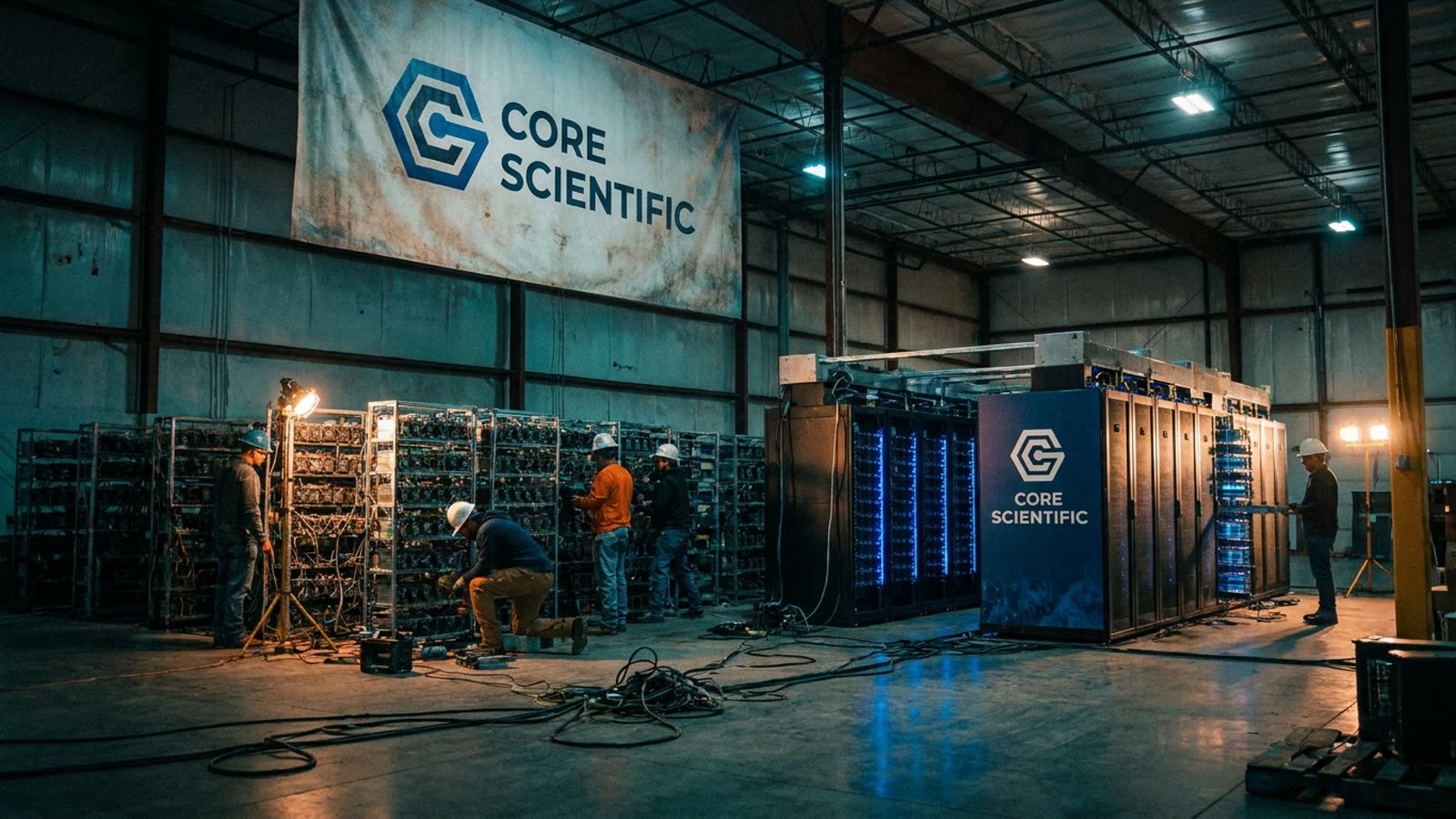
When a company that built its identity on Bitcoin decides the future lies elsewhere, the signal is worth heeding. Core Scientific, which emerged from bankruptcy protection less than two years ago as one of North America's most formidable crypto mining operations, announced it will cease all Bitcoin mining by December 31st and pivot entirely to AI infrastructure services. Mining now accounts for just 7.5 percent of quarterly revenue — a figure that would have been unthinkable when the company was pulling hundreds of millions from proof-of-work operations.
The conversion is not a pivot so much as a surrender to economic gravity. AI workloads pay better, demand more predictably, and come with corporate customers who sign multi-year contracts rather than algorithmic protocols that halve rewards every four years.
The arithmetic of abandonment
Core Scientific's transformation reflects a brutal calculus that has been reshaping the data center industry for the past eighteen months. A single rack of Nvidia H100 GPUs running inference for an enterprise AI customer can generate more reliable margin than rows of ASICs grinding through SHA-256 hashes. The company's existing facilities — purpose-built for power-hungry, heat-intensive computation — translate almost directly to AI training and inference workloads. What was once a liability (massive electricity bills, cooling requirements, remote locations near cheap power) has become an asset class that hyperscalers and AI labs are desperate to lease.
The timing is notable. Bitcoin's post-halving economics have squeezed miners who lack the lowest-cost power arrangements, while the AI infrastructure shortage has created a seller's market for anyone with megawatts to spare. Core Scientific is choosing the bid that values its assets most highly.
A template for the industry
Other mining operations are watching closely. Marathon Digital, Riot Platforms, and CleanSpark have all flirted with AI diversification, but none has committed to a full exit from mining. Core Scientific's move tests whether the market will reward a clean break over hedged bets. If the stock responds favorably — and early indications suggest institutional investors prefer the predictability of contracted AI revenue — expect imitators.
The broader implication is that Bitcoin's security model, which depends on miners finding the economics attractive enough to keep hashing, faces a new competitor for the same scarce resources: electricity, cooling, and physical space. Every megawatt that flows to AI is a megawatt that does not flow to securing the Bitcoin network.
Our take
Core Scientific's exit is less a betrayal of crypto than a recognition that computation is fungible and capital is not sentimental. The company spent years and hundreds of millions of dollars building infrastructure optimized for one kind of math; it turns out that infrastructure works for other kinds of math that pay better. This is not the death of Bitcoin mining, but it is a preview of what happens when a more lucrative buyer shows up for the same real estate. The AI boom is not just creating winners — it is rearranging the entire topology of who gets to use the world's power and cooling capacity. Mining's loss is inference's gain, and the market has made its preference clear.