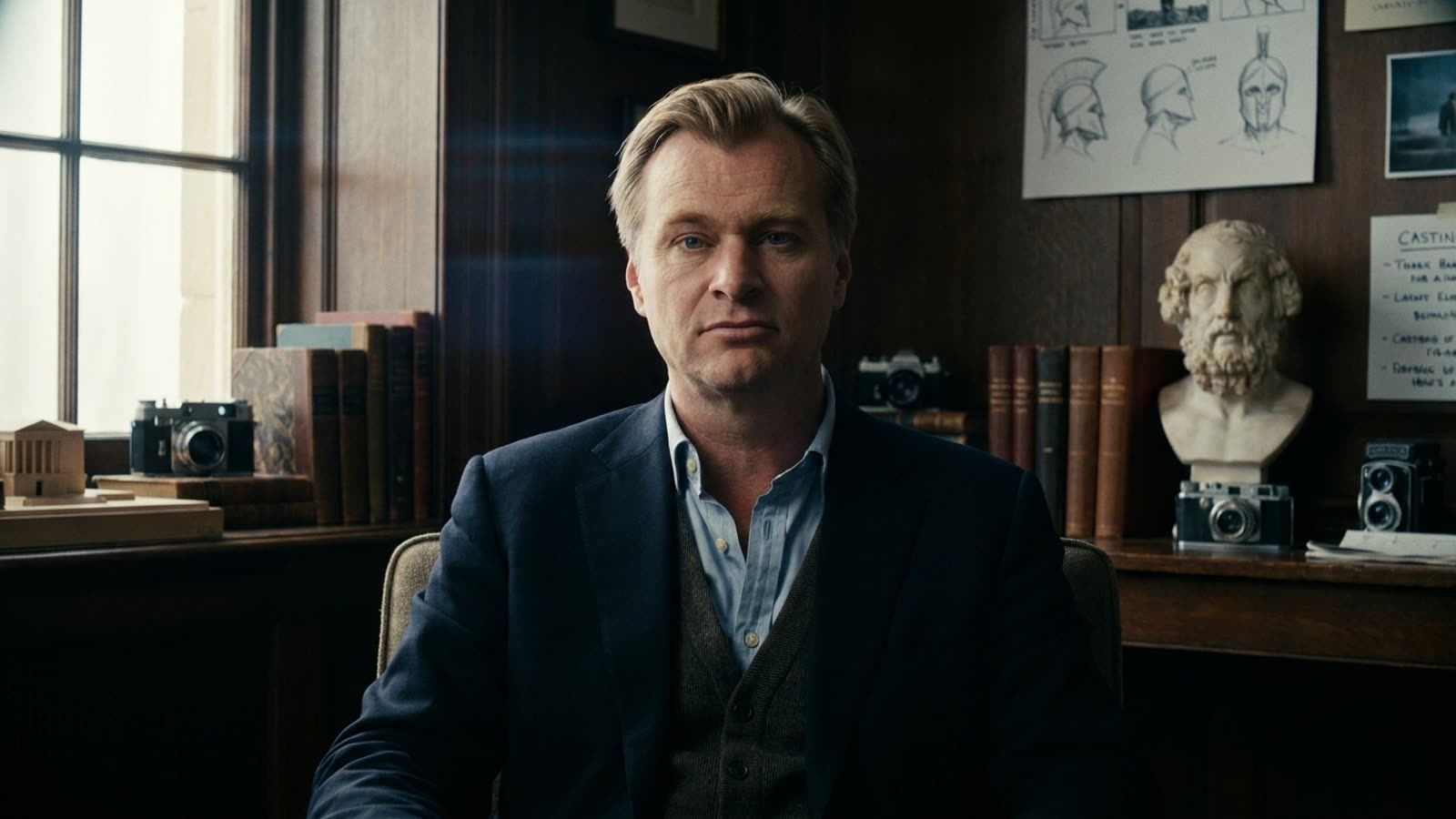
Christopher Nolan has never been particularly interested in explaining himself, which makes his decision to address the mounting criticism of The Odyssey all the more revealing. In what appears to be a calculated pre-Cannes offensive, the director has offered his most substantive comments yet on the controversies that have dogged his Homer adaptation since casting announcements began trickling out last year.
The backlash has centered on two fronts: the casting of rapper Travis Scott in an undisclosed role, and leaked set photos showing armor designs that classicists have derided as historically incoherent. Nolan's response—"What is the best speculation?"—is characteristically elliptical, but his broader defense suggests a filmmaker who has grown weary of litigating creative choices in the court of social media opinion.
The Travis Scott Question
Scott's involvement has drawn the most pointed criticism, with detractors questioning both his acting credentials and, more uncomfortably, whether his presence represents the kind of celebrity stunt-casting that Nolan has historically avoided. The director's defense sidesteps these concerns entirely, instead emphasizing the audition process and what he describes as Scott's "innate understanding of performance as ritual." It's the kind of answer that will satisfy no one who wasn't already inclined to trust Nolan's judgment—which may be precisely the point.
What's notable is that Nolan chose to address the controversy at all. His previous films have weathered casting debates (Cillian Murphy's Oppenheimer, Anne Hathaway's Catwoman) with studied silence. That he's engaging now suggests either genuine concern about the narrative forming around the film or, more likely, a strategic decision to control the story before Cannes.
The Armor Problem
The armor criticism is more substantive, at least from an academic standpoint. Historians have noted that the leaked designs appear to blend Bronze Age Mycenaean elements with classical Greek hoplite equipment—a temporal mashup spanning roughly 700 years. Nolan's response invokes the same logic he applied to Dunkirk's timeline manipulations: fidelity to emotional truth over archaeological accuracy.
"Homer wasn't writing a documentary," the director reportedly said, a statement that will land differently depending on one's tolerance for auteur liberties with source material. The Odyssey is, after all, already a text that plays fast and loose with geography, chronology, and the laws of physics. Whether Nolan's visual anachronisms constitute creative interpretation or careless production design remains a matter of perspective.
The Bigger Picture
What's most striking about this moment is what it reveals about the current state of blockbuster filmmaking. Nolan remains one of the few directors who can greenlight a $250 million adaptation of an ancient Greek epic poem—a project that would be unthinkable from almost any other filmmaker working today. That even he must now defend creative choices to an online audience months before release suggests how thoroughly the discourse economy has colonized Hollywood's decision-making apparatus.
Our take
Nolan has earned the benefit of the doubt, but his responses here feel uncharacteristically defensive. The Travis Scott casting may prove inspired or disastrous—we genuinely cannot know until we see the film. The armor debate is largely academic noise. What matters is whether The Odyssey can deliver the kind of transportive, IMAX-scale spectacle that justifies its existence. Nolan's track record suggests it will. His need to explain himself this early suggests even he isn't entirely sure.