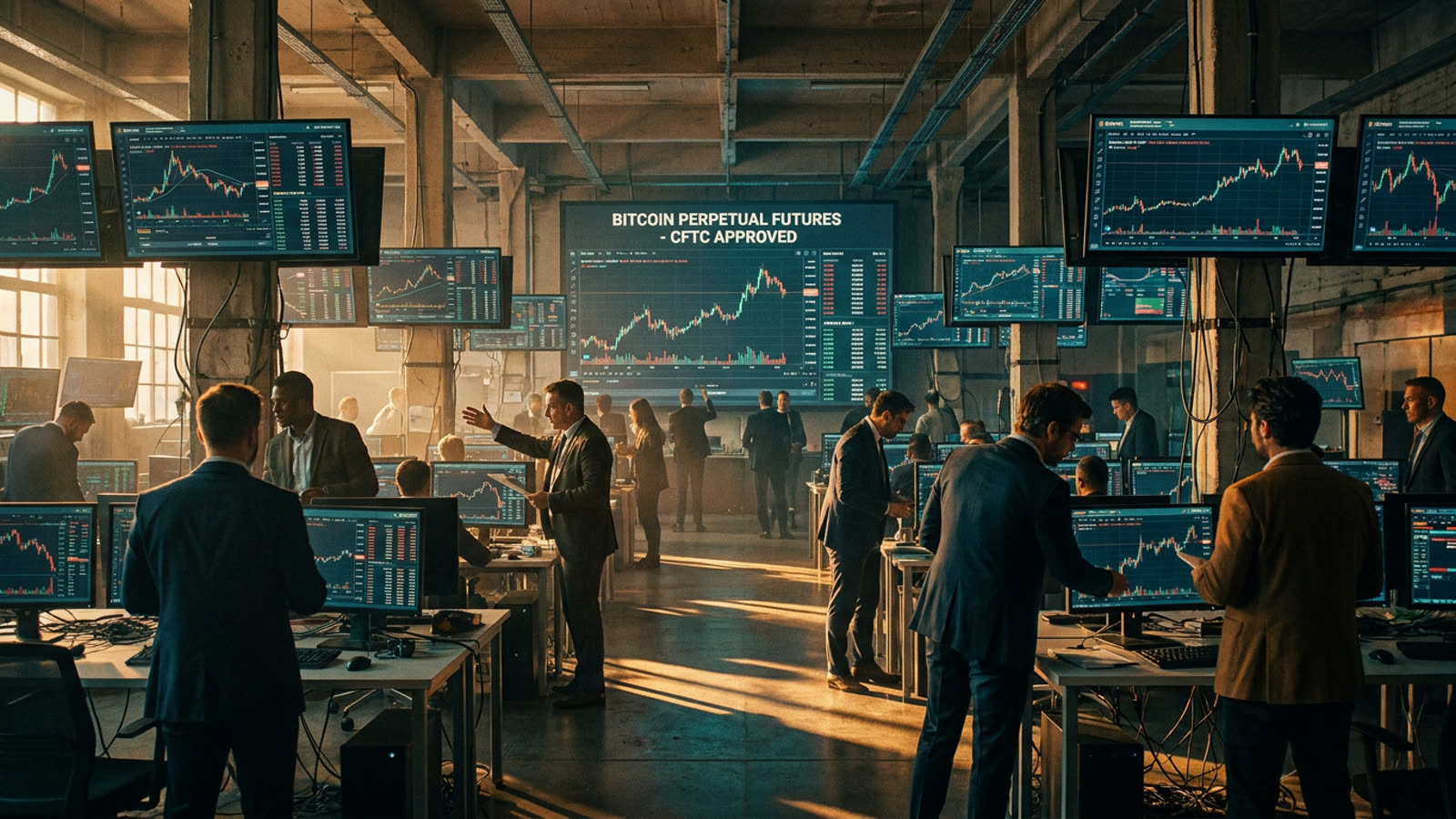
For years, American crypto traders have watched from the sidelines as offshore exchanges like Binance and Bybit turned perpetual futures into the dominant way the world speculates on Bitcoin. The instruments—futures contracts with no expiration date that can be held indefinitely—account for the vast majority of global crypto derivatives volume. US regulators, wary of the leverage and complexity involved, kept them firmly offshore. That era ended this week when the Commodity Futures Trading Commission approved both Kalshi and Coinbase to offer Bitcoin perpetual contracts to American customers.
The twin approvals represent the most significant expansion of regulated crypto derivatives in the United States since the CME launched Bitcoin futures in 2017. But the real story isn't just regulatory liberalization—it's the strange bedfellows now competing for the same pool of speculative capital.
The prediction market's unlikely pivot
Kalshi built its reputation on event contracts: binary bets on elections, economic data releases, and cultural phenomena. The platform fought a bruising legal battle with the CFTC over political prediction markets and emerged victorious, establishing itself as the poster child for a new kind of regulated speculation. Now it's pivoting hard into financial derivatives, a move that puts it in direct competition with Coinbase, the largest US crypto exchange.
The strategic logic is clear. Prediction markets live and die by liquidity, and crypto perpetuals are among the most liquid instruments on earth. Offshore venues regularly see tens of billions in daily volume. Even capturing a fraction of that flow could transform Kalshi's economics. But the pivot also raises questions about mission drift—is Kalshi still a prediction market, or is it becoming another crypto exchange with a regulatory moat?
Coinbase's defensive expansion
For Coinbase, the approval is defensive as much as offensive. The exchange has watched its international competitors offer perpetuals for years while its US business remained confined to spot trading and a limited menu of regulated futures. The perpetuals approval finally gives Coinbase a product that can compete with offshore venues on their own terms.
The timing matters. Crypto ETF inflows have cooled significantly in recent weeks, with Bitcoin and Ether funds seeing substantial outflows even as XRP products attracted fresh capital. Spot trading volumes have softened. Perpetuals offer Coinbase a new revenue stream precisely when its core business faces headwinds. The fees on leveraged derivatives tend to be substantially higher than spot commissions, and the contracts generate continuous funding-rate revenue.
The leverage question
The CFTC's approvals come with guardrails. Initial margin requirements and position limits will be stricter than what offshore venues offer, where traders routinely access 100x leverage. American perpetuals will likely be tamer, perhaps 10x to 20x, depending on the specific contract terms the exchanges implement.
That's probably appropriate. The offshore perpetuals market has produced spectacular blowups, with billions in liquidations cascading through the system during volatile periods. A more conservative American market might attract institutional capital that has stayed away from the Wild West of offshore derivatives. But it also means US venues will struggle to compete on pure leverage, forcing them to differentiate on regulatory clarity, counterparty safety, and integration with traditional finance.
Our take
The CFTC's perpetuals approvals mark a genuine inflection point for American crypto markets. For the first time, US traders will have regulated access to the instrument that actually dominates global crypto speculation. The competition between Kalshi and Coinbase—a prediction market versus a crypto-native exchange—will be fascinating to watch, and the winner may depend less on product design than on which platform can attract market makers willing to provide tight spreads. The real question is whether regulated perpetuals can capture meaningful share from offshore venues, or whether American traders will continue to find ways around geographic restrictions. History suggests the latter, but regulatory legitimacy has a way of mattering more than traders expect—especially when the next market crisis arrives and counterparty risk suddenly becomes everyone's primary concern.