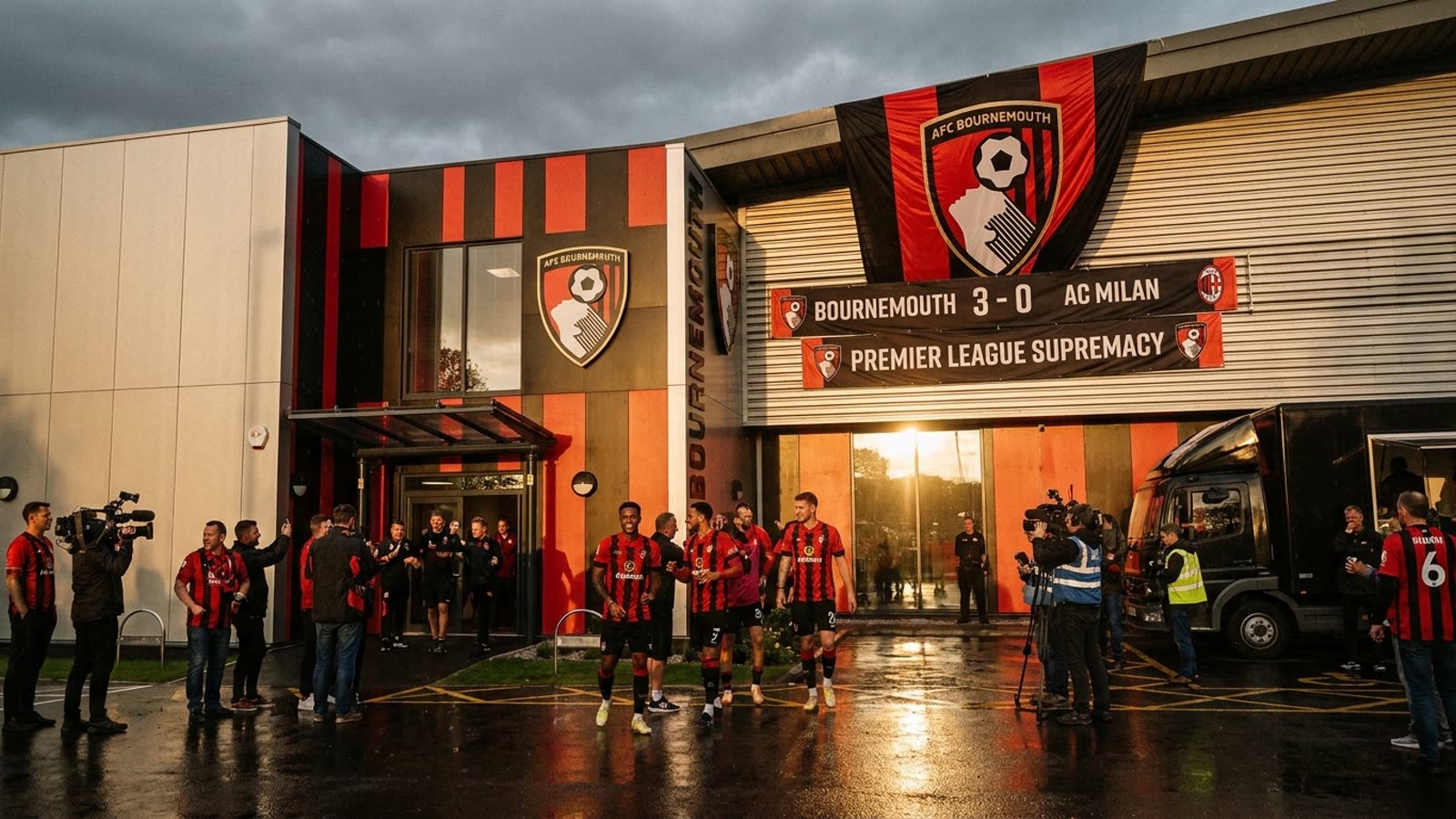
When Bournemouth—a club that was playing fourth-tier football in 2009 and nearly liquidated in 2008—put three unanswered goals past AC Milan at the Vitality Stadium, the result was less an upset than a confirmation. The Premier League has become European football's apex predator, and even its middle class can feast on the old aristocracy.
Milan, holders of seven European Cups and architects of some of the sport's most elegant dynasties, were outrun, outpressed, and outclassed by a side whose entire transfer outlay this summer would barely cover one of the Rossoneri's marquee signings. The scoreline flattered the visitors.
The wealth gap made visible
The Premier League's television deal—worth roughly £6.7 billion domestically through 2029—has created a financial ecosystem where even promoted clubs operate with budgets that dwarf mid-table sides in Serie A or Ligue 1. Bournemouth, owned by American investor Bill Foley, have invested shrewdly in pressing systems and athletic profiles that exploit the physical demands of English football. Against Milan's ageing midfield, that intensity was suffocating.
Andoni Iraola's side completed more high-intensity sprints in the first half alone than Milan managed across ninety minutes. The Italians' technical superiority—once a given—was rendered irrelevant by the sheer volume of English running.
A broader pattern
This was not an aberration. English clubs have dominated European competition for the better part of a decade, and the trend has accelerated. Last season's Champions League quarterfinals featured four Premier League sides. The Europa League and Conference League have become near-monopolies. What Bournemouth demonstrated is that this supremacy now extends beyond the traditional Big Six—the entire league has lifted.
Milan, for their part, looked like tourists. Their press was passive, their transitions labored, and their defending bordered on charitable. Manager Paulo Fonseca offered little tactical adjustment as the goals mounted.
Our take
There is something faintly melancholic about watching Milan reduced to cannon fodder for a club whose stadium holds fewer than twelve thousand. But sentiment does not win football matches, and the Premier League's financial machinery has fundamentally altered the sport's competitive landscape. Bournemouth's victory was not a miracle—it was arithmetic. Until European football addresses its economic imbalances, nights like this will become routine, and the romance of continental competition will continue to curdle into something closer to exhibition.