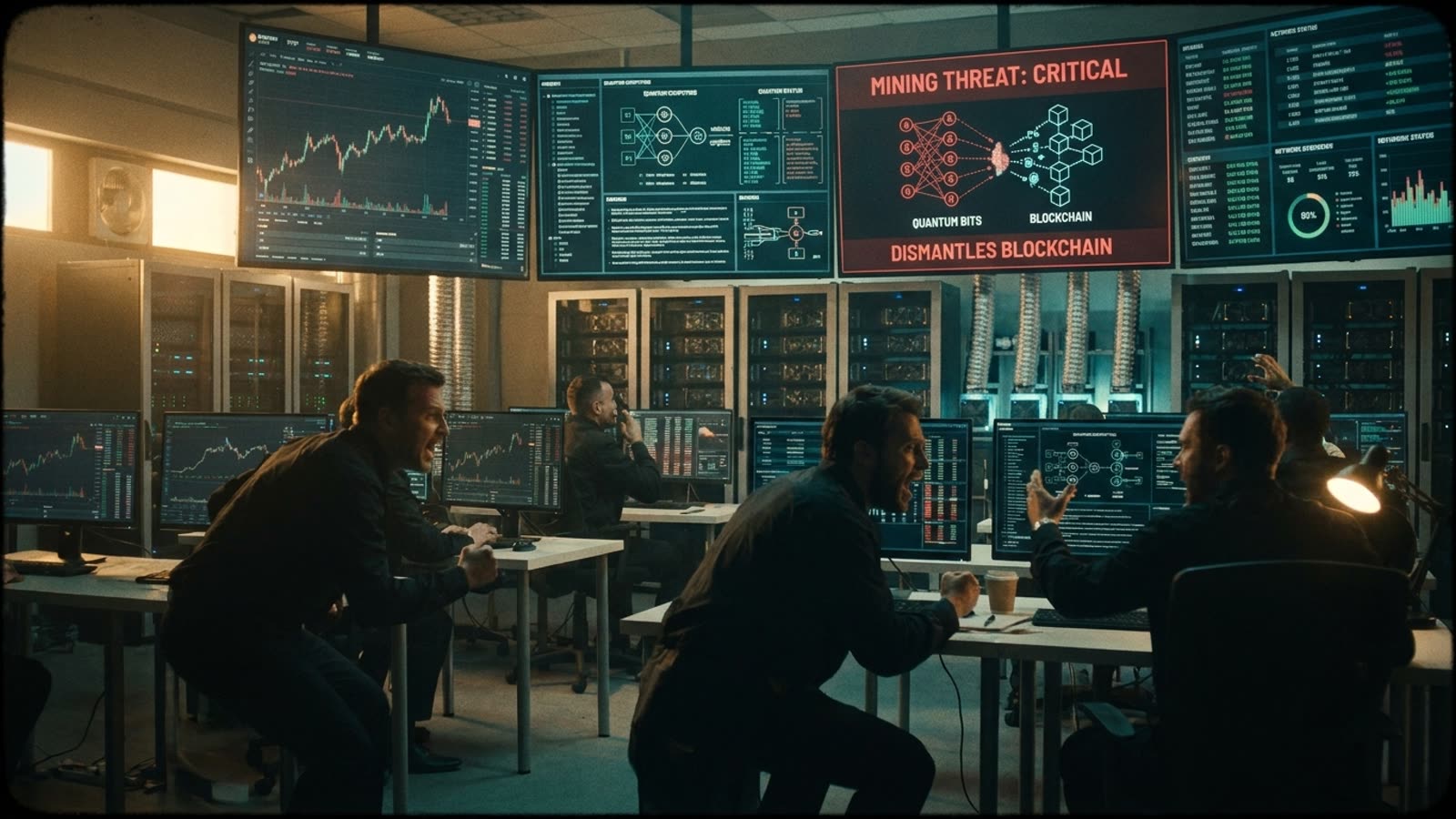
The crypto industry's quantum computing anxiety has long fixated on the wrong target. While security researchers and Bitcoin maximalists alike obsess over the eventual ability of quantum machines to derive private keys from public addresses, a more fundamental vulnerability lurks in the protocol's foundation: the mining algorithm itself.
The concern, raised by an early Bitcoin investor in recent commentary, centers on Grover's algorithm—a quantum computing technique that could theoretically halve the computational difficulty of Bitcoin's SHA-256 mining puzzle. Unlike Shor's algorithm, which threatens public-key cryptography and remains decades from practical deployment against Bitcoin's elliptic curve signatures, Grover's speedup applies to the brute-force search problems that underpin proof-of-work consensus.
The asymmetry problem
Bitcoin's security model assumes that mining difficulty adjusts to maintain a roughly ten-minute block interval regardless of how much hashpower enters the network. But this equilibrium depends on all miners operating under the same computational constraints. A quantum miner with even a modest Grover speedup would enjoy a structural advantage invisible to the difficulty adjustment algorithm, potentially allowing them to accumulate hashpower share disproportionate to their energy expenditure.
The implications cascade from there. A sufficiently advanced quantum miner could approach—or exceed—the 51% threshold needed for double-spend attacks, block censorship, or chain reorganizations. Unlike the wallet-key scenario, where users can migrate to quantum-resistant signature schemes, there is no simple protocol upgrade that preserves proof-of-work while neutralizing quantum mining advantages.
Why the industry isn't listening
The relative silence on mining-layer quantum risk reflects several cognitive biases. First, the wallet-key threat is more intuitive: people understand that stolen keys mean stolen coins. Second, the mining threat feels abstract because no quantum computer currently exists that could meaningfully accelerate SHA-256 hashing. Third, acknowledging the problem implies that Bitcoin's core consensus mechanism may require fundamental redesign—a conversation that challenges maximalist narratives about the protocol's immutability and perfection.
Ethereum's transition to proof-of-stake in 2022 eliminated this particular vulnerability for its network, though it introduced different trust assumptions. Bitcoin's community has shown little appetite for similar changes, preferring to treat proof-of-work as a feature rather than a potential liability.
Our take
The quantum mining threat deserves more serious attention than it receives, even if practical quantum advantage in hashing remains years or decades away. Bitcoin's value proposition rests on credible long-term security guarantees, and the current discourse—focused almost exclusively on signature schemes—leaves a significant blind spot. The honest answer is that nobody knows when quantum mining becomes viable, and the protocol has no obvious upgrade path if it does. That uncertainty should be priced into the conversation, even if it isn't priced into the asset.