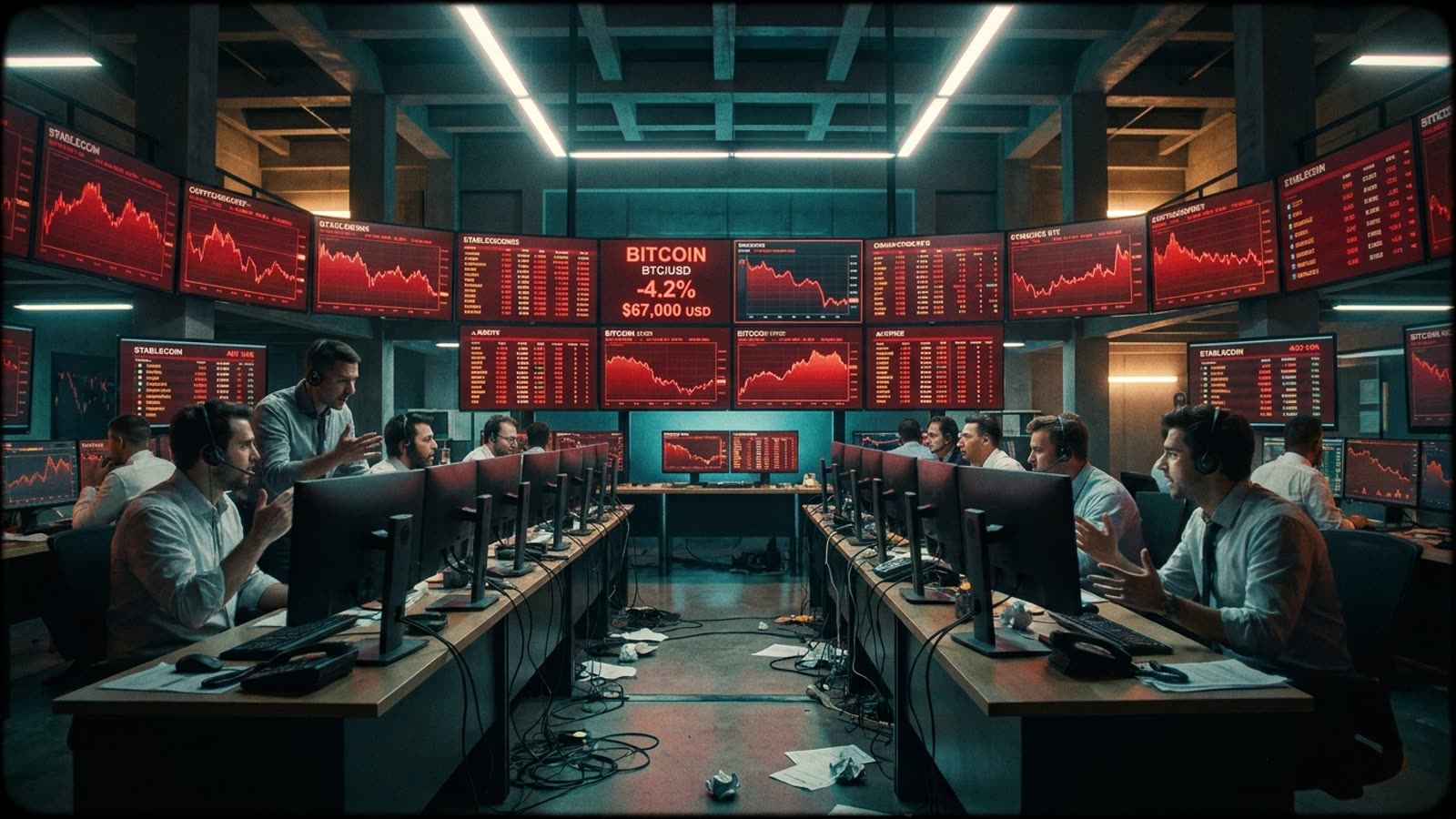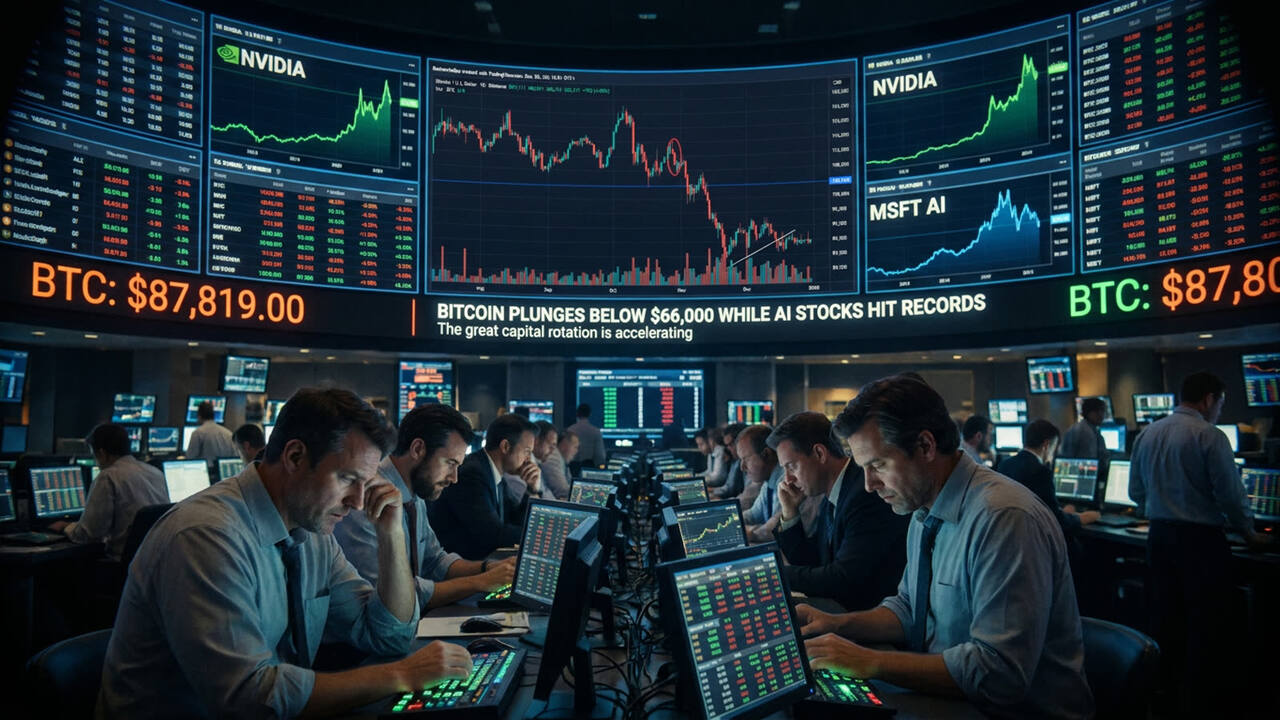
The divergence has become impossible to ignore. As Bitcoin slid below $66,000 this week—its lowest level since early spring—the Nasdaq Composite and AI-heavy indices notched fresh all-time highs, with Nvidia alone adding roughly the entire market capitalization of Ethereum in a single session. What looked like a temporary dislocation in April now appears structural, and the capital flows tell the story.
Institutional money is rotating out of digital assets and into the AI trade with a velocity that recalls the 2021 meme-stock frenzy, except this time the destination is blue-chip tech rather than GameStop. Bitcoin ETF outflows have accelerated for three consecutive weeks, even as equity funds tracking artificial intelligence themes report record inflows. The correlation between Bitcoin and risk assets, which spent most of 2024 hovering near historic highs, has collapsed.
The opportunity-cost problem
For allocators managing multi-asset portfolios, the math has become punishing. Nvidia is up more than 140% year-to-date; Bitcoin is flat to slightly negative. When the risk-free rate sits above 5% and the hottest sector in living memory is compounding at venture-capital rates inside public markets, the case for holding a volatile, non-yielding asset weakens considerably. Several macro hedge funds that added Bitcoin exposure in late 2024 have quietly trimmed positions, according to prime-brokerage data, reallocating toward semiconductor and infrastructure plays.
The shift is not irrational. Generative AI is producing tangible revenue—OpenAI's annualized run rate reportedly exceeds $10 billion—while Bitcoin's institutional narrative remains tethered to "digital gold" and inflation hedging, themes that have lost urgency as disinflation persists and real rates stay elevated.
Stablecoin inflows complicate the picture
Paradoxically, on-chain data shows stablecoin supplies near all-time highs, suggesting capital has not left crypto entirely—it has simply parked on the sidelines. Traders are holding dry powder in USDC and USDT rather than rotating back into fiat, a pattern that historically precedes sharp Bitcoin rallies once a catalyst emerges. The question is whether that catalyst arrives before the AI supercycle exhausts itself, or whether sidelined capital eventually capitulates and exits to chase equity momentum.
Our take
Bitcoin's short-term pain is real, but the obituaries are premature. The asset has survived a half-dozen "rotation" narratives—into gold, into bonds, into cash—and emerged with a higher floor each cycle. What matters now is whether the halving-driven supply shock, still less than two months old, can reassert itself against the gravitational pull of AI mania. If history rhymes, patience will be rewarded; if it doesn't, the 2024 ETF approvals will look less like a new era and more like a well-timed exit ramp for early believers.