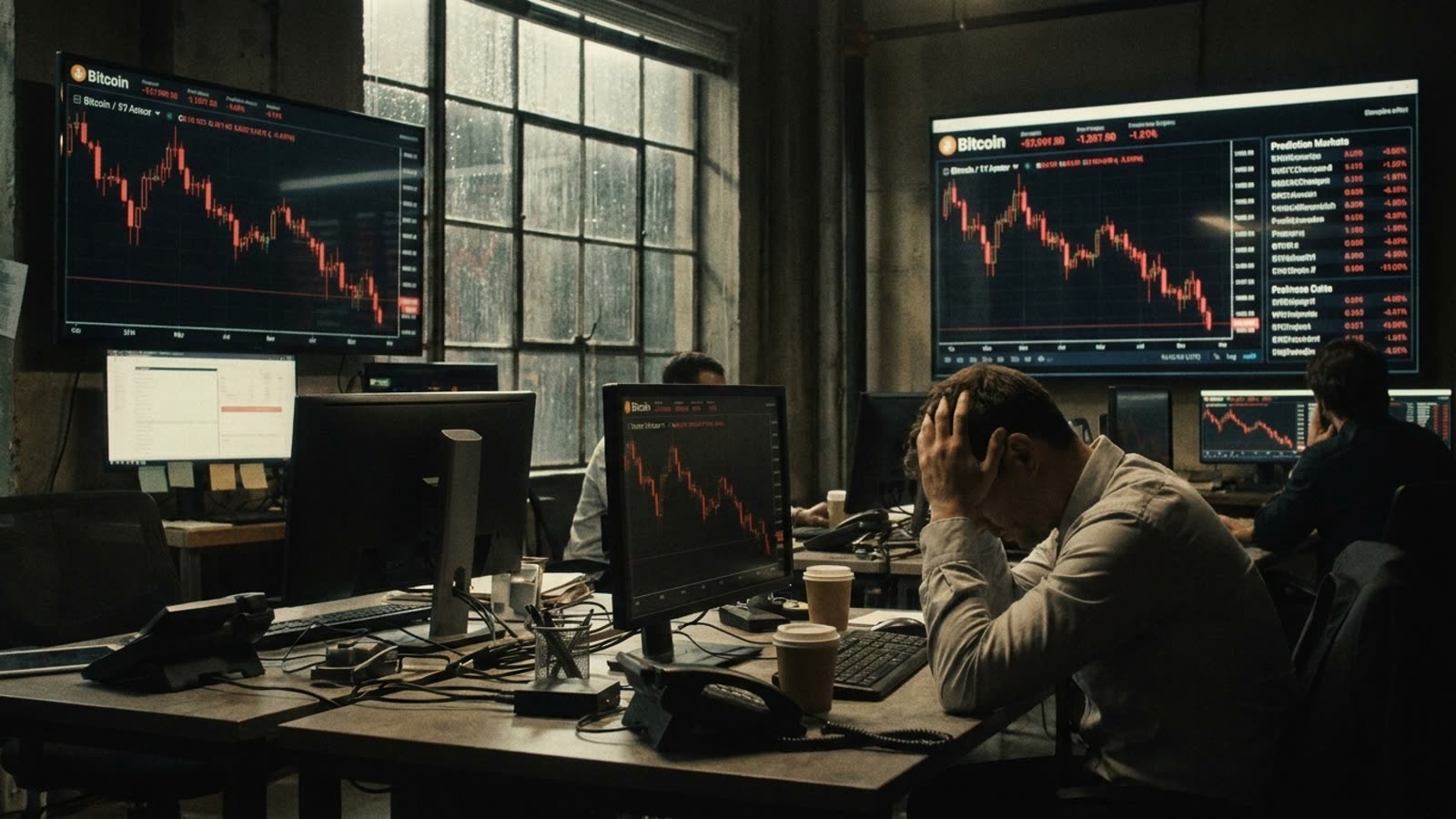
The prediction market crowd has discovered a new pastime: betting against Bitcoin's near-term stability. Polymarket and other decentralized betting venues now show elevated odds—somewhere in the mid-teens, up from single digits earlier this month—that Bitcoin will close May below $70,000, a level it hasn't breached since the spring correction began.
This is not, to be clear, a consensus forecast of doom. It is something more interesting: a real-time pricing of tail risk by traders who have actual money on the line. And the signal it sends is worth parsing carefully.
The mechanics of crypto fear
Prediction markets work differently from traditional derivatives. When you buy a contract on Polymarket betting that BTC will drop below $70,000, you're not hedging a portfolio or expressing a leveraged directional view. You're making a discrete probability bet—and the market-clearing price reflects the crowd's aggregated estimate of that probability.
The current odds suggest roughly a one-in-six chance of a significant drawdown by May 31. That's meaningful but hardly alarming. For context, Bitcoin has experienced monthly declines of 15% or more in roughly 12% of all months since 2015. The market is pricing in slightly elevated risk, not capitulation.
What's driving the shift? The usual suspects: macroeconomic uncertainty, the Federal Reserve's continued hawkishness, and technical weakness as Bitcoin has struggled to reclaim its March highs. Add to that the leverage overhang in perpetual futures markets, where funding rates have turned negative—indicating more shorts than longs—and you have the ingredients for a sentiment wobble.
What the whales are actually doing
On-chain data tells a more nuanced story. Long-term holders—wallets that haven't moved Bitcoin in over a year—continue to accumulate. Exchange balances remain near multi-year lows, suggesting that large holders aren't rushing to sell. The prediction market anxiety appears concentrated among shorter-term speculators, not the institutional money that has increasingly defined Bitcoin's price floor.
The corporate treasury bid, led by Strategy and its imitators, also provides structural support that didn't exist in previous cycles. These buyers aren't selling into 10% dips; they're programmatically accumulating. That doesn't prevent volatility, but it does raise the floor.
Our take
Prediction markets are useful precisely because they force participants to put money behind their opinions—unlike Twitter, where bearish takes are free. But they're also reflexive: rising downside odds can themselves influence sentiment, creating feedback loops that amplify moves in both directions. The current setup suggests caution is warranted, not panic. Bitcoin has survived far worse odds than one-in-six.