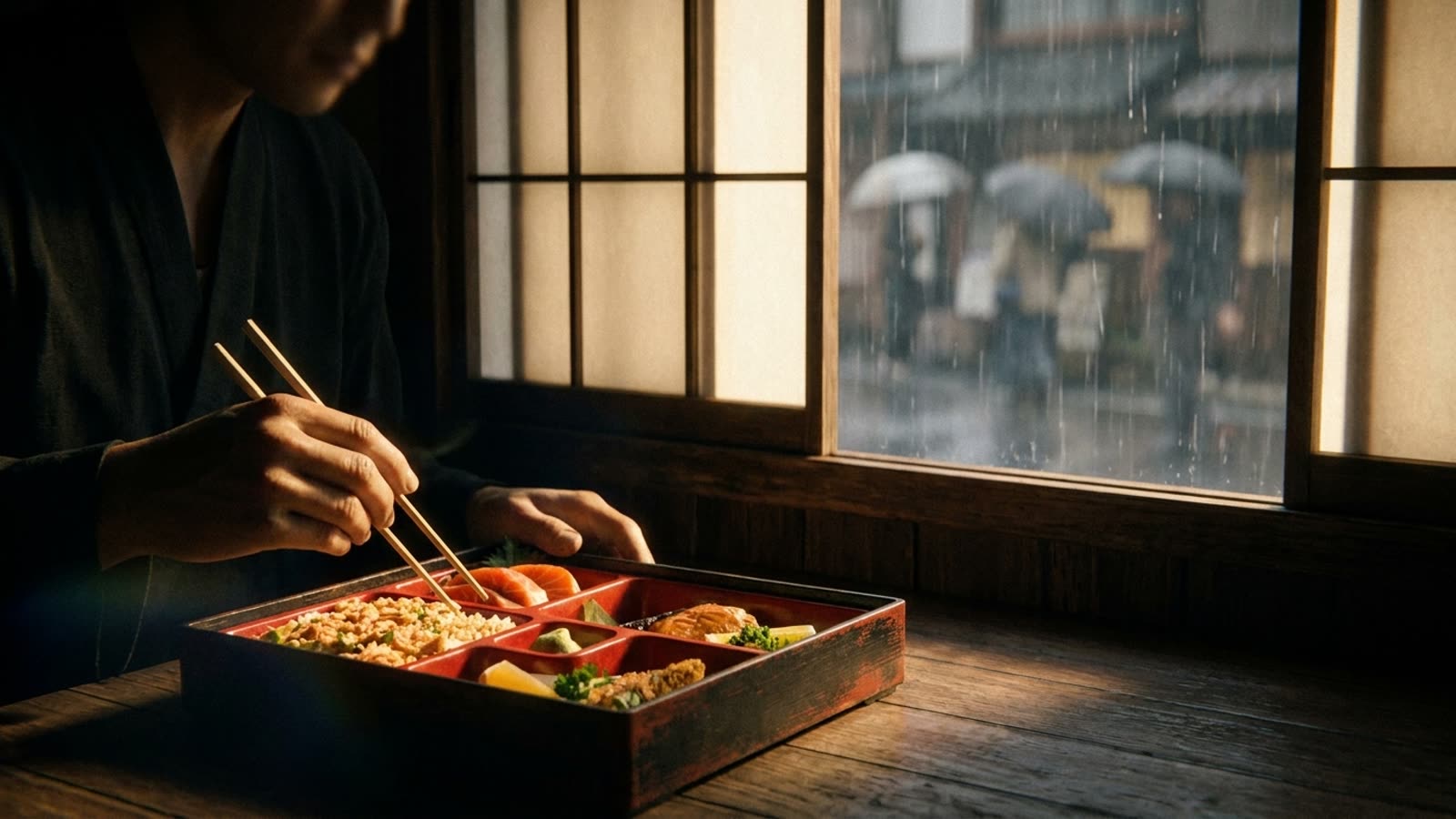
The bento box presents a puzzle that Western meal culture has never quite solved: how to make limitation feel like abundance. Five compartments, perhaps six. A rectangle no larger than a paperback novel. Into this modest frame, Japanese home cooks and professional chefs have been composing edible still lifes for over a millennium, proving that restriction is not the enemy of creativity but its most demanding teacher.
The practice predates the word itself. Farmers in the Kamakura period carried rice balls wrapped in bamboo leaves. By the Edo era, lacquered boxes accompanied theatergoers to kabuki performances, their contents as carefully staged as the drama onstage. The bento evolved alongside Japanese aesthetics, absorbing principles from ikebana and kaiseki: asymmetry over symmetry, seasonal awareness over year-round convenience, negative space as a compositional element rather than wasted real estate.
The grammar of the grid
Every bento follows an unwritten ratio that Japanese children absorb before they can articulate it. Rice claims roughly half the territory. Protein takes a quarter. Vegetables, pickles, and small surprises divide the remainder. This is not nutritional science dressed up as tradition — though the proportions happen to align with contemporary dietary wisdom — but rather a visual grammar that the eye recognizes as complete. A bento that violates the ratio looks wrong before it tastes wrong.
The compartments enforce another discipline: foods must not touch, must not mingle, must not compromise one another's integrity. A cherry tomato sits in its own cup. Tamagoyaki occupies its designated corner. This separation is partly practical — soy sauce should not saturate rice prematurely — but mostly philosophical. Each element deserves its moment of attention. The eater is invited to taste sequentially, to notice, rather than to shovel.
Export and adaptation
The bento's global migration accelerated in the early 2000s, propelled by anime, Instagram, and a growing Western appetite for portion control without deprivation. American meal-prep culture discovered the format and promptly misunderstood it, stuffing containers with quinoa and calling the result a "Buddha bowl." The spirit was willing; the discipline was absent.
More faithful interpretations emerged from unexpected quarters. French chefs recognized a kindred obsession with presentation. Korean dosirak had always shared the same container DNA. The pandemic turned millions of remote workers into reluctant home cooks, and the bento offered a template: finite space, finite decisions, finite time spent agonizing over what to eat. The box became a frame, and the frame became a relief.
The labor of love, literalized
In Japan, the bento carries emotional freight that transcends nutrition. A mother's kyaraben — character bento, with rice shaped into cartoon faces — communicates devotion through labor. A spouse's packed lunch signals domestic harmony or, in its absence, domestic trouble. The bento is legible; its message is understood. To receive one is to be cared for. To make one is to prove you care.
This emotional dimension does not translate easily. Western individualism resists the idea that love should require a 5 a.m. wake-up call and a set of nori punches. Yet something in the practice appeals even to cultures that prize efficiency over effort. Perhaps it is the evidence of intention — the visible proof that someone thought about you, planned for you, arranged the world in a small rectangle on your behalf.
Our take
The bento endures because it answers a question that abundance cannot: what is enough? In a food culture drowning in choice, the box draws a border and says, this much, no more, and notice how satisfying that is. The West has spent decades supersizing, then guiltily downsizing, then inventing elaborate systems to manage the anxiety of infinite options. Japan simply handed us a rectangle and trusted us to figure it out. Most of us are still learning.