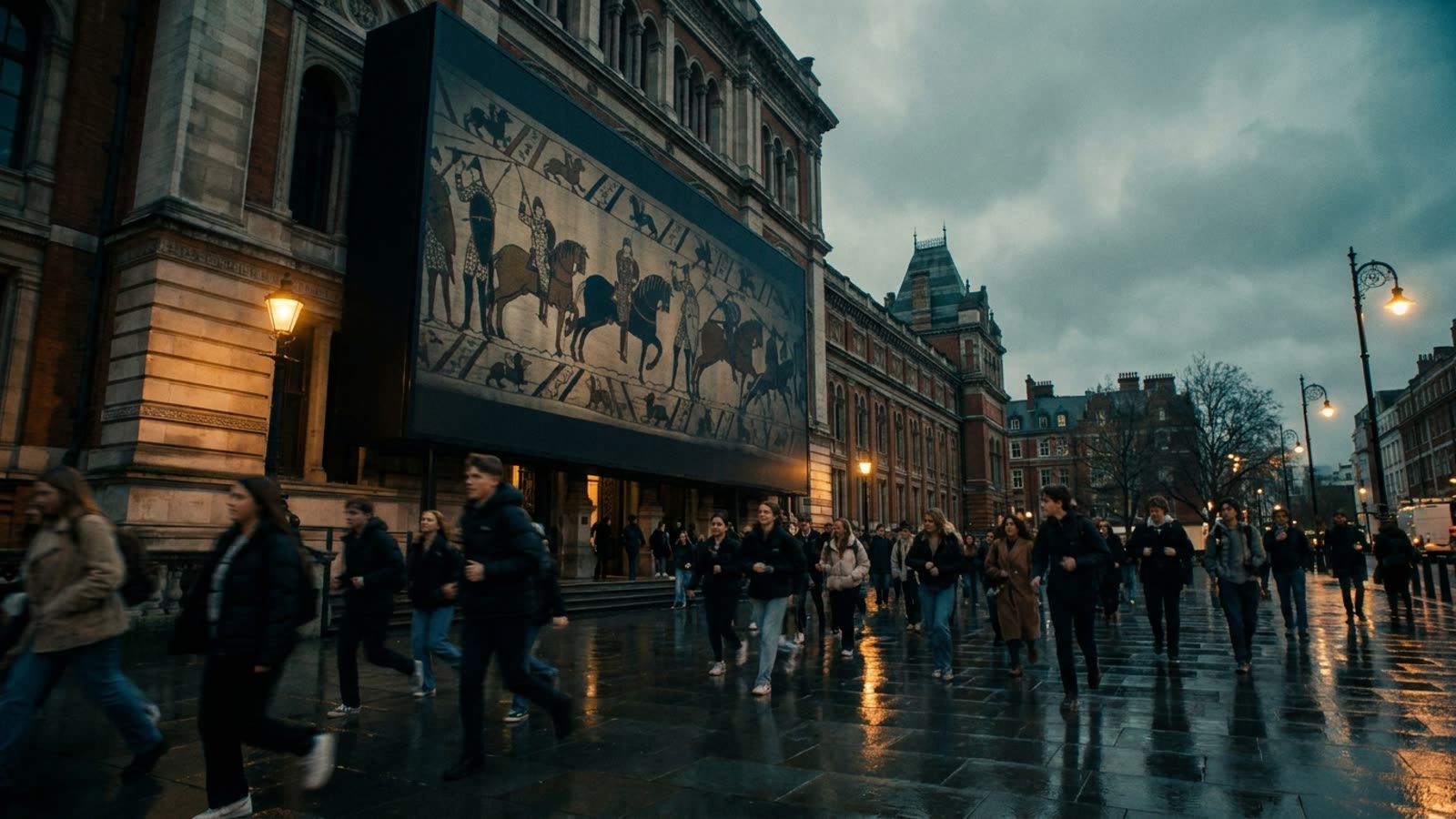
The numbers are almost too neat to be true: 55 percent of cardholders who bought British Museum tickets in the first hour of the latest Bayeux Tapestry release were under 35, according to data from Monzo. That cohort, supposedly allergic to anything that cannot be consumed in vertical video format, is now queueing—digitally, at least—for a 70-meter linen chronicle of Norman conquest.
The tapestry, on loan from France for the first time in over nine centuries, has become the unlikely cultural event of the autumn. Tickets vanish within minutes of each drop. Resale demand, while officially discouraged, has spawned a grey market. And the exhibition's social-media footprint rivals that of major film premieres—except the content is hand-stitched wool thread depicting the Battle of Hastings.
Why now, why them
The easy explanation is scarcity. The tapestry rarely travels; seeing it in London feels like a once-in-a-lifetime proposition, which it almost certainly is. But scarcity alone does not explain the demographic skew. Young audiences have access to infinite content; they are not starved for novelty. What they appear to be starved for is weight—objects and experiences that resist the scroll, that demand physical presence and sustained attention.
There is also the matter of visual storytelling. The tapestry is, in essence, a 70-meter graphic novel, a sequential narrative with recurring characters, dramatic pacing, and a clear protagonist-antagonist structure. It is not a stretch to say it has more in common with manga than with the static oil portraits that dominate most medieval galleries. Curators have leaned into this, offering audio guides and digital overlays that treat the tapestry as a story to be followed rather than an artifact to be admired from a respectful distance.
The museum as social currency
Instagram and TikTok have, paradoxically, made physical cultural experiences more valuable, not less. A selfie at the Louvre or a story from the Uffizi functions as a status marker in ways that streaming a film does not. The Bayeux exhibition fits neatly into this economy: it is photogenic, historically significant, and temporally limited. It is also, crucially, difficult to access, which makes attendance a minor achievement worth broadcasting.
This is not cynicism. The desire to share meaningful experiences is as old as the tapestry itself; only the medium has changed. What matters is that the experience is, in fact, meaningful—and by all accounts, visitors are emerging from the exhibition genuinely moved, not merely content-harvested.
Our take
The Bayeux Tapestry's London triumph is a useful corrective to the narrative that young audiences have abandoned depth for dopamine. They have not. They are simply selective, and their selections increasingly favor the singular over the serialized, the irreplaceable over the replayable. If a 1066 war chronicle can outpace Hollywood's autumn slate, perhaps the problem is not attention spans—it is what we have been asking people to pay attention to.