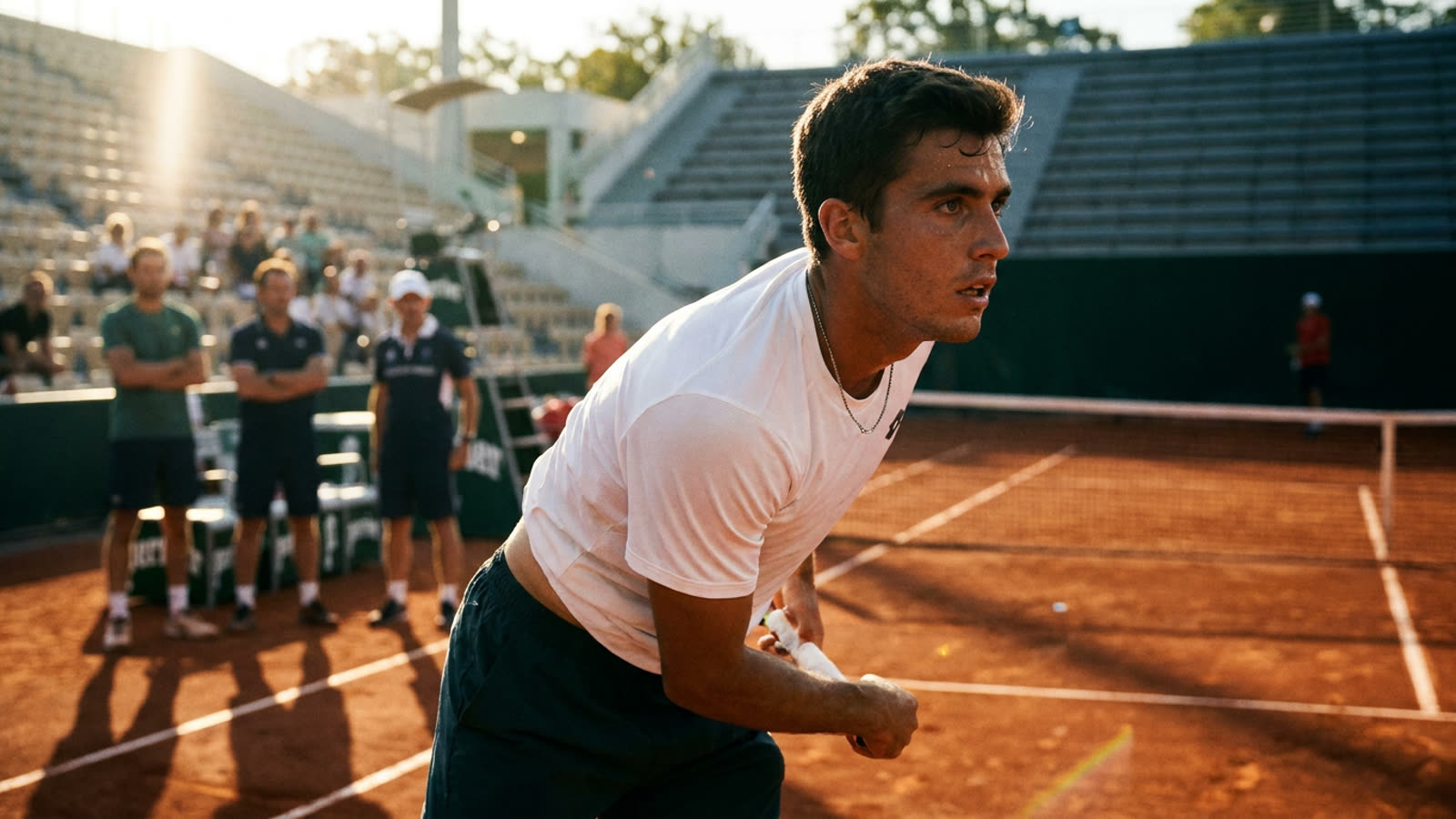
Every few years, French tennis convinces itself it has found the next Yannick Noah — the man who won Roland Garros in 1983 and has haunted every promising tricolore talent since. Arthur Gea, a lean 19-year-old with a one-handed backhand and preternatural composure, is the latest to inherit that particular burden. Unlike most of his predecessors, he might actually be equipped to carry it.
Gea's rise has been swift but not improbable. A junior standout who skipped the traditional grinding through Challengers, he broke into the ATP top 100 last autumn and has continued climbing, currently sitting comfortably inside the top 50. His game is unusually complete for someone his age: a serve that has added pace each month, groundstrokes that combine modern topspin with old-school variety, and movement that suggests hours of childhood football before tennis claimed him entirely.
The pressure of the Porte d'Auteuil
What makes Gea's Roland Garros debut as a seeded player so compelling is the specific cruelty of French tennis fandom. The country produces excellent players with metronomic regularity — and then watches them wilt under the expectation that they must win at home. Jo-Wilfried Tsonga, Gaël Monfils, Richard Gasquet: all reached the later rounds of Grand Slams, all became beloved figures, none lifted the Coupe des Mousquetaires. The crowd at Court Philippe-Chatrier is passionate but demanding, and young French players often describe the experience as playing against their own supporters as much as their opponents.
Gea, by all accounts, possesses the temperament to navigate this. In interviews he is polite but unrevealing, offering the kind of anodyne quotes that suggest either genuine equanimity or excellent media training. His coach, former tour player Arnaud Clément, has spoken about protecting his charge from the circus that surrounds French tennis, limiting press access and keeping Gea's training base in Lyon rather than relocating to Paris.
A game built for clay, and beyond
The one-handed backhand is the stroke that draws comparisons to Roger Federer and Stan Wawrinka, but Gea's weapon is actually his forehand — a shot he can redirect with disguised angles that leave opponents stranded. On clay, where the slower surface rewards construction over power, his ability to build points methodically before accelerating into a winner is particularly effective. His first-round opponent will face someone who has already beaten multiple top-20 players this season and shows no signs of being intimidated by reputation.
Whether Gea can translate this form to faster surfaces remains an open question. His Wimbledon and US Open results have been modest, though he is young enough that such gaps are expected. The more pressing matter is whether he can survive the next two weeks without the weight of history flattening him.
Our take
French tennis has spent four decades searching for Noah's heir and destroying candidates in the process. Gea feels different — more insulated, more patient, more aware that the tournament is a marathon rather than a coronation. He probably will not win Roland Garros this year. But he might be the first French prospect in a generation who could lose in the quarterfinals and emerge with his trajectory intact. Sometimes the most promising sign is knowing how to survive the hype.