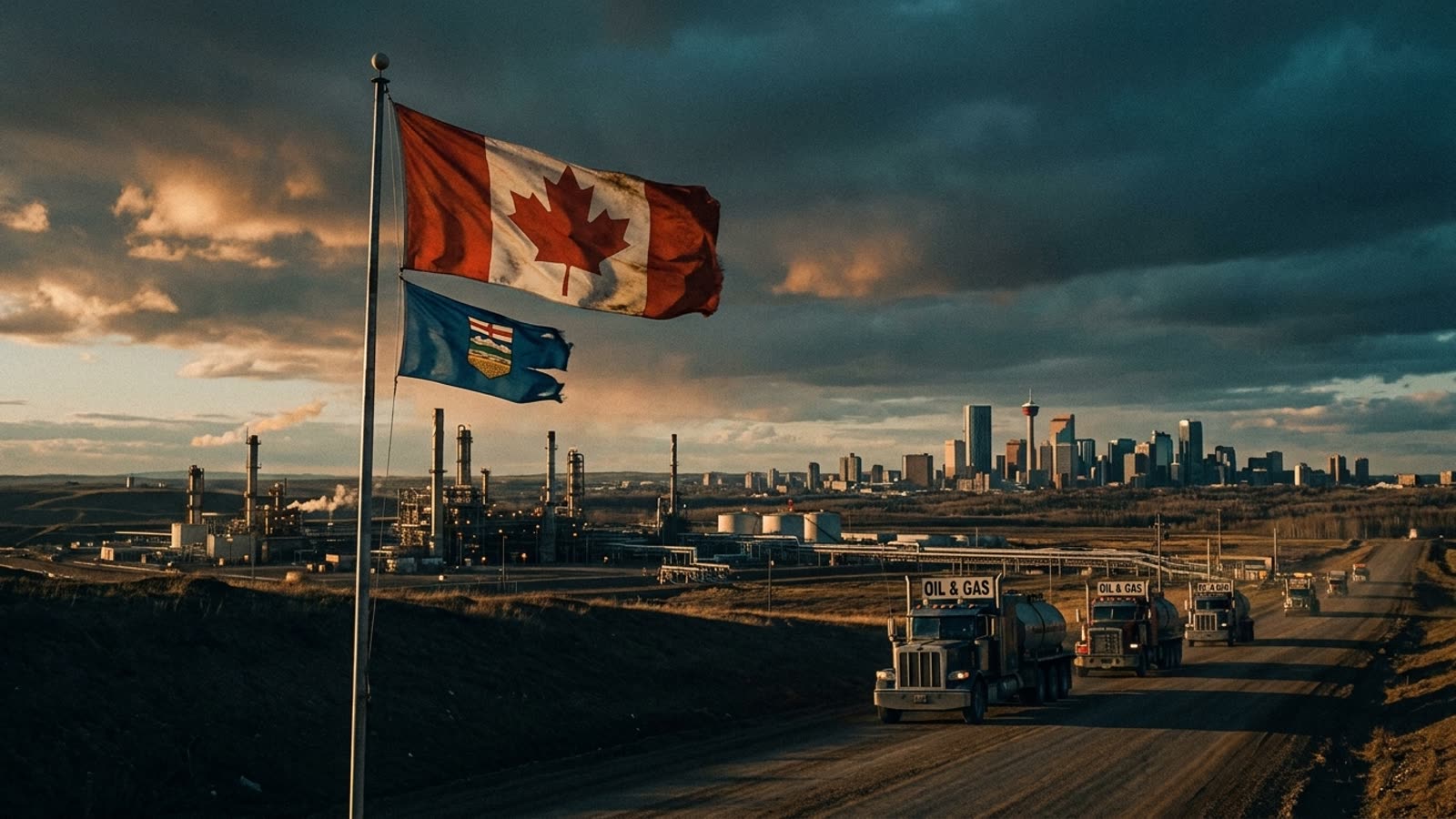
The question on Alberta's ballot is not whether to secede — not yet — but whether the province should begin the constitutional process that could eventually lead there. It is the kind of vote that sounds academic until you remember that Quebec came within a percentage point of leaving in 1995, and that Alberta's grievances are, if anything, more economically concrete.
The referendum asks Albertans whether the provincial government should pursue greater autonomy from Ottawa, including control over taxation, pensions, and policing — powers that would functionally make Alberta a nation-within-a-nation. The subtext is unmistakable: if Ottawa will not grant these powers, separation becomes the logical next step.
The economics of resentment
Alberta's complaint is simple arithmetic. The province contributes more to federal coffers than it receives back, a gap that has widened as oil revenues have surged while federal climate policy has tightened. The Trans Mountain pipeline expansion, completed only after years of federal intervention, became a symbol of what Albertans see as Ottawa's ambivalence toward their primary industry.
Prime Minister Mark Carney, the former Bank of Canada governor who took office promising fiscal discipline and national cohesion, has warned that separation would be economically catastrophic for Alberta — a landlocked jurisdiction that would need to negotiate transit rights for its oil through either British Columbia or the United States. But Carney's technocratic warnings land differently in a province where distrust of central Canadian elites is the default setting.
The political calculation
Alberta Premier Danielle Smith has positioned herself carefully: supportive of the referendum without explicitly endorsing separation. The strategy mirrors the Quebec playbook of the 1990s, using the threat of departure as leverage for concessions. Smith's United Conservative Party benefits either way — a strong "yes" vote strengthens her hand in negotiations with Ottawa, while a narrow "no" lets her claim the issue remains unresolved.
For Carney, the referendum is an early test of whether his government can hold the federation together through persuasion rather than coercion. His response so far has been to promise a "new deal" for Western provinces, though details remain thin. The risk is that anything short of a comprehensive offer will be dismissed as too little, too late.
Our take
Alberta will not leave Canada this week, and probably not this decade. But the referendum matters because it forces Ottawa to confront a question it has avoided for years: whether a federation designed in the nineteenth century can accommodate a province whose economy looks nothing like the rest of the country's. Carney's challenge is not to win this vote — it is to make sure there is never another one.