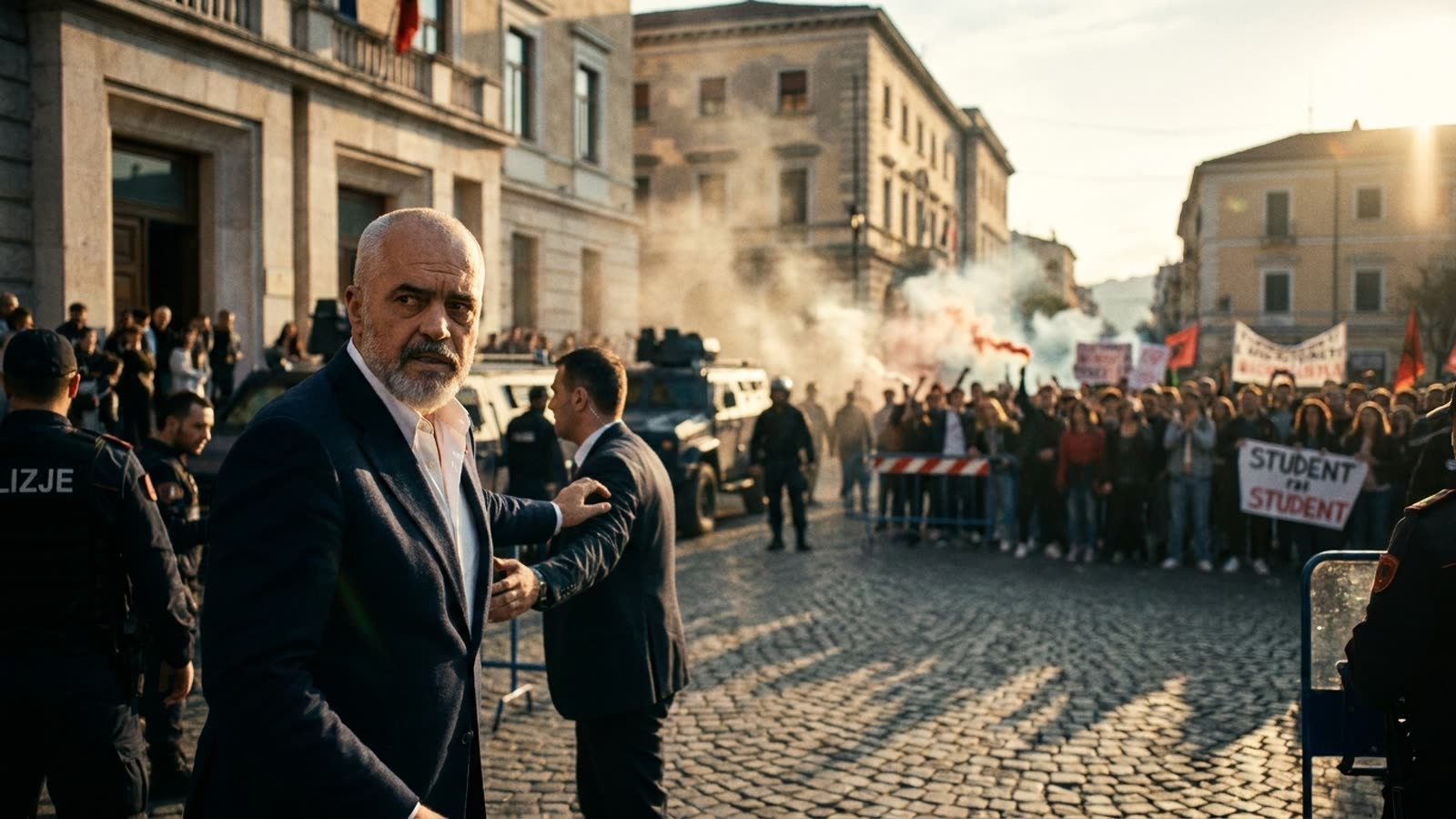
Edi Rama has governed Albania for thirteen years, long enough to see the country open formal EU membership talks, build highways, and cultivate an image as the Balkans' most media-savvy reformer. Now students in Tirana are throwing rocks at riot police and demanding he leave office, and Rama's response—defiant, dismissive, unmoved—suggests he believes longevity is its own legitimacy.
The protests, which began earlier this week over university funding and dormitory conditions, have metastasized into a broader indictment of Rama's Socialist Party government. Demonstrators accuse the administration of corruption, authoritarian drift, and treating EU accession as a branding exercise rather than a genuine commitment to rule-of-law reforms. Clashes have injured dozens. Rama, speaking Thursday, ruled out resignation and framed the unrest as the work of political opponents exploiting youthful frustration.
The generational fracture
Albania's median age is around 36, and the cohort now filling Skanderbeg Square came of age entirely under Rama's premiership. They have watched neighboring Montenegro and North Macedonia inch toward Brussels while Albania's own candidacy, opened in 2022, remains mired in screening chapters. Youth unemployment hovers above 20 percent. The promise that EU alignment would deliver jobs and judicial independence feels, to many protesters, like a promissory note that keeps getting extended.
Rama's government counters that it has delivered tangible progress: new infrastructure, a tourism boom, and a diplomatic profile that includes hosting Afghan refugees at Washington's request. But infrastructure without institutional reform is a familiar Balkan formula, and students are explicitly rejecting it.
Brussels watches, carefully
The European Commission has urged restraint on all sides, the diplomatic equivalent of a shrug. But the optics are uncomfortable. Albania is supposed to be a success story of EU soft power in the Western Balkans, a counterweight to Serbian ambivalence and a rebuke to Russian influence. Prolonged street violence and a prime minister who refuses dialogue complicates that narrative, especially as Brussels tries to demonstrate that enlargement remains a credible policy.
Rama's critics note that his government has consolidated control over media and the judiciary in ways that echo the democratic backsliding Brussels has condemned in Hungary and Poland. Supporters argue he operates within constitutional bounds and that the opposition is weak precisely because voters keep choosing him.
Our take
Rama is probably right that he can survive this wave of protests; Albanian opposition parties are fractured and the security apparatus remains loyal. But survival is not vindication. The students in Tirana are not asking for revolution—they are asking for the European future their government keeps promising. If Rama cannot hear the difference, his legacy will be highways that lead nowhere in particular.