For seventy years, weather forecasting has been the domain of differential equations. Numerical weather prediction, pioneered in the 1950s when ENIAC computed the first machine-generated forecast, works by dividing the atmosphere into a three-dimensional grid and solving the laws of fluid dynamics at each point. The approach has been spectacularly successful—five-day forecasts today are as accurate as one-day forecasts were in 1980—but it has also been spectacularly expensive, requiring some of the largest supercomputers on Earth to run.
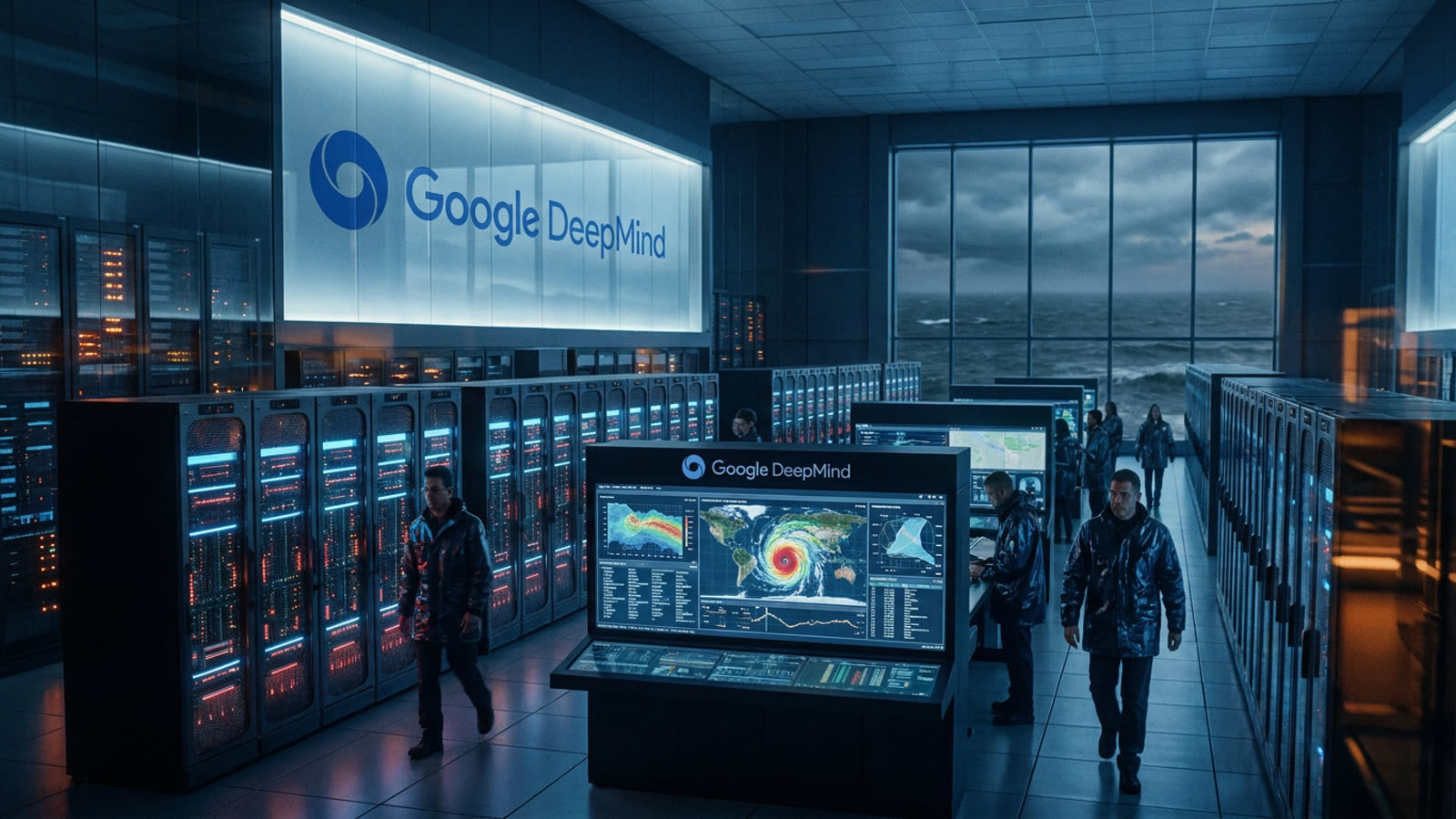
Then, in 2022 and 2023, something unexpected happened. Research teams at Google DeepMind, Huawei, and Nvidia released machine learning models that matched or exceeded the accuracy of the European Centre for Medium-Range Weather Forecasts' gold-standard system. GraphCast, Pangu-Weather, and FourCastNet don't solve physics equations at all. They learn patterns from decades of historical atmospheric data and extrapolate forward. A ten-day global forecast that takes hours on a supercomputer can be generated in under a minute on a single graphics card.
The pattern-matching paradigm
The shift represents a philosophical departure as much as a technical one. Traditional forecasting is ab initio—it attempts to simulate the actual physical processes that govern weather. Machine learning models are agnostic about mechanism; they simply identify statistical regularities in how atmospheric states evolve. This makes meteorologists nervous for good reason. A model that doesn't encode the laws of thermodynamics might produce physically impossible forecasts under novel conditions.
Yet the results have been difficult to dismiss. In blind tests against operational forecasts, AI models have shown particular strength in predicting tropical cyclone tracks, often identifying the correct landfall location days earlier than conventional systems. They also excel at medium-range forecasts in the six-to-ten-day window, where traditional models accumulate errors from repeated calculations.
What physics still does better
The machine learning revolution has limits that reveal something important about the nature of prediction itself. AI models struggle with rare, extreme events—the very scenarios where accurate forecasts matter most. A neural network trained on historical data has seen relatively few Category 5 hurricanes or unprecedented heat domes. Physics-based models, by contrast, can simulate conditions that have never occurred because they're built on principles that apply universally.
Precipitation remains another weakness. Predicting exactly where and when rain will fall requires resolving atmospheric processes at scales smaller than most AI models can capture. The current generation excels at large-scale patterns—the movement of pressure systems, the trajectory of storms—but often blurs the local details that determine whether your afternoon barbecue gets rained out.
Our take
The most likely future isn't AI replacing physics but the two approaches merging into hybrid systems that use machine learning for speed and pattern recognition while physics-based constraints prevent nonsensical outputs. Weather forecasting, it turns out, is an ideal testing ground for understanding what neural networks can and cannot do. The atmosphere doesn't lie, measurements are abundant, and the feedback loop is immediate. Every forecast is a falsifiable prediction evaluated within days. If AI can prove itself here—in a domain with clear ground truth and no room for hallucination—it strengthens the case for trusting machine learning in messier, higher-stakes applications. For now, the barometer is encouraging.